

The US Food Pyramid Is Back, And It Looks Very Different
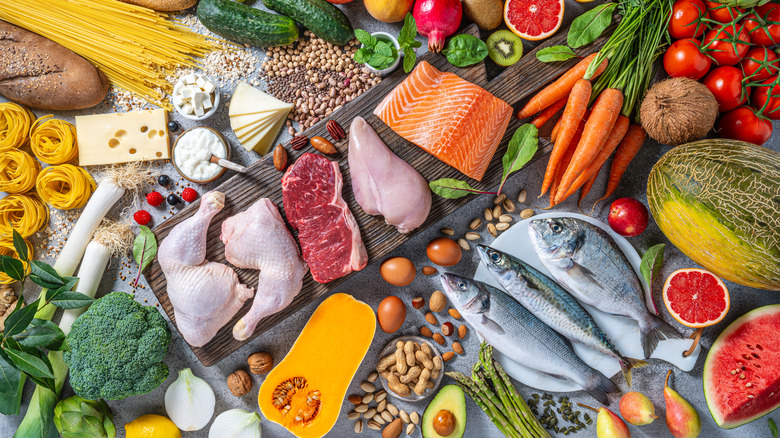
For years, the food pyramid was the example of healthy eating that everyone in America was given, and now, more than a decade after it was discarded in favor of simpler recommendations, it's set for a return. The federal government had long tried to give Americans healthy eating advice, dating back to the "food wheel" of seven essential food groups in World War II, but the food pyramid was probably the most iconic. Introduced in 1992, it emphasized the most important food groups at the bottom, which at the time were grains like bread and rice, with smaller recommended portions for groups farther up the pyramid.
However, the food pyramid was criticized for being overly vague and confusing, and was eventually replaced by MyPlate in 2011, which instead visualized the ratio of how each food group should contribute to your diet in the form of portions on a plate. That has seemingly now been dismissed as ineffective as well, and the U.S. Department of Agriculture (USDA) has brought back the pyramid, but in an inverted form.
The pyramid is now upside down, with the large base on top, and features a new emphasis on high-protein eating and whole-fat dairy, in addition to the older focus on fresh fruits and vegetables. Available on the new government website RealFood.gov, it also no longer separates the groups into distinct sections, instead featuring a jumble of food drawings representing three different categories of nutrition, with whole grains now the smallest section.
The new US food pyramid is upside down and touting healthy fats and protein
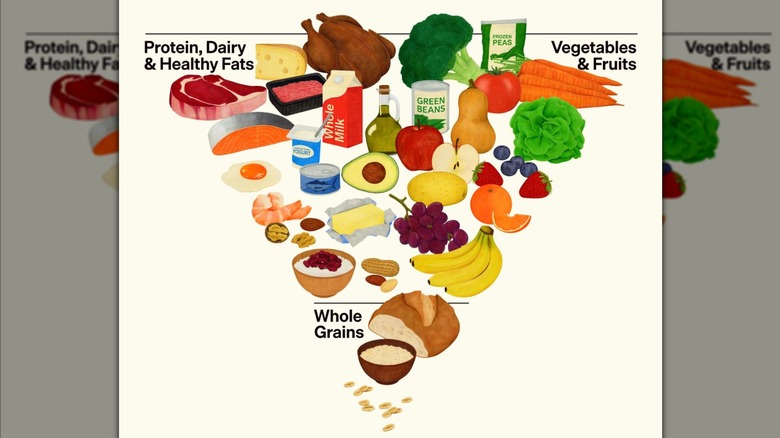
The new food pyramid was announced by the USDA and Health and Human Services Secretary Robert F. Kennedy, Jr., with Kennedy saying, "These Guidelines return us to the basics. American households must prioritize whole, nutrient-dense foods — protein, dairy, vegetables, fruits, healthy fats, and whole grains — and dramatically reduce highly processed foods." The focus on cutting out processed foods is mostly illustrated through the pictures of fresh ingredients used in the pyramid, and the grains section additionally emphasizes cutting out refined carbohydrates that lack fiber.
While the recommendations to cut out ultra-processed foods and eat more vegetables and whole grains have been well received, the American Heart Association has directed some criticism at the encouragement of eating more animal fat. The new guidelines say adults should consume 1.2 to 1.6 grams per kilogram of body weight daily, about a 50% jump from previous recommendations. Americans already eat plenty of protein, and decades of scientific and nutritional research support the idea that cutting down on saturated fats from animal protein is good for heart health. The USDA still recognizes this, recommending that fewer than 10% of calories come from saturated fat, but the high levels of protein and full-fat dairy recommended by the other parts of the guidelines would make following this limit very difficult. Either way, it will be interesting to see if this update has any impact on eating habits in the coming years.