

If Your Dishes Still Feel Greasy After Hand Washing, Here's Why
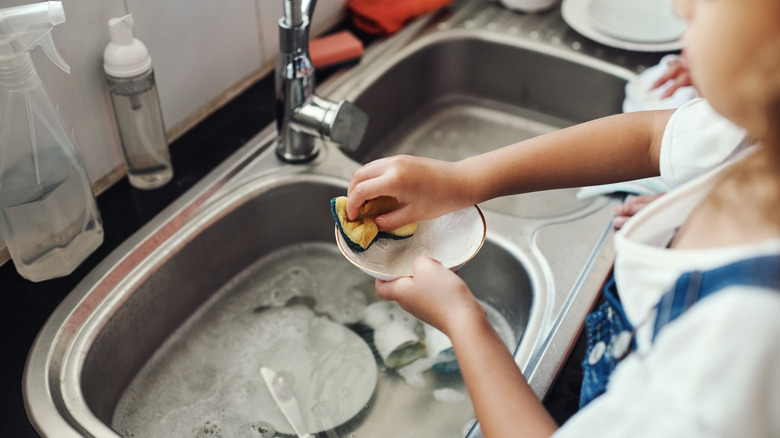
If you've ever pulled a plate from the drying rack only to detect a slippery film under your fingers, and a sinking feeling in your stomach, you need to understand how hand washing actually works. Essentially, it's about persuading oil to let go of a surface, and that persuasion requires a few basic conditions.
Dish soap is both hydrophilic and hydrophobic, and is designed to break the bond between oil and water. Grease doesn't dissolve in water on its own, which is why a pan rinsed under the tap can look clean but still feel coated. Soap molecules surround oil and allow it to be lifted away when you rinse. For that to happen, the water needs to be hot enough to loosen the fat, which is what grease and oil are, and there needs to be enough soap present to grab onto it. If your sink water is lukewarm, or your soap barely produces suds, the oil stays put.
Greasy dishes can also happen when soap doesn't get enough contact time. A quick swipe with a sponge followed by an immediate or haphazard rinse often just spreads the grease around. What's more, there are a number of kitchen items you should never put in the dishwasher, even if that seems easier in the moment. That's why many professional kitchens wash dishes in stages; it's also more efficient to repeat one movement (scrubbing with soap), then move on to the next movement (rinsing and placing in the rack). You scrub everything first, stack it soapy, then rinse all at once. This gives the soap time to do its job. Unlike glass or ceramic, plastics are hydrophobic and non-polar at the molecular level, making them more hospitable to oils. Grease isn't just sitting on the surface; it can lightly absorb into the plastic itself, especially if the container was heated. Letting it sit, fully coated in suds before rinsing, usually solves the problem.
How to wash dishes like a pro

Greasy dishes are often the result of zoning out, or rushing through a task you don't want to be doing. Dishwashing may not be tremendously fun, but it is, inevitably, part of your one little life. Don't check out, because doing it halfway means you'll be back at the sink later, repeating the same task. Doing it with technique and intention finishes it once and for all, and then you can do literally anything else, including making meal prep more enjoyable by introducing weekly themes.
Start with water that's genuinely hot. Not scalding, but hot enough that you'd hesitate before holding your hands under it too long. Use more soap than you think you need, enough that the sink looks actively, robustly sudsy the whole time. Wash deliberately. Use the sensation in your hands, not just your eyes, because your fingertips can feel invisible oil. Pay attention to rims, undersides, and handles, where grease accumulates and hides. If something still feels lubed up, it isn't clean yet. Another culprit responsible for greasy residue is greasy dish pan water. If the sink fills up with cloudy water and you keep rinsing into it, you're not removing grease so much as redistributing it. While you can start a soapy marinade in your sink, refreshing the water partway through, or rinsing under running water at the end, prevents clean dishes from picking up layer of gunky film right as you thought you were done.
Dishwashing is a small, repetitive task, which makes it easy to drift through it. But rushing a job you dislike doesn't make it shorter; it doubles it. You wash once, then again. Washing with presence finishes the work. Hot water, soap, time, and clean tools handle the chemistry. Awareness covers the rest. When the dish is actually clean, you can put it away and move on.