

Watch Out For These 7 Red Flags When Buying Fish And Seafood
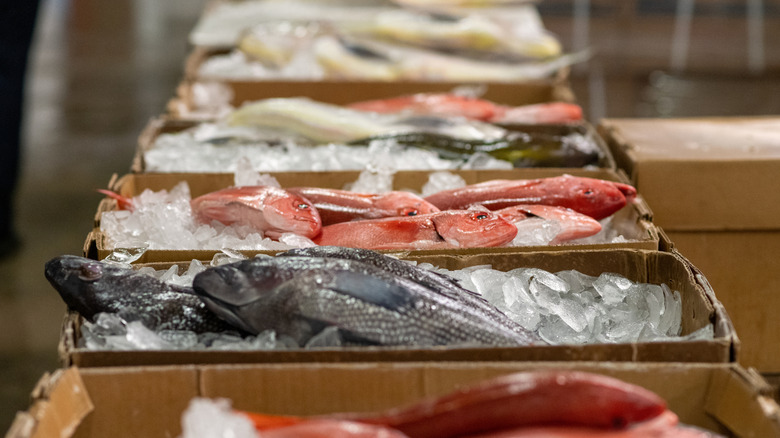
When it first reaches you, the idea of seafood is one of cleanliness. Maybe it's the associated freshness of the ocean, or its reputation as a healthy food. However, underneath upscale presentations or coastal dreaming, there is a complex and opaque part of the global food system at work, and it's not always at the front of mind when shopping for fish and seafood.
All the same, consumer demand for fish and seafood continues to rise. That puts pressure on fisheries and aquaculture farmers, while also increasing the end price at seafood markets and groceries. This pinch can increase the risk of corners being cut during fishing, handling, transporting, and selling of seafood. It can increase the risk of buying something that isn't high quality, showing up as out-of-season fish, suspiciously priced seafood, or even food that's spoiled before you buy it. As such, it's important to train yourself to identify common signals that can alert you to a potentially less-than-fresh seafood experience.
Understanding these red flags is less about becoming an expert fishmonger than a smart shopper. It's possible to get quality food that nourishes you, fits your budget, and doesn't perpetuate harmful industry practices. To this note, we've talked with three experts to help identify the red flags that are hiding out in the open: Bobby "Tuna" DiGregorio, the director of seafood quality at Fulton Fish Market; Athena Davis, the marketing manager for Aquaculture Stewardship Council, North America; and Will Plamondon, director of wholesale operations at Chicago's The Fish Guy.
The sensory cues aren't indicating freshness
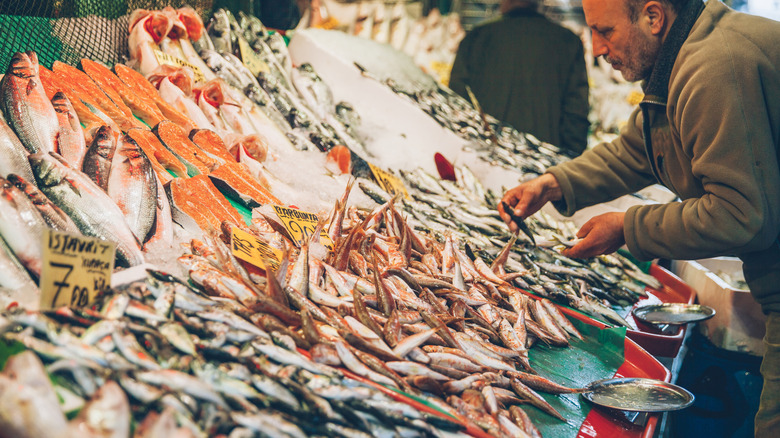
The clearest red flags that your seafood isn't fresh will always be the sensory details of the product: How does it look, smell, and feel? Are the gills red? That's a good sign, according to both Bobby DiGregorio and Will Plamondon. Gills are where fish get their oxygen, so red or pink gills mean that harvesting has occurred relatively recently, while brown, rust-colored, or mucus-laden gills are a sign of disease. Similarly, the eyes are a window to the fishy soul. If they're clear and glassy, the fish has likely been caught recently, stored, and packaged in a careful way. Foggy or cloudy eyes are a sign that something is off.
As for scent, your hope is for fish that smells "clean, a little briny, sometimes faintly like cucumbers," per Plamondon. Any odor of fishy funk is a red flag. Lean fish, such as cod and haddock, will develop bacteria that emit a strong scent as they break down. Species like skate release urea during decay, which produces a pungent ammonia smell. Not all fish display the same markers, however. Fattier fish, like mackerel and salmon, can sometimes spoil without much scent.
"When looking at the whole fish, check that it has a nice sheen and that the colors are bright and distinct," says DiGregorio. "Fillets should also have a sheen — they should not look dried out or splitting apart." Your fish should feel springy to the touch and resist indenting when pressed, according to Plamondon.
Bivalves, like mussels, clams, or oysters, should have no visible signs of opening. "Shells should be tightly closed or snap shut when tapped," says Plamondon. "An open shell that doesn't respond is a dead animal." When it comes to purchasing scallops, they "should look firm and plump with distinct shapes," notes Bobby Tuna. "They shouldn't look saggy or soggy, and they shouldn't be sitting in a puddle of milky liquid."
The price isn't lining up
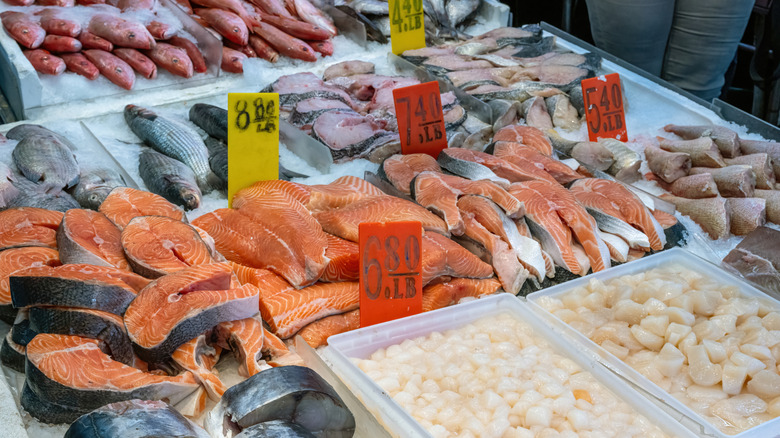
Kory Foltz, executive chef of Florida's Sunseeker Resort, once told Mashed, "If [seafood] pricing is too low or not what you would expect, then it could be lesser quality products, inferior products, or an issue with truth in the menu." Although Foltz was talking about seafood restaurants, the obfuscation he's pointing out holds up to retail seafood, too. Low prices at your local seafood counter could be a result of species substitution, such as lower-value fish being mislabeled as premium varieties (think escolar being sold as white tuna). It could also mean seafood that is close to spoilage has been priced to move.
In other cases, bargain pricing may reflect poor handling, previously frozen fish that's being sold as fresh, or the product being harvested through dubious fishing methods. Before you shop, consider getting familiar with the going rate of your favorite seafoods, and be reasonable about what's a bargain versus what's a bad bet.
High prices, meanwhile, are a red herring that don't always guarantee freshness or sustainability. Vague terms and unverified claims may be used to sound impressive and imply quality, despite lacking formal standards to justify the cost. Even expensive fish have to travel long distances and spend time in cold storage if they're not local. Sometimes, inflated prices rely on an image of scarcity, rather than true differences in quality.
As in all circumstances, gaining knowledge and making good choices about where you spend your money will result in a better experience. Become familiar with seasonality and the types of seafood sold in your area. Find vendors who can clearly discuss where it came from, how it was handled, and when it was harvested. It's much safer than taking a risk or making a splurge that could've been cheaper.
The ice is an ick
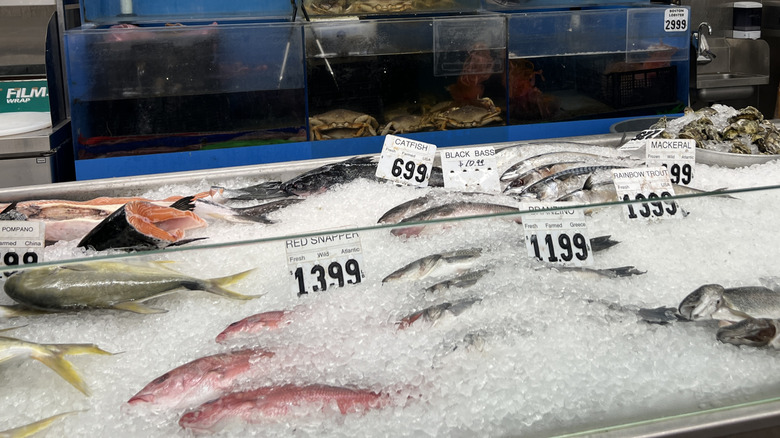
In storing fresh seafood, temperature is vital. "Fish should be held as close to 32 degrees Fahrenheit as possible without freezing," says Bobby Tuna. "Fish held above 40 degrees Fahrenheit have a very short shelf life and may be prone to developing histamines, which can adversely affect some people." If you arrive at your local seafood counter, grocery store, or farmers market, and the seafood ice display is giving anything other than a fresh winter day, you should tighten up your laces and skate off.
There is an abundance of threads that make up this red flag. Ice that's wet or actively pooling at the edges or in an underlayer is a sign that drainage isn't happening properly beneath the display. Ice that's in the form of refrozen lumps or sheets means that things haven't been refreshed in a while. And slick, slimy, or discolored areas of ice are basically blinking bacteria marquees. It's not easy to maintain the temperature in an ice bed, as even store lamps can cause fluctuations and increase losses.
"Ice should be clean and fresh — not reused," stresses Bobby. Flake ice is the premier product to look for in display windows. You'll recognize the softer, fresher-looking crystals. Other proprietary brands sell a product called hard-cracked ice, which is more dense, melts slower, and can be better for transportation.
The rest of the display is crowded, dirty, or lacking signage
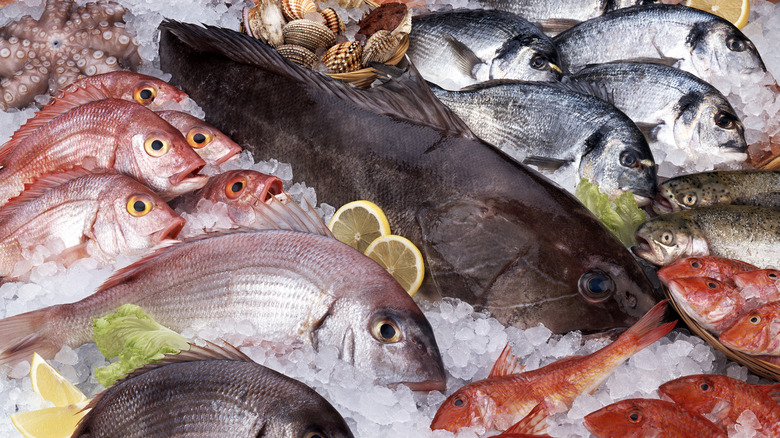
If the ice that keeps your fish cold is important, then so too is the overall display. A range of things can be indicative of what's going on behind the counter and down the supply chain. Athena Davis, of the Aquaculture Stewardship Council (ASC), told us that labeling and signage is a top priority to consider: "Trustworthy certifications, validated claims, and signage that helps communicate to shoppers is the best way to assure that the seafood they're buying is what it claims to be, and that it came from a sustainable or responsible source," says Davis.
Bobby Tuna agrees, pointing out that the ASC label of approval is a great one to look for, given that it "indicates responsibly farmed seafood that meets strict environmental, animal welfare, worker safety, and food safety standards." Labels from the Marine Stewardship Council (MSC) and Best Aquaculture Practices (BAP) are also green flags.
Among the other things you can check signage for are the country of origin and whether or not the product has been pre-frozen. Flash freezing isn't inherently bad for seafood quality, but if it's not thawed appropriately, it can impact it. Even if sustainability labeling doesn't feel important to you, proper signage and proper placement demonstrate that employees care about appropriately labeling and pricing products without confusion.
The seafood display case should be cold to the touch and under 40 degrees Fahrenheit. In order to prevent bacterial growth, temperature is crucial. Bobby Tuna also says seafood "should not be overcrowded, with fish stacked in high piles, as this limits the surface area in contact with the cold ice."
The tuna looks tinted with carbon monoxide
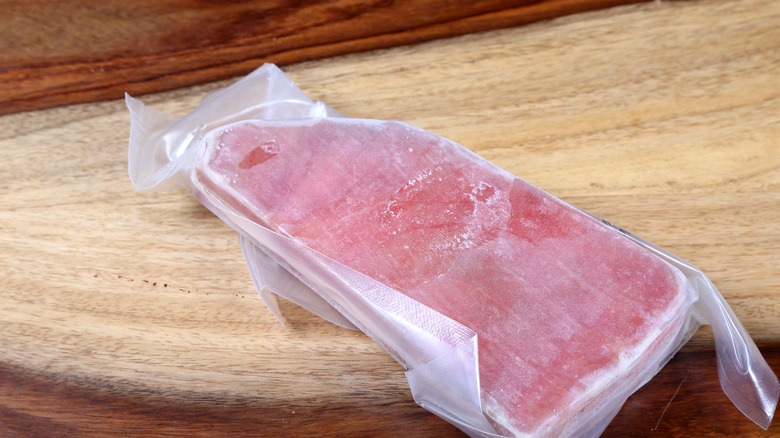
If you've ever approached a seafood display only to be stunned by a near-neon hue in some of the fish, we have an explanation. Color alteration commonly happens in fatty fish such as tuna or farmed salmon, but the causes are different in each case.
When it comes to keeping tuna fresh, sometimes, cheaper pieces of fish — or fish that have to travel further — are treated with carbon monoxide. CO will inhibit oxidation. This maintains the color of the tuna flesh, giving it the appearance of being fresh for longer, even if it's spoiling beneath the surface. CO use is generally recognized as safe by the FDA, yet Bobby Tuna tells us, "By law, this treatment must be listed on the label, but once the fish is removed from its packaging and displayed in a case, that information is often no longer visible." Ultimately, if your tuna looks a bubblegum or taffy color, rather than maroon, you should ask your monger if it is CO-treated. Pink tuna is a seafood red flag.
As for salmon that looks an artificial shade of orange, fear not. Farm-raised salmon are fed astaxanthin, per Bobby. It's "an antioxidant that wild salmon naturally obtain from their diet of fish, algae, and small crustaceans," he says. "One natural side effect is that it turns the flesh orange." In moderate amounts, a collection of research is growing that supports astaxanthin as a powerful antioxidant for human consumption, too. You might not want to rush to a salmon fillet just because it has markers of being fed astaxanthin, but consider this more of a yellow flag.
The ingredient label on shellfish includes additives
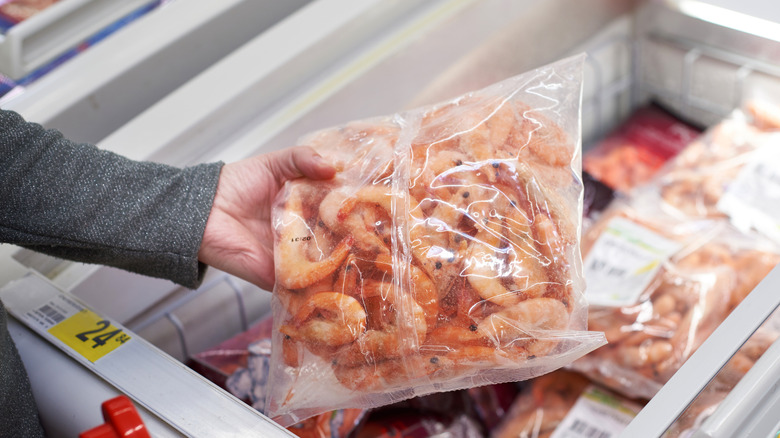
Unfortunately, preservative use is a thing that happens to shellfish, including fresh scallops and packaged shrimp. Their use is prevalent enough that the industry has divided scallops into "wet" and "dry" packed categories, while shrimp are treated in a number of different ways. And as Will Plamondon says, "'Wet' or 'juiced' scallops are a racket. They've been soaked in phosphates to retain water, so you're paying $25 a pound for tap water."
Phosphates, specifically sodium tripolyphosphate (STPP), are one of the most common preservatives in these shellfish. Excess dietary phosphorus is also a potential neurotoxin. In shrimp, the chemical has an effect of making shells look glossier and firmer. Plamondon notes that natural shrimp will have variation, and if yours all look the same in color and size, they're likely treated.
In scallops, STPP acts as a whitener and preservative, but it qualifies them as wet scallops and can leave a soapy taste in your mouth. In both cases, STPP also impacts the value of what you're getting. "The product has been soaked in a salt solution," says Bobby Tuna. "While it may be marketed as preserving color, it also adds significant weight, meaning consumers end up paying for waterlogged seafood."
Another chemical you'll see in packaged shrimp is sodium bisulfite, which is used to combat discoloration. While not a phosphate, this additive can ignite reactions in sensitive individuals. It's still not mandatory for companies to label STPP as an ingredient on packaged seafood labels, though sodium bisulfite is required if concentrated in more than 10 parts per million. Fortunately, "Treated scallops are easier to identify," says Bobby. "If left sitting, they will begin to purge and release a milky liquid. Dry, untreated scallops do not behave this way."
There's a lack of meaningful certification
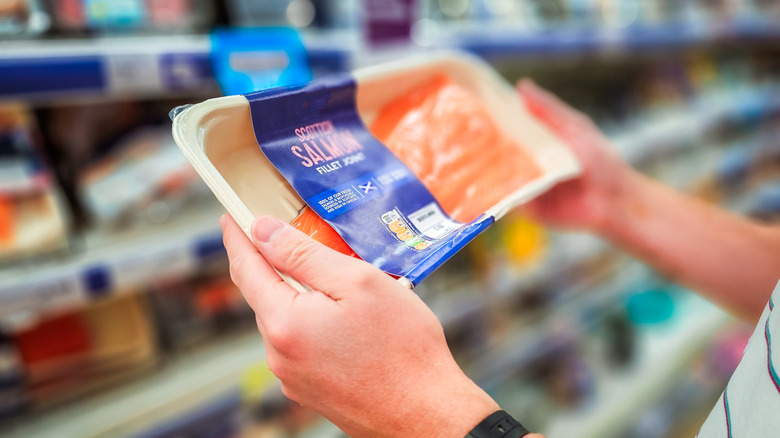
The long and skinny is that seafood certification is an important part of shopping these days. If your local market lacks it, you should be concerned. "When grocers don't specify whether their seafood is certified by a reputable third party or what specific sustainability commitments and processes they adhere to," says Athena Davis, "there is no way to prove where the seafood came from, how it was farmed or fished, or that major issues didn't occur throughout the supply chain."
These issues range in severity and what they reveal to the shoppers. They could hide the fact that fish is coming from an unmanaged fishery, or that there were poor conditions for workers (which translates to poor care throughout the supply chain). But they might also cover up for things like seafood fraud or intentional substitutions, according to Davis. Fish mislabeling is common, and a lack of certification is your first signal that your fish might not be what it looks like.
One thing to know is that sustainability isn't a stagnant point. The industry shifts and makes changes, and it's incumbent on shoppers to stay current with the information that's available. When it comes to research, take some tips from chef Eric Ripert, who uses abundant government reporting to stay current on how to shop for sustainable seafood.
Static Media owns and operates Mashed and Tasting Table.