

5 Store-Bought Pastas That Are Made In The US
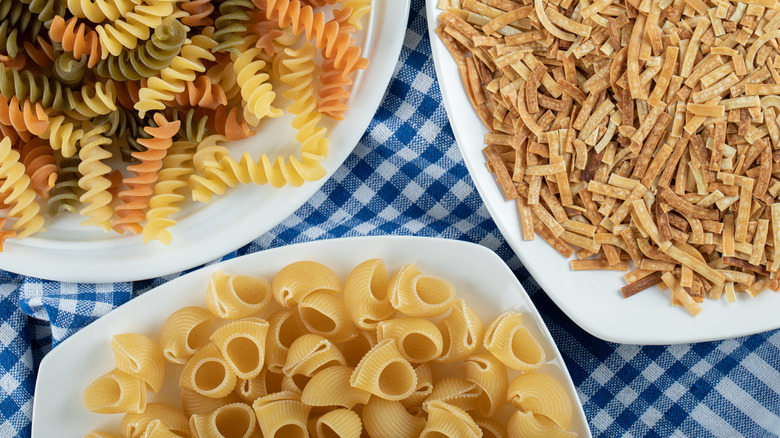
The cost of groceries just keeps on climbing, and unfortunately there does not currently seem to be any end in sight. In fact, for pasta lovers, things look like they are on their way to getting much, much worse — at least for certain brands. Currently, all products imported to the U.S. from EU countries have a 15% tariff tacked on, bringing the cost of some favorite brands up considerably. But 13 Italian pasta companies are looking at a much steeper tax set to arrive in January 2026. In September, the Commerce Department put out a proposal to punish these companies for "dumping" product with a startlingly high tax of around 92%. Added to the standard EU tariff, that totals a 107% increase in price, likely enough to remove these products from the shelves entirely.
Fortunately, while these Italian pasta tariffs may make your favorite brands disappear from your local grocery stores, there are plenty of domestic pasta producers out there. Pastas made in the U.S. will, of course, be unaffected by any of these tariffs, though it is important to note that a reduction in supply across the board could still lead to price increases. That said, it would take some outsized external factors to bring those increases anywhere near to the taxes being applied to the Italian pasta producers in question. So, if you want the best that U.S.-based pasta has to offer, look to these five brands.
American Beauty
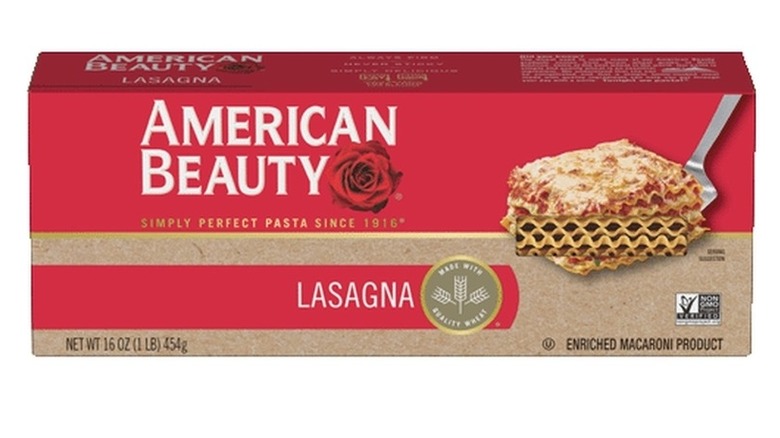
We'll start with a pasta manufacturer that would be a real surprise if it turned out not to be based somewhere in the U.S. (or maybe even Canada): American Beauty. This pasta manufacturer was formed in 1916 at the merging of the Denver Macaroni Company and the Kansas City Macaroni and Importing Company, so there's no doubt as to its American origins. The brand uses wheat from all over the U.S., from the Southwest deserts to the northern plains. Notably, American Beauty also boasted the largest geographic distribution area during the Great Depression.
The company is now a subsidiary of Winland Foods, which offers a wide array of food companies producing products from sauces to pie fillings, preserves, and, of course, pasta. In fact, several of the brands on this list are owned by Winland. While Winland Foods is backed by Investindustrial, a large European independent investment group, so long as the production is taking place in the U.S., these products will remain tariff-free.
Mueller's
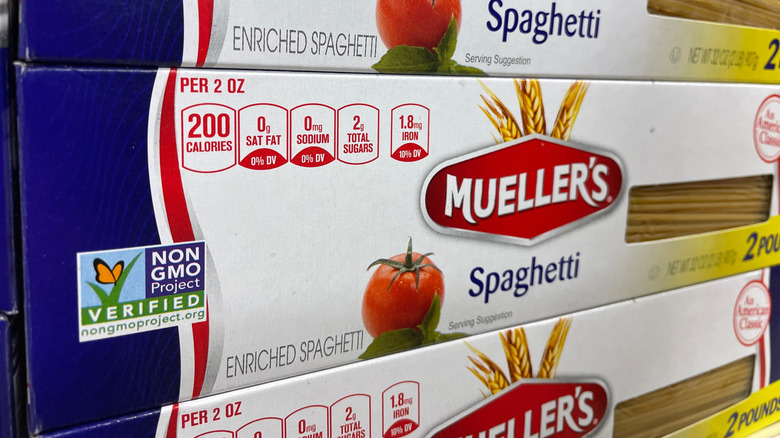
As the name might have tipped you off to, Mueller's pasta was not originally started by an Italian but rather by a German immigrant to New Jersey named Christian Mueller, all the way back in 1867. At the time, Mueller was simply making egg noodles from his home kitchen and delivering them throughout the neighborhood and to local restaurants. By 1890, however, Mueller's was distributing pasta all across the American Northeast.
Over the next century-plus, Mueller's continued to grow from there, bringing these dried pasta products to grocery stores across the country. These days, it does so under the umbrella of Winland Foods. These days, the line of products includes many of the standards, like penne and fettuccine, but also some innovative ideas like "pot-sized" spaghetti. Perhaps it takes a German to sell spaghetti that is essentially already broken in half (it certainly wouldn't be an Italian), but it is undoubtedly an interesting modernization of a classic product.
Creamette
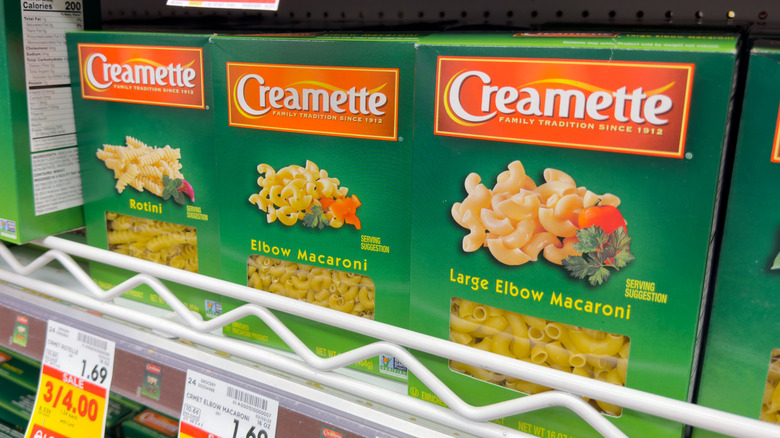
As we work our way down this list, it becomes clear that there was a real boom time for pasta in the late 1800s and early 1900s. Creamette is another brand that falls into this window. Similar to Mueller's, Creamette got its start with just one man, James T. Williams, in his Minneapolis, Minnesota-based grocery store in 1896. Macaroni noodles were his specialty, and his unique innovation in the field was an elbow macaroni with thinner walls and a wider tube.
Furthermore, Williams implemented these changes with the intent to reduce the cooking time required for the pasta. According to the brand, this macaroni quickly took off in popularity thanks to its quick-cooking nature, allowing home cooks to get dinner to the table faster. That's certainly something we can all appreciate. Creamette, too, as it turns out, is a Winland Foods brand, though we promise it is the last one on this list.
Ronzoni
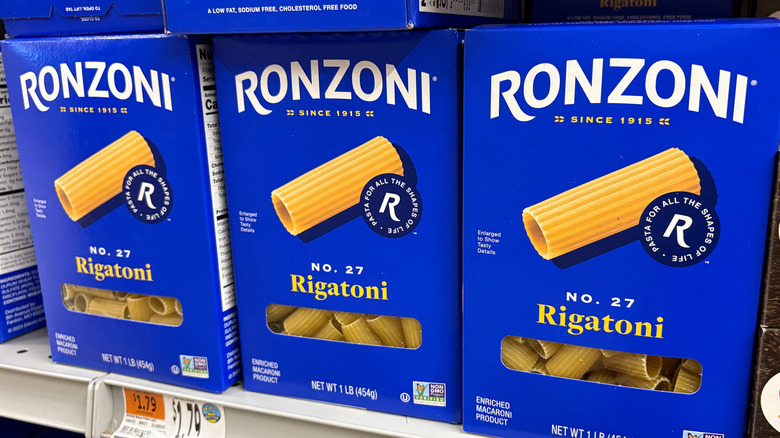
One of the blue-box pasta companies made in the U.S., Ronzoni got its start with an Italian immigrant by the name of Emanuele Ronzoni, who arrived in the states in 1881. Ronzoni wasted no time getting into the pasta business, launching his first small macaroni company with one other partner when he was just a teenager, just 11 years after arriving in the United States. A little further down the road, they joined forces with a couple of other partners to create the Atlantic Macaroni Company in Queens, New York.
It wasn't until 1915 that Ronzoni went into business on his own, and that's when things really stuck. As Ronzoni launched his eponymous business, the signature blue box that is now one of the most iconic pasta companies in the U.S. was born. Ronzoni pasta was a family business for many years, with Ronzoni's son eventually taking the reins. But today, the company is part of Richardson Food & Ingredients.
Barilla
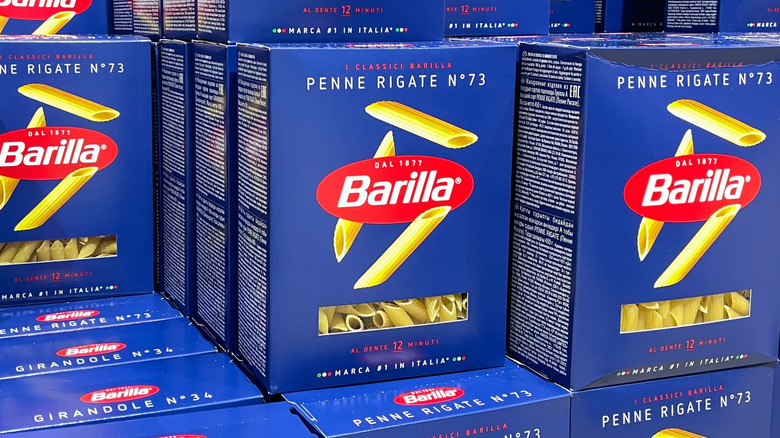
The last company on this list is one that you likely have in your pantry right now, and one that you also likely will be relieved to hear won't be affected by these taxes — for the most part, at least. You see, Barilla is technically an Italian company. The birthplace of Barilla is the same as Parmigiano-Reggiano: Parma, Italy. It was established in the Old Country all the way back in 1877 but has since moved much of its production to the U.S., with the headquarters of Barilla USA located in Northbrook, Illinois. But despite this expansion (and unlike any of its competitors on this list), Barilla remains a family business.
The majority of the Barilla pasta sold in the U.S. is produced in the company's plants in Iowa and New York, but some of their products are also imported from Italy. This includes the "Al Bronzo" line, which you can find on our list of the pastas with the highest quality ingredients. If this is your preferred Barilla product, it may be best to stick with its American-made products; otherwise you may risk the additional taxes.