

Make This Costly Icing Mistake And Your Gingerbread House Will Be Headed For Collapse
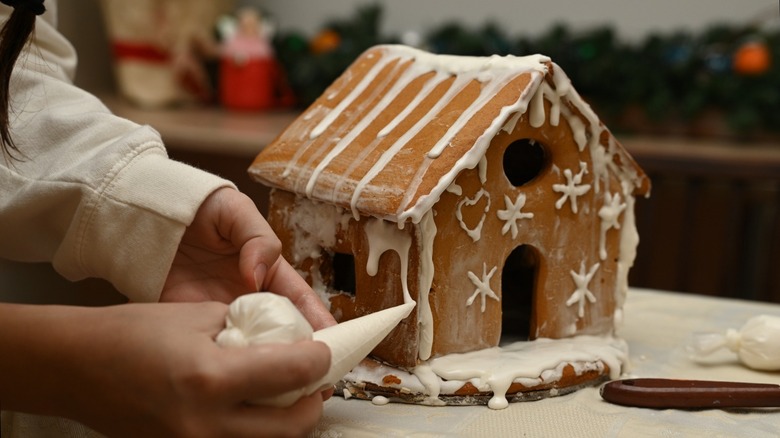
Have you ever spent hours crafting an adorable gingerbread house, only to have it completely fall apart the second you tried to move it? While Christmas movies make it seem as though it's incredibly easy to construct a perfectly decorated, multi-story gingerbread structure that seemingly defies the laws of physics and architecture, real life is much more complicated. To find out why so many homemade gingerbread houses seem destined to collapse, Tasting Table spoke with two experts who highlighted nine common mistakes you should avoid with your homemade gingerbread house – including a particularly costly one involving your icing.
Rena Awada, a food blogger and founder of Healthy Fitness Meals, pointed out that one of the most common reasons gingerbread houses collapse is the use of icing that is too soft or warm. Awada cautioned that "royal icing is used as the glue" for your house. If you don't create icing with the perfect consistency, it won't harden properly into the glue-like material you need. She said, "If it is too runny or does not set correctly, the entire structure will collapse." When the icing is too soft or warm when you apply it, it will just melt and run down the sides rather than hardening properly.
Thick royal icing is the key to creating a solid foundation for your gingerbread home. Think of it like the mortar that holds brick or stone walls together: you want to achieve the best royal icing consistency to support the weight of your gingerbread walls and roof. For that, it must be prepared correctly and allowed to fully harden prior to building and decorating.
Creating the perfect royal icing consistency for gingerbread houses

When making the royal icing for your gingerbread house, Awada advised that you "Make sure the icing is thick." Royal icing is made from beating together egg whites or meringue powder and powdered sugar and adding water until you reach the ideal consistency. While icing recipes for cookie decorating call for about 9 tablespoons of water, you'll want to reduce that amount to about 4 or 5 tablespoons to start. This will achieve a thicker icing better suited for adhering gingerbread pieces together.
If you start applying icing and you notice that it is too thin and it starts dripping down the sides of the house, the good news is that it will create a cute, snow-like appearance that just adds to the beauty. You can then thicken your remaining icing and apply more to each piece to strengthen the bond between walls and the roof by adding more powdered sugar or chilling it in the fridge for a bit. If you're worried that the house looks too messy, simply cover up globs or drips with your candy decorations.
Royal icing takes a while to dry, so you'll want to let the icing set for three to six hours at room temperature to allow it to fully harden before you start decorating the house. You might want to turn your heat down to keep the icing from melting before it can set. As Awada told Tasting Table, you must "let each section dry completely before adding more. This will take a while to complete, but patience is important."