

Chicken Kiev Didn't Originate In Ukraine, But A Different European Country
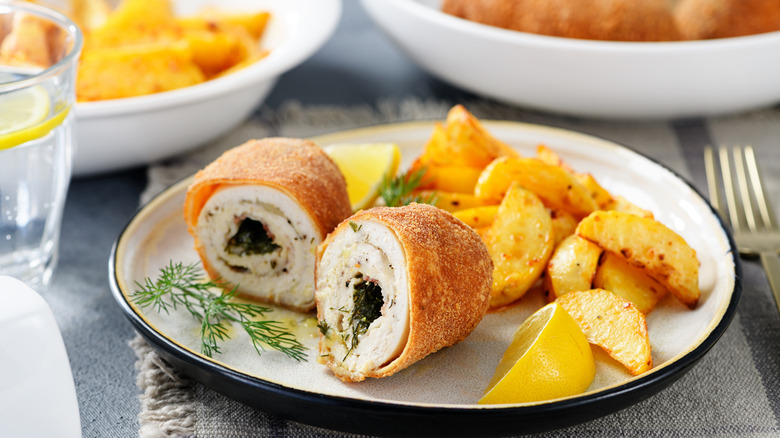
Some dishes are so intrinsically tied to their birthplace that you can't mention one without thinking of the other. Pad Thai conjures up street food stalls in Thailand, Philly cheesesteak reminds us of Philadelphia's hustle and bustle, and Neapolitan pizza feels quintessentially Italian. All this time, you may have thought chicken Kiev belongs in the same category — that is, until you look into its origins. Before journeying into Ukraine, it may have actually been created in France, making it one of those
foods named after places they don't originate from
.
Over the years, France has been blurred out of chicken Kiev's origin story. Its namesake, after all, is Kyiv, the capital of Ukraine (formerly spelt as Kiev before 1995). However, one origin story suggests it originated in Paris in the late 1840s, where Russian chefs came to learn more about haute cuisine, and brought back a dish called Mikhailovsky (or Novo-Mikhailovsky) cutlet. According to Russian historian William Pokhlebkin, the creation of this dish might also have been tied to the infamous St Petersburg Merchants' Club. Along with the Pozharsky cutlet, this dish is considered to be one of the predecessors of chicken Kiev, setting the foundation for what would be the herb-butter-stuffed and rolled chicken dish we know today.
In another version of the story, chicken Kiev traces back to another French dish called suprême de poulet, created by Parisian chef Nicolas François Appert. Later on adapted by Russian and Ukrainian chefs, it eventually evolved into côtelettes de volaille and first appeared on the menu of the Continental Hotel in Kyiv in 1897. The literal translation is "poultry cutlet", but it's more commonly known as the French term for chicken Kiev.
How chicken Kiev eventually became a global dish
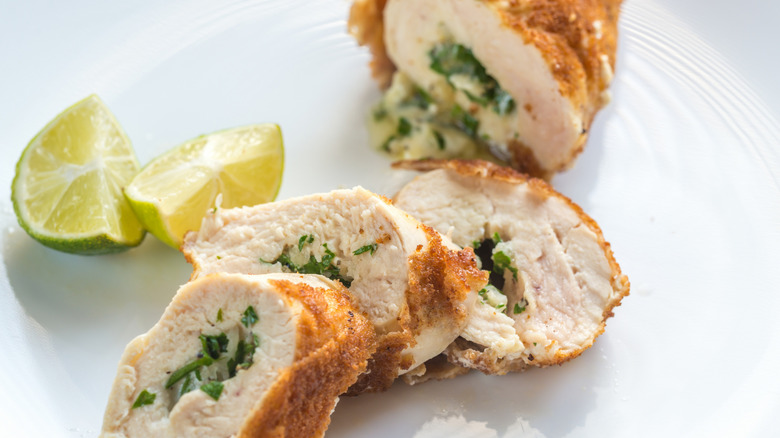
Flashing forward to a century later, chicken Kiev gained popularity in the U.S. between 1940 and 1970. It started popping up on restaurant menus in New York, where it was speculated to have been named "chicken Kiev" to attract Russian and Ukrainian immigrants and give the dish a simpler, less bourgeois flair. In the 1960s, the modernized version of this dish finally became more common in Ukraine, mainly due to popular demand from tourists.
Then, chicken Kiev started taking over cookbooks and home kitchens in the late '70s, and even became a ready-made meal sold in grocery stores. As one of the first successful made-ahead products by Marks & Spencer, it was considered the era-defining start of the U.K.'s frozen food industry. Much like most trends, however, chicken Kiev's momentum later halted, then declined in the following decades. Still, to this day, the dish hasn't been forgotten completely, and oven-baked chicken Kiev remains a staple in some families' dinner nights.
Chicken Kiev is presumed to have influenced French cuisine's famous chicken cordon bleu. Though there is a key difference between chicken cordon bleu and chicken Kiev, they both undeniably share similar elements. Having travelled across continents and eras, it's no surprise that there have been many variations of chicken Kiev. Some versions stuff theirs with cheese, while others add garlic and parsley to enhance the flavor, but some chefs insist that the most authentic recipes are only stuffed with butter.