

9 Essential Tex-Mex Dishes You Need To Try At Least Once
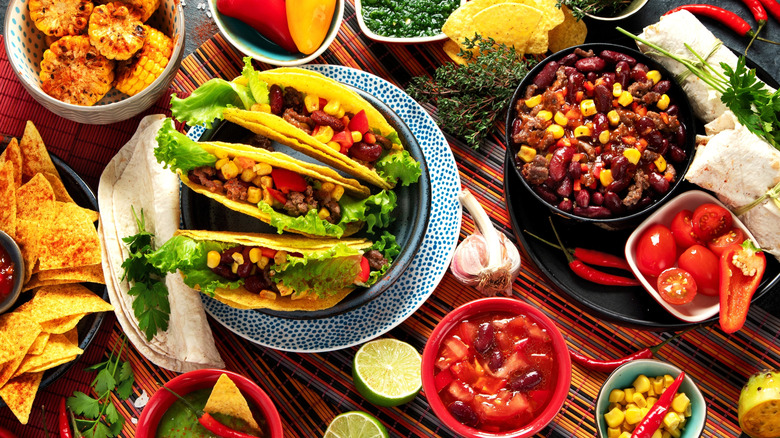
Ah, Tex-Mex, one of the world's great cuisines. It's hard to call it a fusion, though, because it's mostly just Mexican food that has been adapted over the years in the U.S. rather than a mash-up between the two cuisines. In fact, it can be tricky to figure out what makes Tex-Mex different from Mexican food. For the most part, the former developed on both sides of the U.S./Mexico border, and the main differences involve specific ingredients rather than specific dishes.
For example, Mexican cuisine rarely calls for yellow cheddar cheese, while multiple Tex-Mex dishes revolve around it. It's worth noting that there are plenty of Mexican dishes that are not part of Tex-Mex cuisine. Mexico is a diverse country with diverse regional cuisines, and many of the dishes there are not prevalent in the Tex-Mex joints of Tucson and Laredo. For a more thorough rundown, here is a guide to eight regional Mexican cuisines.
Although it can be difficult to find Tex-Mex dishes that aren't just copies of Mexican recipes, there are certain ones that have their own unique histories. From chili con carne to nachos, here are some of the dishes that can truly be called Tex-Mex originals.
Chili con carne
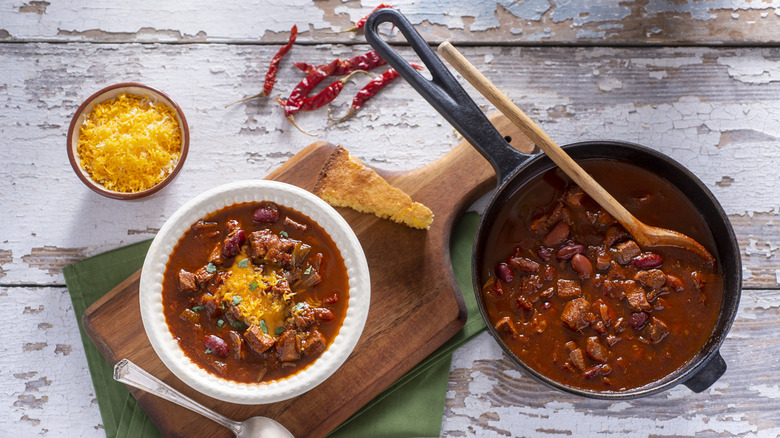
It can be a comfort food; it can be a health food. Whatever recipe you're using, chili con carne has a few required elements, including meat (the carne of the title), some type of chili pepper, and cumin. The precise origins of this flavorful stew are murky and contested. Some claim it was an off-shoot of an Aztec dish, while others claim it cropped up in San Antonio in the 18th century via a group of Canary Islanders moved to the area. However, most sources cite San Antonio as the town where it went the 19th-century equivalent of viral.
Following the Civil War, chili stands began to crop up around San Antonio and other parts of South Texas. The women who made and sold the thick, nourishing stew were so famous that they became known as Chili Queens. It became increasingly popular in the U.S. through the 1940s and '50s, until it became inextricably linked to Tex-Mex cuisine.
It's easy to see why, as chili con carne is the full package: filling, rich, easily adapted, and full to bursting with flavor. You can pile it high with cheese, guacamole, cilantro, tortilla chips, and sour cream, or simply enjoy it on its own. You don't have to take our word for it when it comes to its adaptability, either. Just look through these 16 delicious chili recipes and see for yourself.
Fajitas
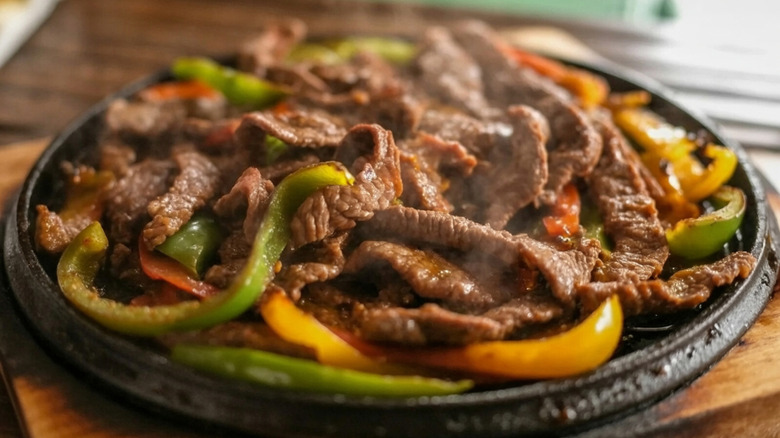
Fajitas are what you order when you want a little drama in your meal. They are invariably served on a piping hot skillet right to your table, leaving the onions, peppers, and meat sizzling away while you inhale their tantalizing aroma. Like many foods, their precise origin is hard to pin down, but nearly all accounts point to the Rio Grande Valley, where they emerged as a cheap, ad hoc meal cooked over an open fire by vaqueros (cattle drivers). In the late 1960s, they became a popular offering at festivals and a few select restaurants, and by the '70s and '80s, they were available in restaurants across the state.
It's easy to see why the dish would gain so much traction. It's so fresh that it's still in the process of cooking when it lands on the table, and the simple combination of meat, onions, peppers, and spices is pretty flawless. But, as with many Tex-Mex dishes, much of the appeal lies in the fixings and the customization. The meat and veggies are the foundation of the dish, but the tortillas, beans, pico de gallo, cheese, and avocado are what make it an over-the-top comfort food. If all of this is making your mouth water, be sure to read these 11 tips for making fajitas at home, and then jump straight into a recipe.
Chimichangas
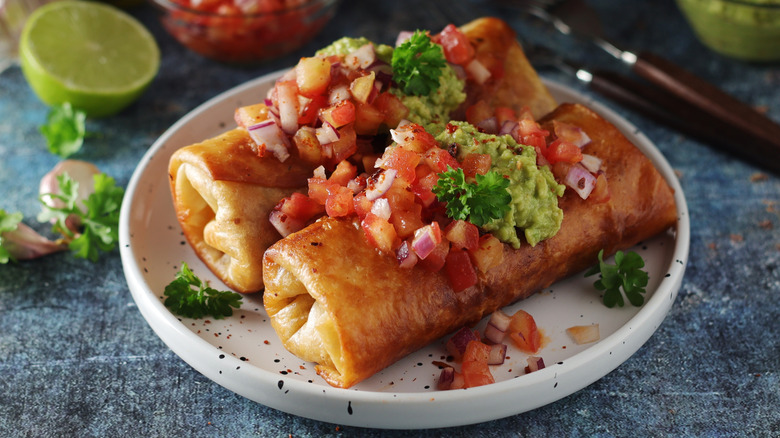
Americans like to deep fry things. Just go to any state fair, and you're bound to find such questionable delicacies as fried butter, fried Jelly Beans, and fried ice cream. It was only a matter of time before we started frying burritos, too. Chimichangas are one of the great innovations of Tucson, a city that was the first (and so far only) in America to be designated a City of Gastronomy by UNESCO.
The stories about how the chimi was invented range in imaginativeness, from a restaurateur whose niece accidentally knocked the burrito out of her hand and into a vat of hot oil to a cook who was just trying to find a novel way to use up old burritos. The origins may be uncertain, but the quality of this ingenious Tex-Mex creation is anything but. Filled with all the usual burrito fillings and crispy from the deep frying, chimichangas are one of the most indulgent and satisfying dishes you can get. If you see them on the menu, you can stop reading and place your order. Or, if you want to make them from home, look no further than this shaved steak chimichanga recipe. It's the real deal.
Nachos
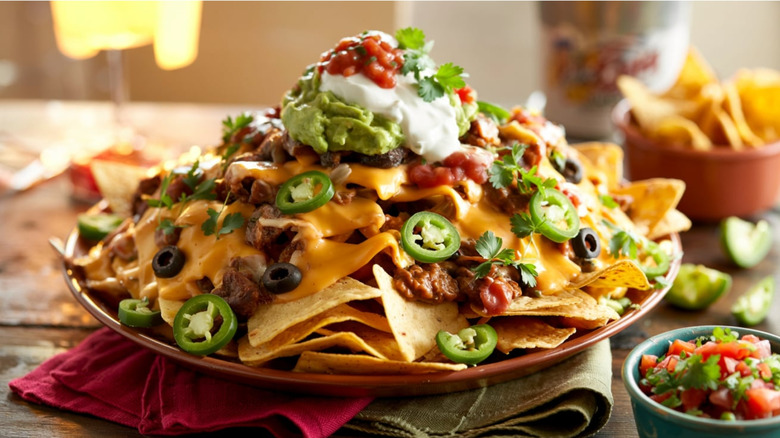
Nachos have become so beloved throughout the U.S. that they have expanded beyond the bounds of a single cuisine, Tex-Mex or otherwise. And how could they not? It is hard to go wrong with tortilla chips drenched in melted cheese. Add a few delectable toppings like jalapeños, chili con carne, and pico de gallo, and you have a show-stopping snack that could possibly count as a main meal.
For those who are used to ordering nachos at baseball stadiums and fast food restaurants in the Midwest, it may come as a shock to learn that the most common origin story contends that they were created on the Mexico side of the border. Legend has it that Ignacio "Nacho" Anaya made the first batch out of necessity in the 1940s when he found himself with a hoard of hungry eaters and no cooks in the kitchen. He hastily threw together some fried tortilla strips, cheese, and pickled jalapeños and popped it in the oven. The results were so gleefully received that they became known as Nacho's special and, eventually, just plain nachos. Anaya later moved across the border and opened a restaurant called, you guessed it, Nachos, and American has been head-over-heels in love with the dish ever since.
Burritos

Burritos are one of the great lunch foods that America has to offer. Like sandwiches, the sky is the limit when it comes to fillings, which makes them pretty hard to dislike. If you aren't a fan of refried beans and cheese, you can find one that is chock-full of rice, pico de gallo, guacamole, and, well, whatever else floats your boat. Most importantly, burritos are huge. In fact, there seems to have been a bit of an arms race over the past few years regarding which restaurants can offer the biggest.
If you go back to the beginning, though, burritos looked quite a bit different. Far from being the exploding quad burritos from Chipotle, they were barely the size of a taco. For the most part, they were simply a way to transport food. Thanks to the careful wrapping of the tortilla, the fillings are fully enclosed, making them easier to carry.
Traditional Mexican burritos can be as small as a cigar and typically only contained one or two fillings. The jumbo wrap that we know and crave in the U.S. today is a so-called Mission burrito, born in the Mission district of San Francisco in the 1960s. Even if you enjoy traditional Mexican-style burritos, it is hard to deny the hunger-trouncing appeal of their enormous American counterpart.
Hard shell tacos
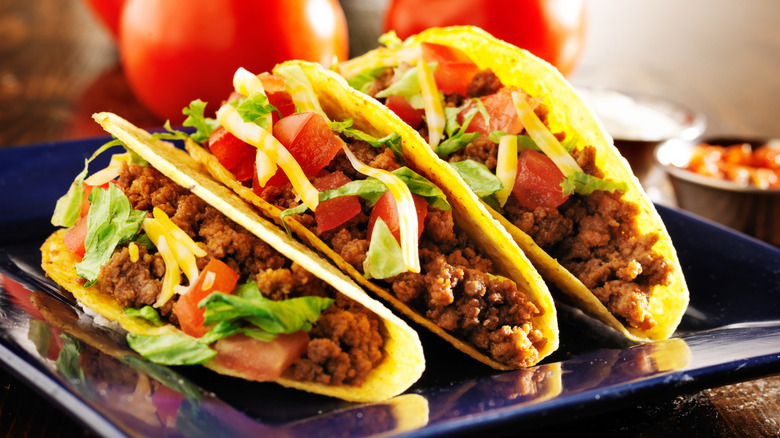
If you've ever had a hard shell taco, chances are, it came from Taco Bell, and we probably won't be bursting any bubbles here when we tell you that Taco Bell is not, in fact, authentic Mexican cuisine. It's hard to say exactly when hard shell tacos were made for the first time, because they are essentially just fried tacos, and it's difficult to invent the process of frying something. In Mexico, they are still called tacos dorados (golden tacos), but it wasn't until an opportunistic burger salesman in California name Glenn Bell started selling them that they became a staple in Tex-Mex cuisine.
Bell had the inspiration to switch from burgers to hard shell tacos when he saw the success of the dish first-hand. Opposite his own food stand was one operated by Lucia Rodriguez, and he couldn't help but notice the constant line that formed over her tacos dorados. Not long after, in the 1950s, he began selling his own version, and the rest is Taco Bell history.
Nowadays, taco shells are ubiquitous, even beyond Taco Bell's iconic crunchy taco. At home, it's pretty easy to cook some meat, throw together some fixings, and scoop it all into a ready-made shell. It's like nachos, but with the claim of being a main dish rather than an indulgent snack.
Queso
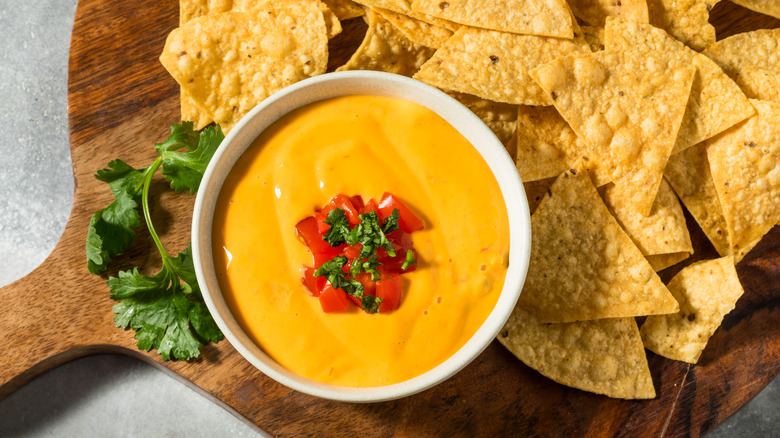
In a very literal sense, queso is Mexican because the word literally means cheese. It's a generic term in Spanish, but in English, it really just means one thing –- a gooey, velvety dip made with orange cheese. Queso is the ultimate comfort food. It's salty, melty, and unabashedly cheesy. It's like fondue but better. Pair it with salty, crunchy tortilla chips and, well, it's pure heaven. It's also easy to make. Just try our 3-ingredient queso dip recipe if you want to see for yourself.
Queso burst onto the Tex-Mex scene in the early 1900s via a San Antonio establishment called Original Mexican Restaurant. Its recipe for chili con queso was lost somewhere along the way, but it's safe to say that the dish itself has only become more popular with time. Even non-Tex-Mex restaurants carry it. You can find countless variations on the classic formula, from Chipotle's questionable attempt at healthy queso (who asked for healthy queso?) to Torchy's Tacos' green chile queso. Ultimately, if you like cheese, you'll love queso, and there will be a product that suits your tastes exactly.
Breakfast tacos
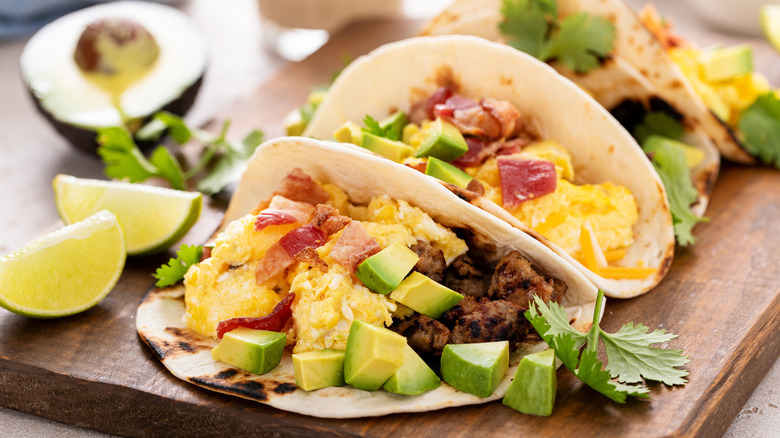
Breakfast tacos are one of the main reasons to live in Texas, and that is not an exaggeration. What the state lacks in public transport and snowy Christmases, it makes up for in the ubiquity and caliber of its morning taco vendors. But while Austin and San Antonio duke it out over which can lay claim to this most mouthwatering of breakfast foods, the rest of us can look South to Mexico, where the concept really began. It is true that the origins of the breakfast taco are not clear-cut, but it's a mostly settled fact that they began in Northern Mexico in Monterrey, Nuevo León, where they were a favorite option for early rising workers.
When breakfast tacos crossed the border, it became clear that Americans from all walks of life simply couldn't get enough of them. And who can blame us? There will always be a contingent of people who prefer their breakfasts to be on the sweeter side, but it's hard to beat the tantalizing power of a bacon, egg, and cheese taco. Throw in some salsa verde or salsa de aguacate and even the most sugary, freshly-made donut starts to look like a last resort.
Tamale pie
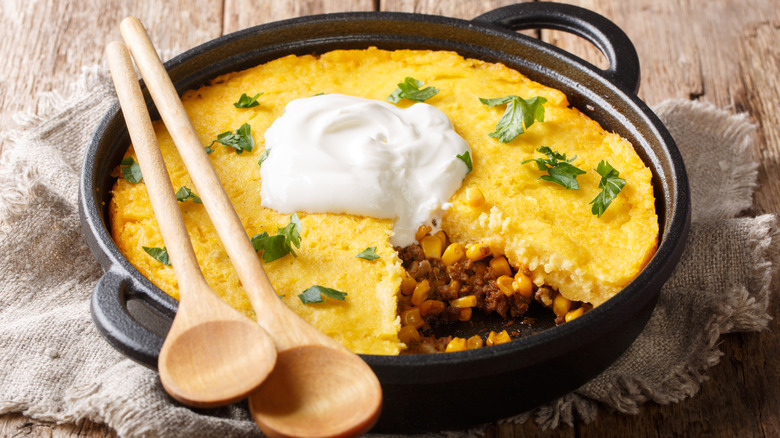
Americans love pie, but while our friends across the Atlantic might favor the savory variety, we typically stick to sweet classics like apple pie and pumpkin pie. Tamale pie is an exception. This is one of the few Tex-Mex recipes that truly feels like a culinary fusion, drawing on Mexican cuisine with the tamale ingredients and American cuisine with the casserole presentation.
Tamales have been a part of Central American cooking since the Aztecs. In their traditional form, they are a labor of love, made by encasing shredded meat in corn-based dough and tying it into corn husks before being steamed. Unlike tacos and chili, tamales were not immediately adopted by Americans, which is probably why it was adapted into something that more closely resembled American cuisine. It was also much easier to make. There was no need to use corn husks and tie each one of them, you simply layered corn mash with the meat and other ingredients.
These days, tamale pie is often made by topping meat, corn, and spices with a layer of cornbread. We even have a vegetarian tamale pie recipe. Though this dish might not hit the spot if you're craving traditional tamales, it is a classic of Tex-Mex cuisine in its own right.