

What Does It Mean If Beef Is Iridescent, And Is It Safe To Eat?
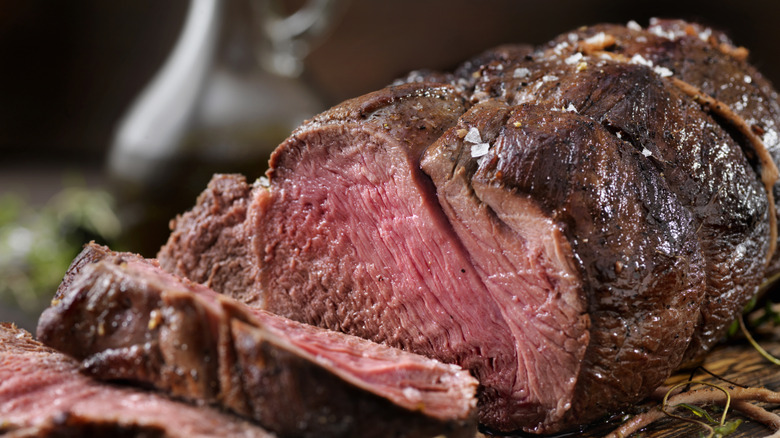
Have you ever sliced into a roast beef and the light caught the meat in just the right way so that it had a sheen like a rainbow or an oil slick on the road? That iridescent shimmer of pinks, yellows, greens, and blues doesn't look like it belongs on meat. It can be jarring to see that, but it's not necessarily a cause for concern, as the effect is a natural and harmless one. That said, there are some occasions when you need to use caution if you see unusual colors in your beef.
To better understand this phenomenon, we asked Scott Thomas, owner of The Grillin' Fools, about his take on iridescent beef. "If you are seeing that sheen on ground beef, be worried," he cautions. "All those little crevices from the grinding process are prime breeding grounds for bacteria." Nevertheless, if that sheen appears on your steaks or roasts, it's not so much a cause for concern. "For steaks, or whole cuts of muscle, it's not as big of a deal because the cooking process will kill those germs," Thomas adds.
According to the American Meat Science Association, that iridescent effect you see on beef, ham, and even some lunch meat is caused by the diffraction of light off the muscle tissue. It's natural and harmless and does not relate to the meat's quality or safety. Beef contains various compounds like iron and fat that can appear colored or iridescent when cooked or processed, per the U.S. Department of Agriculture. If you're worried about the quality of your meat, you should look at more than just that colorful effect.
Iridescent ground beef and other concerns
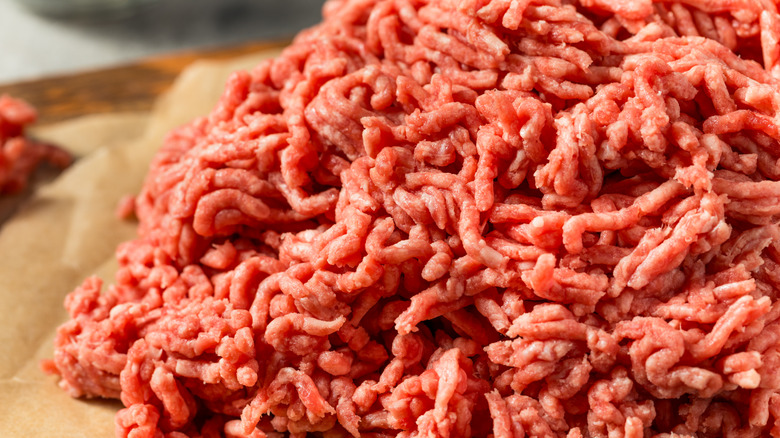
According to the National Cattlemen's Beef Association, ground beef does not produce iridescence. Once it is ground up, the muscle fibers that create the colorful effects are no longer present in the same form. If you're noticing a distinct discoloration that doesn't seem typical of beef, something else may be going on. That's why you need to heed Thomas's warning. It's not iridescence you are seeing, but likely something else, such as bacteria or spoilage.
If you're concerned about whether your meat has spoiled, Thomas has some other tips. "The bigger issue is the smell and the slime test," he explains. "If the steak has a rank smell, be careful. If it has gone from having a little moisture on the outside to slimy, be careful." One caveat to all this is vacuum-sealed meats. Those may still be fine even if they have an unusual odor. "This is due to lactic acid buildup in the meat, which actually means it was packaged safely and properly," Thomas adds. "Give the meat a rinse and pat dry with paper towels to remove the liquid from the vac-packed bag."
If it still smells off after that, you're better off not risking it. Throw the meat out instead, just to be safe. You really want to combine the smell with the appearance before you make any judgments, though. If you are just seeing the iridescent color, it is not really a problem and not something you need to worry about.