

When Shopping For Vintage Kitchen Knives, Always Keep An Eye Out For This Red Flag

Collecting vintage cutlery requires knowledge about which pieces are well preserved and which are irreparably past their prime. Knives, in particular, are especially delicate because of their thin blade. Some antique knives could be worth a small fortune today, but others could come with permanent damage. To learn the difference, Chowhound spoke to two experts on the topic, who shared how to recognize a vintage knife that isn't worth your money. The first expert is Andrew Sargent, the sous chef at the 3 Michelin Star restaurant Per Se in New York City and the winner of the first season of "Next Gen Chef." In his view, "Many things can be rehabbed, but pitting is a death sentence."
Pitting is the corrosion of stainless steel knives, which can be recognized by small pits appearing in the blade. Pitting damage can be significant, with lots of clearly visible indents on the surface, or it can be minor and therefore harder to spot; look for dark gray or black spots on the blade, concentrated together in certain areas. "A little rust isn't too concerning," said Sargent, although it could be an indication of a larger issue. "The goal is to find something someone knew how to care for," he pointed out, as "anything vintage loses the mystique if not properly cared for." Another red flag he highlighted is a bad heat treatment, which can be recognized by a flaky, warped, or cracked blade.
How to care for your vintage kitchen knives
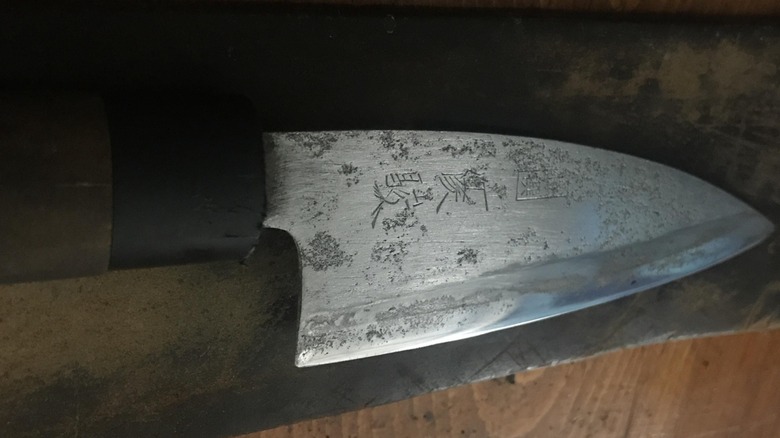
The second expert Chowhound spoke to is Josh Donald, co-founder of Bernal Cutlery in San Francisco. For him, too, "Condition is always key. 'This was a nice knife' is less compelling than 'this is still in great condition.'" He advised looking for bends in the blade, which, as already mentioned, can be the sign of poor heat treatment. "Sight the edge and spine like a rifle and look for significant bends and warps," he said. "Handmade stuff can have some," he warned, and went on to say that "a little is okay: but a lot is not." Ultimately, only proper care leads to well-preserved knives.
One of the common mistakes people make that is damaging to vintage items is improper washing. Water exposure is a big cause of pitting in knives — leaving the blades wet, not drying them immediately, or even soaking them in the water all significantly speed up the corrosion process. You should avoid putting knives in the dishwasher for the same reason; they'll be in contact with water for a longer time, plus certain salts and powdered detergents can damage the blade just as well. The best way to care for your vintage (and non-vintage, for that matter) knives is to wash them by hand with a simple liquid detergent and dry them immediately afterward.
Static Media owns and operates Tasting Table and Chowhound.