

Don't Buy The Wrong Dutch Oven: How To Pick The Perfect Size For Your Cooking Needs
We may receive a commission on purchases made from links.
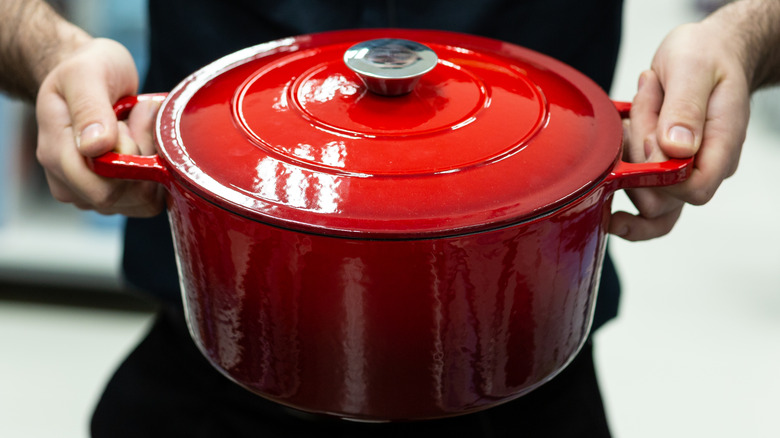
Every cook has that one piece of cookware they can't live without. For some, it's a wok, while others, a paella pan. However, if your regular rotation includes home-cooked roasts, tortellini soups, and black bean chilis, then odds are good your kitchen MVP is an enameled Dutch oven. But, say your old one's out of commission for whatever reason, and you need to buy a new one — your choices can be pretty overwhelming. Walk into your local supermarket and you'll be greeted with Dutch ovens of all shapes and sizes, from tiny ¼ quart minis to 13 quart monsters. Which size, then, should you bring home?
Professional chef and cooking instructor, Danielle Turner, shared her 15 tips for cooking with a Dutch oven in a previous Tasting Table feature, and she laid this exact predicament out rather simply: When determining the right size Dutch oven for you, you'll want to accommodate 1 quart for every person you're feeding — rounding up for leftovers. If you're flying solo or have a partner, that means a 3 to 4 quart Dutch oven like the Overmont Enameled Cast Iron Dutch oven, is going to work great.
For most people, however, Turner recommended getting a 5 to 7 quart Dutch oven. This can handily feed about four people and hits the sweet spot from family dinners to backyard BBQs no problem, with the space to fit and cook just about every Dutch oven recipe. As for those supersized 7 ½ to 13 quart giants? It's best not to touch them unless you've got just as big a family or gathering to match. It can handily feed anywhere from seven to a dozen people, but considering how heavy and expensive they tend to be, you should only buy them if you have a real need for the capacity.
Does shape matter all that much?
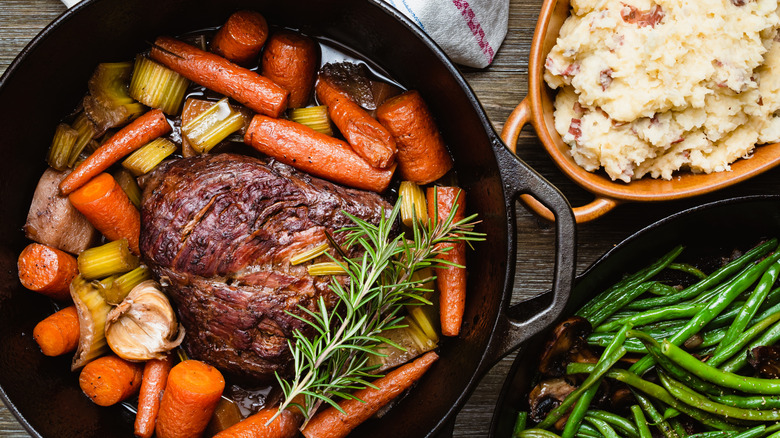
As noted before, Dutch ovens come in all shapes and sizes. That's not an exaggeration — you'll find Dutch ovens either in a regular round shape, such as this Mueller DuraCast Enameled Cast Iron Dutch Oven, or as an oval like the Crock-Pot Artisan Enameled Cast Iron Oval Dutch Oven. You might even find some with a far shallower bottom than normal, and some shaped like pumpkins when the time of year rolls around. But, as fun and cute as they might be, shape matters a lot more to your Dutch oven than you might think.
Round Dutch ovens tend to have the best cooking performance since the round base fits perfectly on top of gas burners and sits flush with the flame, giving you better heat distribution. But if you like to cook big cuts of meat like a whole German-style pot roast with beer gravy, an oval-shaped oven is going to give you more cooking real estate lengthwise. Danielle Turner pointed out that an adequate cooking surface is especially crucial when you're searing proteins, so think long and hard on what you often cook before committing to a shape.
Depth deserves attention, too. Standard Dutch ovens have those classic tall sides that Turner mentioned as perfect for cooking things like soups and stews. Shallow-bottomed versions exist, too, and they're called braisers. Braisers are wider and shorter than a traditional Dutch oven — and, since the moisture circulates lower in the pan and closer to the food, they're naturally perfect for braising. Braisers, however, are specialists — not generalists. If you don't have one yet, get a standard-depth Dutch oven first and a braiser later, when you know you'll actually use it.