

The Vegetables That Don't Cook Well In Cast Iron (They're Not The Ones You'd Guess)
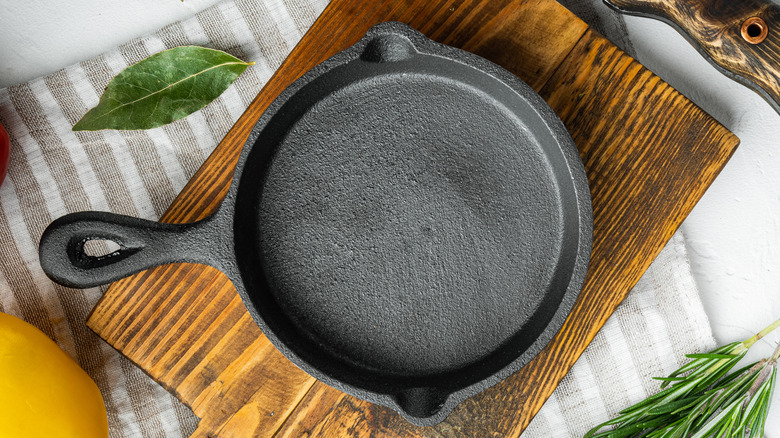
If you're a seasoned cast iron user, you already know that your pan doesn't react well to acids. Ingredients like tomatoes, vinegar and lemon could not only ruin the layer of seasoning on your pan, but also impart a metallic taste to the food. What you probably don't know is that there's a whole other category of vegetables that don't cook well in cast iron: your favorite leafy greens and vegetables.
"If you've ever cooked food, usually vegetables, in cast iron and they've ended up off in color, you're already familiar with oxalate," Danielle Turner, a professional chef and cooking instructor who has trained more than 8000 students, wrote in their Tasting Table article about the 6 ingredients you should never use in cast iron. When the oxalic acid in these vegetables come in contact with cast iron, it triggers a chemical reaction that turns them dark brown or even black.
Oxalates occur naturally in leafy greens, but not in equal amounts. Spinach, collards, rhubarb, and Swiss chard contain high concentrations of oxalic acids. Kale, Brussels sprouts, and bok choy, on the other hand, are examples of nutrient-rich greens with lower concentrations. Other common vegetables, like potatoes, snap peas, carrots, and beets, contain high concentrations, while others — including broccoli, celery, cauliflower, and sweet potatoes — contain less.
Are high-oxalate foods safe to cook with?
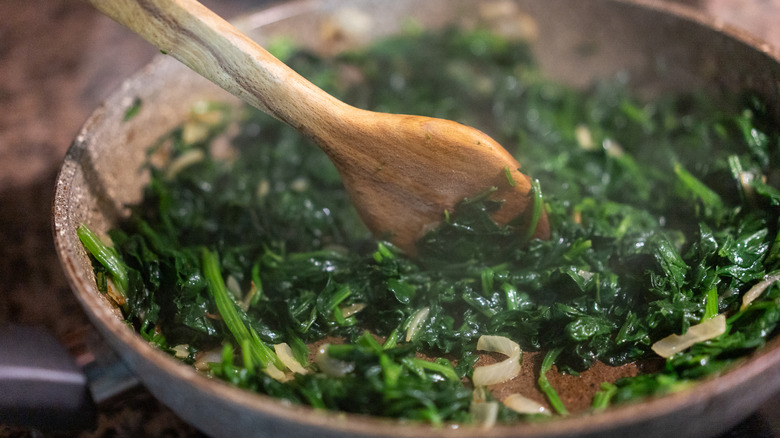
While cooking high-oxalate vegetables in cast iron makes them look unappetizing, they're still safe to eat. Even so, there are a couple of scenarios in which you might need to avoid them. The first is if they're present in very high concentration. When it comes to rhubarb, for example, the stalks are perfectly fine but the rhubarb leaves are not safe to eat – containing up to 1,900 milligrams of oxalate per 100 grams. Eating them could cause blisters and swelling in the mouth, burning in the throat, and possibly nausea and vomiting. People suffering from kidney stones are told to avoid eating them and other high-oxalate foods.
Unlike acidic foods — which can cause the seasoning to come off of your cast iron after extended periods of time — your pan won't suffer any significant damage when cooking high-oxalate vegetables. It just isn't the ideal choice for the sake of your veggies and their color. There are a few other foods for which your cast iron pan isn't the best choice for either. For example, cooking delicate fish on cast iron is risky, with a high chance of it falling apart if it gets stuck. The cast iron's weight also makes it less than ideal if you're cooking something that needs you to constantly manipulate the pan.
Having said that, if you're preparing a delicate fish or making Gordon Ramsay's creamy scrambled eggs – which you really should — it's highly recommended that you use a lightweight, non-stick pan. As for your high-oxalate vegetables, reach for a pan that has the usual characteristics you'd look for when choosing a pan for sautéing: ideally a flat, wide base made from stainless-clad or non-stick.