

These Are Some Of The Oldest Fast Food Chains In The US
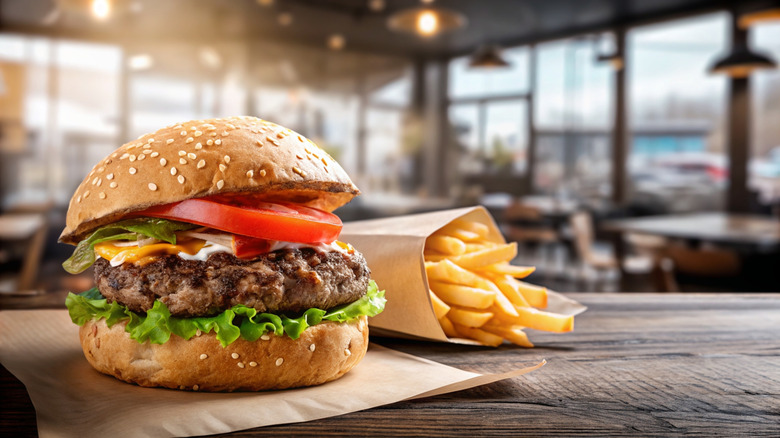
Can you imagine a world without fast food? We'll hazard a guess, and it's probably a no. As there are roughly half a million fast food restaurants in the world, it's not surprising that most of us have grown up with fast food all around us. This means that it's hard to picture a life without drive-thru burgers and fries on tap. But it did exist, albeit quite a long time ago.
As you'll see from the list below, the seeds of the fast food industry were being sewn in the early 1900s. Over the 20th century, more and more chains joined the market, creating the crowded fast food industry we're all familiar with today.
If you're interested in fast food history, you've come to the right place. Below, we've listed 10 of the oldest fast food chains in the U.S., focusing specifically on when each chain opened its first restaurant under its current name, rather than on when each became the fast food juggernaut we're familiar with today. The very first one might surprise you. Spoiler: It's not McDonald's.
Nathan's Famous
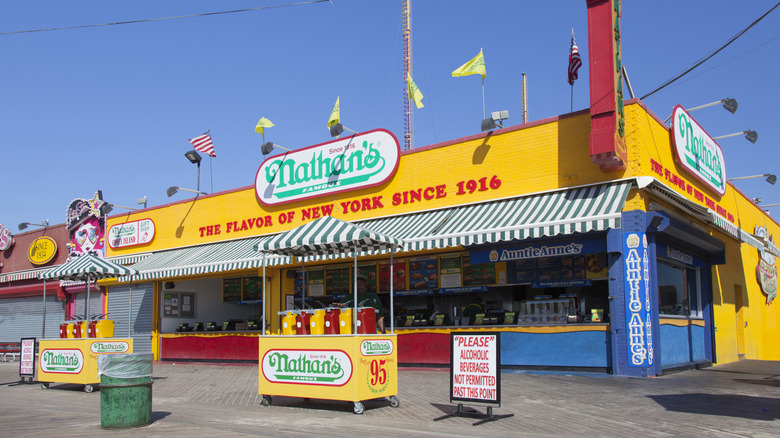
When Nathan Handwerker arrived in New York City more than a century ago, he didn't have it easy, to put it mildly. He was a Jewish Polish immigrant who didn't speak English, and he'd never been to school. But he was determined to succeed. After working at Feltman's Restaurant in Coney Island as a roll slicer, Handwerker decided to branch out and open his own rival hot dog stand, after being egged on by two of his colleagues. This was back in 1916 — for context, it was the middle of the World War I and Woodrow Wilson had just been reelected as President of the United States.
That simple hot dog stand evolved into Nathan's Famous, the fast food hot dog chain we're all familiar with today. There were many reasons why it thrived, and it wasn't an easy ride, but it largely came down to this very simple fact: The hot dogs were far cheaper than Feltman's offerings, but they still tasted pretty good, thanks to the secret recipe provided by Handwerker's wife.
The business was helped massively by the extension of the New York subway system to Coney Island. It ended up selling tens of thousands of hot dogs every weekend in the decades that followed. In the 1950s, the Handwerkers decided it was time to expand. Fast forward to 2023, and Nathan's Famous has four company-owned locations, more than 230 franchised locations, and nearly 270 virtual kitchens.
A&W
Three years after Handwerker branched out and started the hot dog stand that would become Nathan's Famous, another entrepreneur on the other side of the U.S. was about to open a small business that would one day become a fast food empire. That entrepreneur was called Roy W. Allen, and he wasn't flogging hot dogs, but root beer. It was 1919, the World War I was over, and Allen was hoping that party-goers in Lodi, California would stop by his humble stand for a little refreshment.
Allen's small business plan paid off. People loved the root beer, and he ended up finding a business partner, named Frank Wright, to help take the small stand to new lofty heights. Their business would go on to become A&W, which sold fast food classics, as well as the original root beer. Fun fact: A&W stands for Allen and Wright.
Society has changed in so many ways since then. This was before World War II, the Swinging Sixties, and the invention of the internet. But one thing is the same: You can still buy Allen's root beer. Just head to one of the 460 A&W restaurants in the U.S.
White Castle
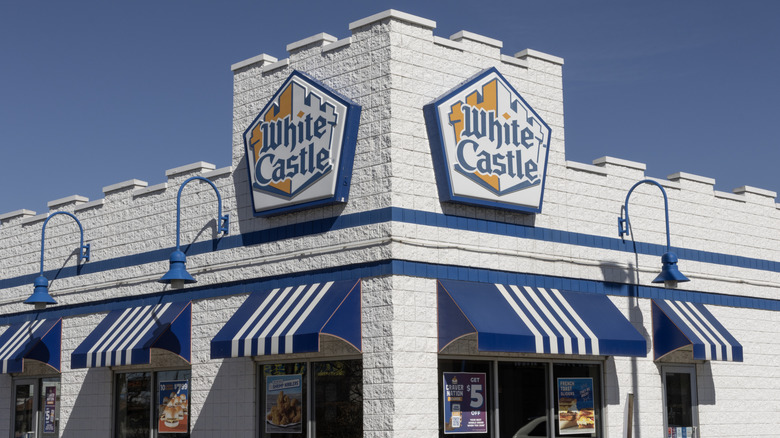
Next time you're munching down one of White Castle's famous sliders, consider taking a moment to think about all the history that is attached to it. Why? Because White Castle has been slinging burgers for more than a century. The first restaurant, founded by insurance salesman Billy Ingram and chef Walt Anderson, opened in Wichita, Kansas all the way back in 1921. For perspective, Woodrow Wilson was gone, and Warren G. Harding was in the White House. "The Great Gatsby" hadn't even been published yet, and prohibition had only just been introduced.
White Castle was the very first hamburger fast food chain on the scene, beating the likes of McDonald's and Burger King. Today, it might be dwarfed by the two fast food giants, but it's still going strong. As of 2024, the chain had 345 restaurants across the U.S. Most of these are in Illinois, Indiana, and Ohio.
Krispy Kreme
The 1930s was a tough decade for Americans. After the roaring twenties, the U.S. was faced with the Great Depression. This period of major unemployment and poverty lasted from 1929 to 1939, but it wasn't all bleak. Some major well-known companies got their start during this period, like Hy-Vee and Publix, for example. Krispy Kreme was one of those companies. It was established in Delaware in 1937, just two years before the end of the Great Depression.
A young entrepreneur called Vernon Rudolph started making and selling doughnuts with a secret recipe that his family had obtained from a French chef a few years before. He initially sold doughnuts to nearby grocery stores, but they smelled so good while they were cooking, people would walk by and ask if they could buy them directly. Krispy Kreme was officially born when Rudolph decided to start selling the doughnuts, which would later become known as Original Glazed, from a window on the street.
Today, people still can't get enough of Rudolph's doughnuts. As of August 2025, there are more than 350 Krispy Kreme locations across the U.S.
McDonald's
When you think of fast food, there's a good chance you think of McDonald's. This legendary chain, symbolized by its iconic golden arches, is one of the biggest restaurant chains in the entire world. At the time of writing, it has over 44,000 locations in more than 100 countries.
But the fast food juggernaut actually had very humble beginnings. In 1940, the founders, Dick and Mac McDonald, opened the very first restaurant in San Bernardino, California. It was kind of similar to what McDonald's is like today as it specialized in fast food, but it was more of a drive-in service. It also had a different name — it actually opened as McDonald's Bar-B-Q.
Over the course of the 1940s, the McDonald's we all know and love started to take shape. There were hamburgers, fries, and thick creamy milkshakes. In the 1950s, the first McDonald's franchise opened, while the 1960s brought iconic menu items like the Filet-O-Fish sandwich and the Big Mac. The latter, of course, would go on to become one of the chain's most popular menu items. Per Dashmote, today, a whopping 900 million Big Macs are sold every single year.
Dairy Queen
The year 1940 was a pretty big deal for the fast food industry. Not only did McDonald's take its first steps in California, but in Joliet, Illinois, the first Dairy Queen also opened on Route 66. Back then, you could stop for a soft-serve cone at the restaurant, and it would only cost you a nickel. Dairy Queen was co-founded by J.F. McCullough and his son who had developed a formula for soft-serve ice cream just two years earlier. Sherb Noble, a store owner who sold McCullough's ice cream, was another co-founder.
Dairy Queen quickly transformed into a fun hang out for young people and teens, who would gather in the restaurant to chat and bond over ice cream. Not much has changed since then, as Dairy Queen is still hugely popular. Sadly, the location in Joliet isn't open, but luckily, there are more than 4,100 other locations to choose from across the U.S.
In-n-Out
In-n-Out might have been pipped to the post by McDonald's and White Castle, which were serving burgers years before its first location opened, but it was still a pioneer of the fast food industry. The drive-thru chain was founded by Harry Snyder in Baldwin Park, California in 1948, and the timing couldn't have been more perfect. World War II was over, and more people had cars. In fact, according to Statista, at the time, there were around 33,350 passenger cars in the U.S., and the number has continued to grow rapidly since then.
Over the years, In-n-Out would managed to define many aspects of the fast food experience. One of the biggest achievements was the two-way speaker box, which made it easier for customers to order food without leaving their cars.
In-n-Out has expanded significantly since the 1940s, but it has, for the most part, stayed in California. This fast food icon currently operates on more than 420 locations across the U.S., with around 280 restaurants located in California.
Dunkin'
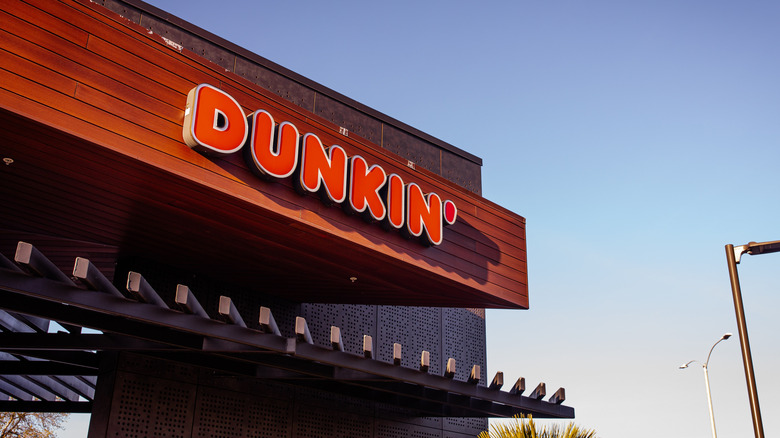
Dunkin' Donuts wasn't always Dunkin' Donuts. In fact, for two years, the first location of the chain in Quincy, Massachusetts, was known as Open Kettle. That was back in 1948, and the name was likely a nod to the restaurant's coffee, which was one of its biggest sellers. The other major seller? You guessed it, it was donuts. That's why, in 1950, founder William Rosenberg decided to change the name to Dunkin' Donuts. Put simply, the name reflected what people liked doing — dunking doughnuts in coffee. Makes perfect sense.
The concept of Dunkin' Donuts quickly took off, giving Krispy Kreme a run for its money. This was largely thanks to its affordable prices and tasty, top-quality doughnuts and coffee. By the early 1960s, there were 100 locations of Dunkin' Donuts all over the U.S. Now, there are nearly 10,000. The company is no stranger to a name change. In 2018, it became simply Dunkin', mostly because it wanted to promote the high-performing drinks section of the business more.
Whataburger
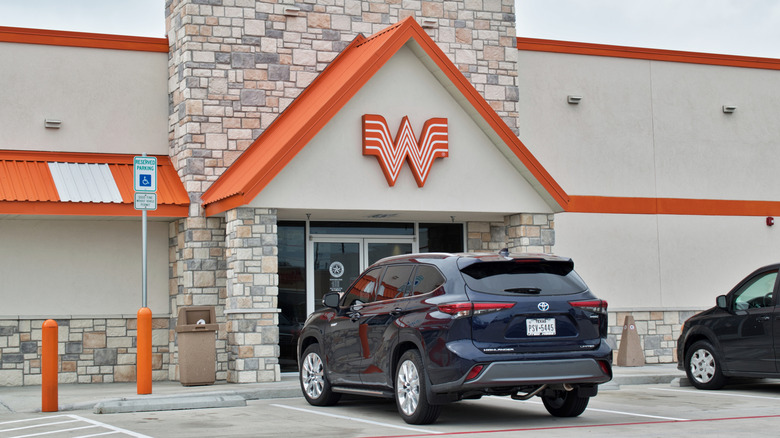
Back in 1950, Harmon Dobson had a dream. It wasn't to do with diamond trading, ship construction, or oil sector, which were the industries he had worked in previously. It was to do with burgers.
Specifically, Dobson wanted to make burgers that tasted so good they made people exclaim "What a burger!" To achieve this dream, the businessman partnered up with another entrepreneur called Paul Burton, and together, they founded the very first Whataburger in Corpus Christi, Texas. The restaurant ended up scrapping the classic 2-ounce burger and pioneering the ¼-pound patty (fun fact: McDonald's didn't copy this idea until the 1970s), which was served on a 5-inch bun. By the early 1960s, the chain had 24 locations.
Today, people are still exclaiming "What a burger!" or, at least, enjoying its burgers. The chain has more than 1,150 locations across the U.S. — more than 760 of these are in its home state of Texas.
Jack-in-the-Box
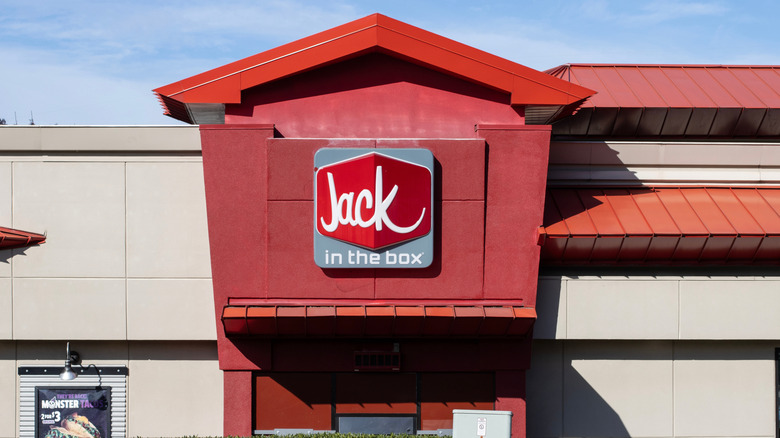
By the time Jack-in-the-Box came along in 1951, the fast food industry was already starting to fill up. It needed something to differentiate itself from competitors, and what better way to do it than to stick a clown on the top of the restaurant? Founded by entrepreneur Robert O. Peterson, Jack-in-the-Box was undeniably unique. The speaker that customers placed their order through was also a clown. Alongside hamburgers and other fast food classics, the clowns made the chain memorable.
Over the years, Jack-in-the-Box turned into a hit. And by the late 1960s, there were 300 restaurants across the U.S. Another fun fact for you: It was among the first to introduce the concept of a breakfast sandwich to the fast food industry.
Jack-in-the-Box has been through some tough financial times, but, at the time of writing, it is still going strong. In 2024, it had nearly 2,200 restaurants in the U.S., although in June 2025, it announced plans to close around 200 locations that didn't prove profitable.