

This Classic Chinese-American Sweet Isn't Actually Eaten In China
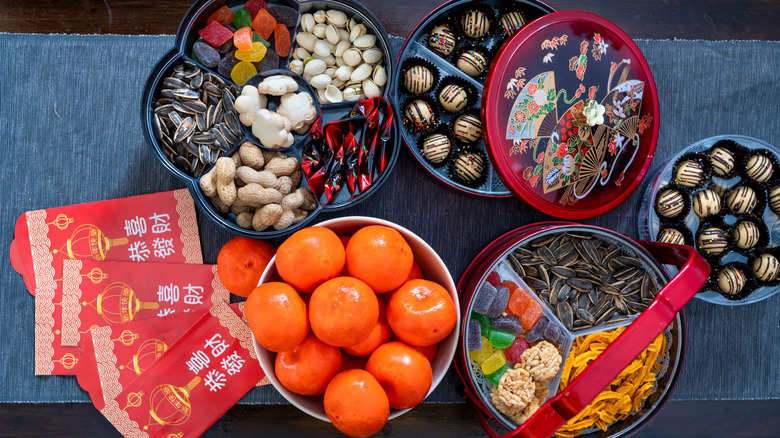
Ordering a takeaway meal from a Chinese-American restaurant comes with certain expectations. The meal will be packaged in those little cardboard cartons, it will probably include egg rolls or another fried appetizer, and for each entree in the bag there will also be a crisp little vanilla cookie hiding a secret note. Fortune cookies are a quintessential part of the Chinese food experience, not just in the U.S., but around the world. Interestingly, however, they are one of those Chinese-American dishes that don't exist in China. In fact, this iconic cookie actually draws its inspiration from another cuisine entirely.
These days, most of the world's fortune cookies come from one company in New York City, where they are produced by machines. With the mechanization of the process, it is easy to see how the history and the human touch of these cookies could be lost. But culinary historians have tracked things back and shown that the modern fortune cookie actually comes from Japan — for the most part.
In Japan there is a cracker called tsujiura senbei that can be either sweet or savory, often flavored with miso and sesame. The cracker is made by pouring a thin batter into an iron press similar to a waffle iron and then heating it over a fire. Just after cooking, the cracker remains pliable and can easily be folded — the secret to how fortune cookies are made as well. The result is much larger and darker than the fortune cookies seen in the U.S., but it is folded into the same shape and also comes with a fortune. With these tsujiura senbei, however, the note is not hidden inside, but rather tucked into the fold of the cracker.
How the US turned a Japanese cracker into a Chinese-American sweet
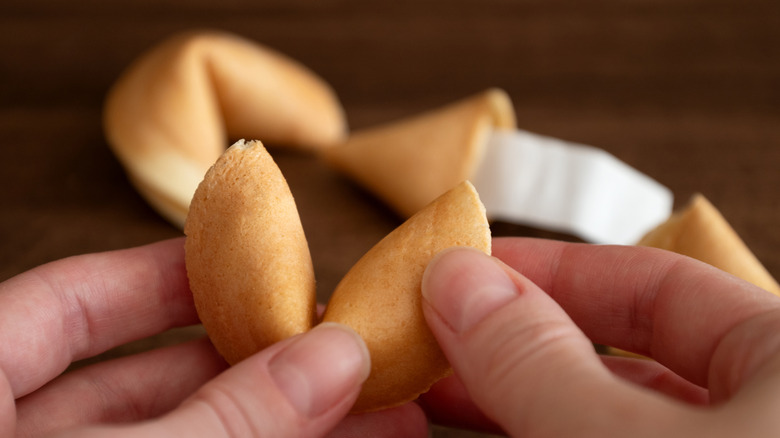
But how is it that these traditional Japanese crackers came to be a sweet most often associated with Chinese-American cuisine? There are many legends around how the fortune cookie may have come to be the staple that it is, and the issue has at times gotten fairly contentious, even leading to court proceedings in 1983. Some people would certainly like to claim the fortune cookie as one of the types of Chinese desserts, but the best explanation out there actually points to the Japanese Tea Garden at Golden Gate Park in San Francisco.
The story goes that a man named Makoto Hagiwara opened this tea garden in 1894 and began serving a form of tsujiura senbei to the customers. This is also likely where the recipe changed to better suit the American palate, replacing miso and sesame with butter and vanilla. Demand eventually exceeded the means of production, and the making of the cookies was outsourced to Benkyodo Candy Factory. From there, it seems to be largely just a matter of popularity.
Fortune cookies spread from there to Chinese restaurants in the San Francisco area, but stayed a regional specialty until around the time of World War II. The final push to countrywide ubiquity may have been down to soldiers returning home from the Pacific Theater and eating in these restaurants on the way. When they got back to their hometown Chinese joint, they asked why they weren't served those fun cookies to finish the meal. Regardless of the journey, fortune cookies are now undoubtedly a treasured part of the Chinese food experience.