

Why It Can Pay To Boil Ribs Before Placing Them On The Grill
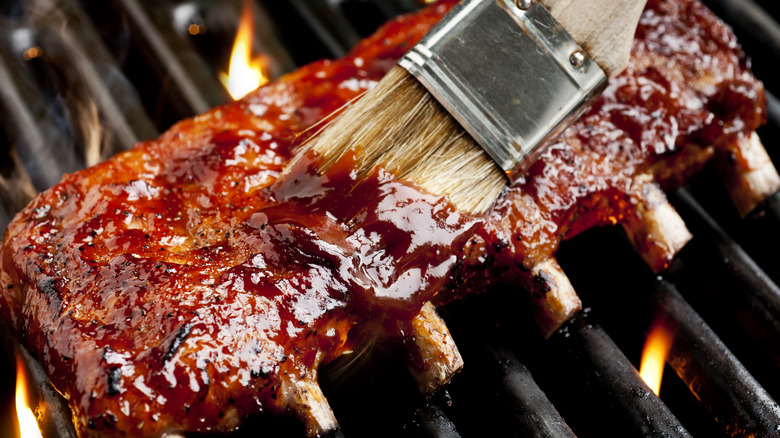
Perfectly tender smoked ribs are an irresistible barbecue meal, but getting them that way on the grill takes skill. Ribs are naturally chewy and full of connective tissues — it's what makes them an affordable meal to begin with; however, turning that meat into something worthwhile means achieving the right balance between temperature and time. Collagen (the tissue in ribs) turns into liquid gelatin at 160 degrees Fahrenheit, but it's a gradual process that can take hours to complete. Because of this, some chefs recommended a parboil to help heat up the ribs gently and more rapidly, before finishing them on the grill for smoky flavor. But does this actually work? We decided to ask Christie Vanover, the head cook and pitmaster for Team Girls Can Grill, and contestant on Season 4 of Food Network's BBQ Brawl, to find out.
Vanover says when she started out, boiling was the method she regularly used, explaining "It's a classic technique that allows you to cook the meat quickly while finishing it on the grill. It's similar to parboiling potatoes, and then crisping them up in a skillet." However she has grown wary of this technique, telling us, "I don't follow this method anymore, however, because when you cook ribs in boiling water, you lose a lot of the flavor in the water." The reality is that boiling ribs is a tradeoff of time for flavor and, although it has some other advantages, that decision comes down to the chef.
Boiling ribs can shorten the time it takes to cook ribs, but it can dull flavors
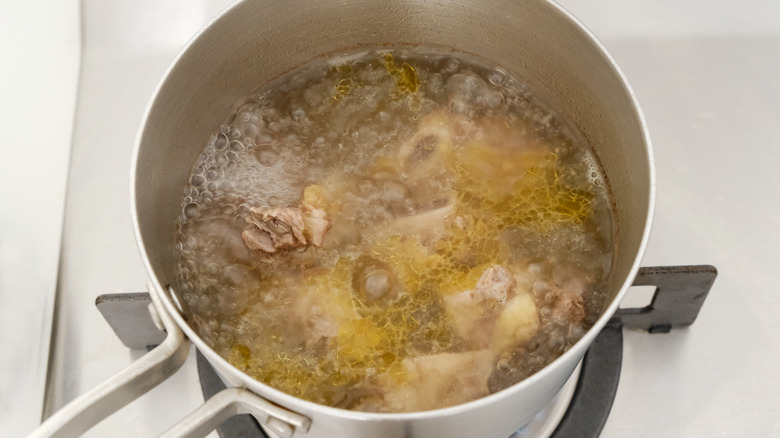
The effects of boiling will be directly impacted by how you do it. Boiling ribs will render fat, but certain options like St. Louis-style ribs have a lot. A short boil will reduce the meat's rich flavor, but it may not be noticeable enough to bother you. Boiling can also help loosen the membrane on the ribs and make it easier to remove, which is also appreciated.
However to really reduce the time needed on the grill, you may need to boil your ribs for up to an hour. In this case, they should be simmered, not boiled. Yet, even then, the water can draw a lot of the pork juices and fat out of the ribs. The resulting ribs will definitely be tender, but they will also have much less flavor. If you are slathering your ribs in good BBQ sauce anyway, this might not be a problem. But if you prefer to let the smoky meat shine, boiling ribs can be a mistake.
Instead of risking that loss of flavor, Vanover has an alternative method for cooking ribs. She says, "If you smoke them and then braise them, you lock that great pork flavor into the ribs themselves." It won't be a quick process, but braised ribs can cook in under three hours, as opposed to the four or more needed for just smoking. If you want to shave off some cooking time without compromising flavor or texture, braising afterwards is a good alternative to boiling initially.