

How To Find The Wishbone Inside A Turkey, And Why We Make A Wish With It
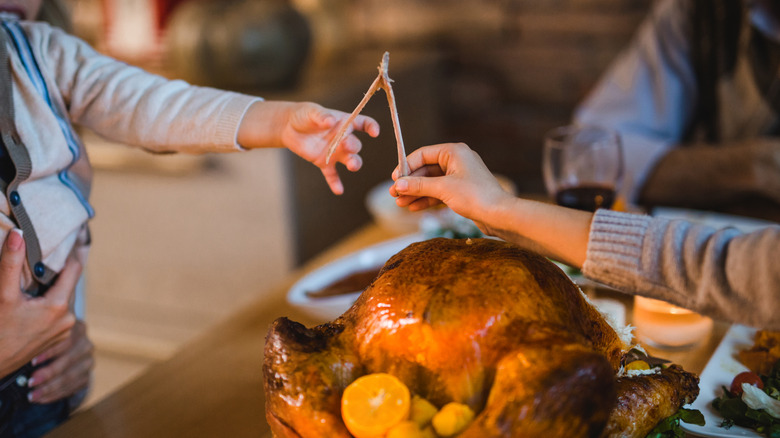
After the annual Thanksgiving feast has come to an end, and the once-tall turkey has collapsed into a pile of bones, there's still one more piece worth saving — the wishbone. For millions of Americans, especially children, engaging in a good old-fashioned tug-of-war in hopes of getting wishes granted is arguably more exciting than the dinner. But how can you find this small, unassuming bone amidst a sea of turkey leftovers, and why has it become a good luck charm?
To locate the wishbone in your Thanksgiving turkey, we'll need a little anatomy lesson. While we commonly refer to it as the wishbone, the bone is formally known as the furcula, which means "little fork" in Latin. The bone rests between the turkey's breasts and neck, and is actually two collarbones fused together. The furcula isn't exclusive to turkeys, most birds have one, including ducks and chickens.
You can choose to either remove the wishbone before or after the turkey is roasted. Many argue that the wishbone should be removed while the turkey's raw so you can easily remove the breasts from the bone, as the furcula connects them together. Position the turkey so that it's laying breast-side up, with the legs facing you. Then, with a sharp knife, gently slice away some of the skin at the upper center of the breast, where the two sides meet. With your hand, carefully retrieve the wishbone, ensuring it doesn't break.
A centuries-old bringer of good luck
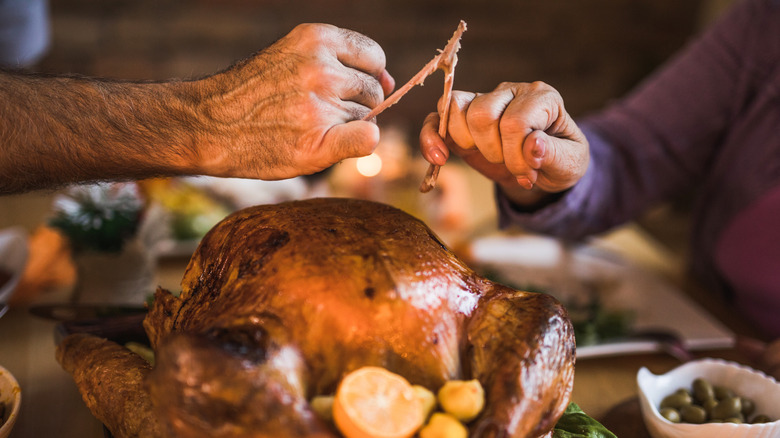
While some Thanksgiving traditions have been forgotten over time, the ceremonial snapping of the wishbone has endured through the ages. The exact origins are dubious, but perhaps the strongest theory starts with the Etruscans. Around 2,400 years ago, this ancient group that lived in what is now Italy believed that birds were prophetic fortune tellers. So, when fowl were killed, the Etruscans preserved the furcula and left it out to cure out the sun. Anyone down on their luck would stroke the sun-soaked bone and make a wish.
It wasn't until a couple centuries later, when the Romans arrived, that the bones started to break. Culinary birds, notably chickens, were in great demand, but with limited supply. As such, they believed that the wishbones should be snapped in half to maximize luck. And so, a game of skill, strength, and good fortune was made. Two people would grab an end of the dried wishbone, and pull as hard as they could. The bone snaps, and whoever held the longer piece could make a wish.
The Romans spread the tradition up north to the British Isles. It caught on quickly, and in 1620, the Pilgrims departed from England, arriving in modern-day Massachusetts. In the New World, they found another type of bird, turkey, was abundant. The tradition continued, and they began to snap turkey wishbones for good luck.