

This Late-'70s Pizza Chain Went Bankrupt, But Chuck E. Cheese Emerged From Its Ashes
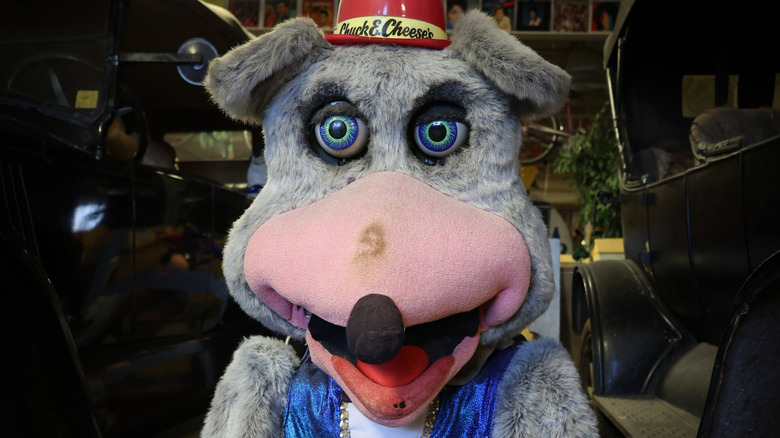
On the historical timeline, novelty pizza joints are like a fading sunset — glorious, warm, yet temporary, and kind of hurt your eyes to look at directly. So it goes with Chuck. E. Cheese's Pizza Time Theatre, the predecessor to the Chuck E. Cheese fans know today, which opened in the late 1970s and was bankrupt by 1985.
Before Pizza Time Theatre, coin-operated video games had a somewhat rowdy public reputation, primarily located in truck stops and dive bars. Pinball machines were even banned in some U.S. cities in an attempt to avoid raucous teenage clientele. Until Chuck E. Cheese, arcade games didn't have the family-friendly connotation they have today.
Chuck E. Cheese's Pizza Time Theatre was originally launched in 1977, the brainchild of Nolan Bushnell, co-founder of video game console pioneer Atari. Fittingly, his dining concept also centered around a technological focal point: Animatronics. When the first-ever Pizza Time Theatre location opened on May 17, 1977 in San Jose, California, it included both an arcade and a stage show, spanning a whopping 5,000 square feet. Faux-framed characters popped out of "picture frames" along the walls to interact with guests.With this business model, founder Bushnell would be able to promote Atari games to a wider audience.
Pizza Time Theatre walked (and rocked) so Chuck E. Cheese could run
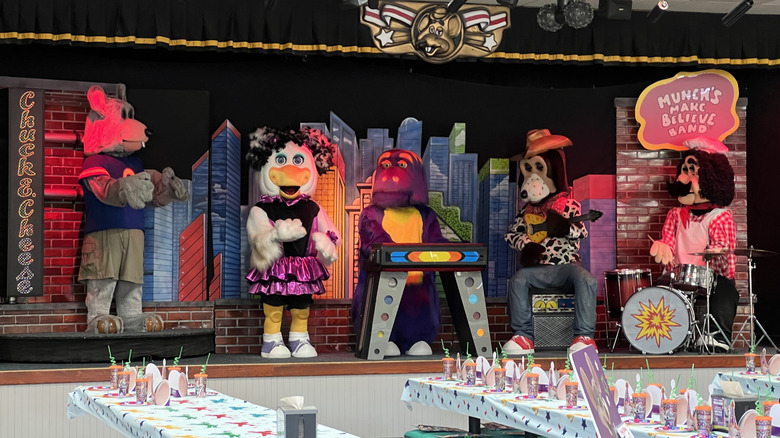
Reportedly inspired by a singing animatronic bird he spied during a Disneyland vacation, Bushnell created his own take on the interactive entertainment concept: A giant animatronic rat band. Disney's now-trademarked "Audio-Animatronics" debuted in The Enchanted Tiki Room attraction in 1963. As Disney writes of the debut, "The groundbreaking technology allowed animators to synchronize movement, audio and visual effects, paving the way for other classic attractions like 'it's a small world,' Pirates of the Caribbean, and Haunted Mansion." Not long after, "Whac-A-Mole" arcade game was invented by Aaron Fechter of Creative Engineering, Inc. in 1976. Enter: Pizza Time Theatre in 1977. The band was intended to entertain adults while their kids played games.
The combination music-and-comedy show quickly became a fixture of children's birthday parties of the late '70s and early '80s, serenading throngs of screaming kids as they ran around jamming tokens into slots. The stage show consisted of large mechanical robot rock band members: Chuck E. Cheese himself, singing dog Jasper Jowls, a furry purple Mr. Munch (genus unknown), and Italian chef Pasqually P. Pieplate, the band's only human member. Today's fans might recognize the Pasqually character from Chuck E. Cheese's ghost kitchen bait-n-switch, Pasqually's Pizza & Wings, of 2020. In the late 1970s, Pasqually's role was to emerge from behind a door and announce pizza orders to the dining room. Later, he switched to ceremoniously introducing children on their birthdays.
The video game industry crashes in 1983, and the pizza arcade rebrands
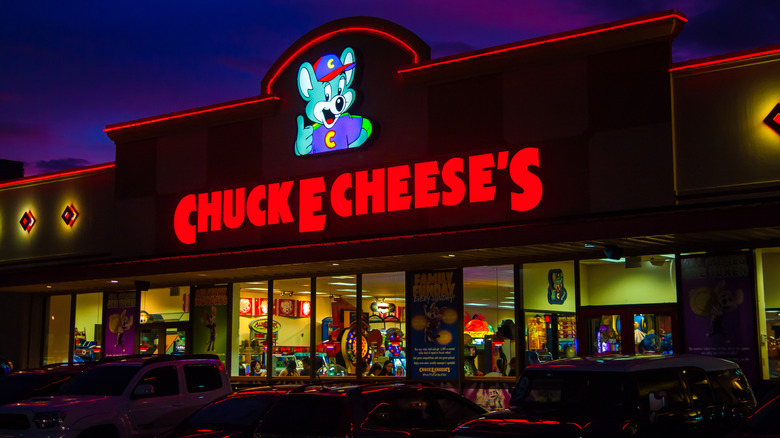
At its peak, Chuck E. Cheese Pizza Time Theatre had more than 240 locations — which could be part of the reason why, in 1984, the chain filed for Chapter 11 bankruptcy protection. Animatronic competitor ShowBiz Pizza Place bought the concept and renamed the stage show Munch's Make Believe Band. In addition to the rapidness of the expansion, exterior forces also stunted Pizza Time Theatre in its prime. Atari's Pong may have revolutionized gaming in 1972, but in 1983, the video game industry took an infamous crash. After Atari delivered a flop E.T.-themed game for Christmas 1982, the industry suffered a 97% revenue drop, plummeting from $3.2 billion to roughly $100 million. As competitors with near-identical concepts encroached, the Atari co-founder's restaurant chain could no longer stand.
Either way, while Pizza Time Theatre faded, Chuck E. Cheese restaurant has endured. The indoor arcade has kept mechanical technology at the front of its innovations since its advent in the '70s, replacing game tokens with scannable "Play Pass" wristbands in 2016. Alas, in 2017, Chuck E. Cheese began phasing out its fuzzy mechanical band. As CEC Entertainment CEO Tom Leverton detailed to CNBC, the shift towards a sleeker, modern, streamlined aesthetic (i.e. swapping the red and teal booths for neutral wood) was an effort to appeal more to adults — a pretty major departure from the O.G. fur-covered-mechanical-skeleton rock band of Pizza Time Theatre yore.