

10 Classic Comfort Foods Midwesterners Love
We may receive a commission on purchases made from links.
Is the dish loaded with corn, cheese, or ranch and cooked in batches big enough to feed an army? Does it seem like the recipe spawned from a fever dream? Then it's probably from the Midwest. There's something about the iconic food of the Midwest that makes it a prime example of American cuisine. Sure, there's the famous seafood of the East Coast and epic burritos as big as your head in the Southwest, but the Midwest's food comes from a unique combination of modesty, necessity, and the altruistic need to feed a crowd, making it all-American through and through.
We're a country that loves comfort food, and no one does it better than Midwesterners. In this list, we'll take a peek into some classic home cooking that middle America has been dishing out for decades — not just the kind of thing you can scoop up at the Hy-Vee hot bar on your way home. Chances are, you've only indulged in these delicacies (to use that term loosely) if you grew up somewhere between Ohio and the Dakotas. However, they're worth taking a crack at in your own kitchen anywhere in the U.S. when a chilly evening calls for some humble, home-cooked grub. So nestle in, grab some pop, and dive into these potluck-friendly, down-to-earth comfort food classics courtesy of America's heartland.
Booyah
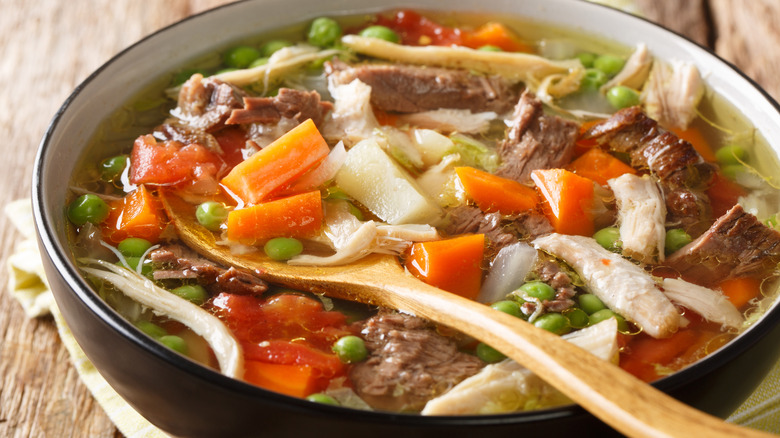
Just about every region of the world has its own take on chicken soup. In Wisconsin, they have booyah — and don't you dare call it chicken soup. Booyah has Belgian roots, gaining popularity in Wisconsin (northern Wisconsin, to be precise) when Belgian immigrants first came to the region in the mid-19th century. The Belgian immigrants who settled in Wisconsin spoke French, so it's thought that booyah gets its name from "bouillon," but the exact origins of the dish's exclamatory-sounding title are unknown.
No one knows who first invented booyah. Like so many historical recipes in the U.S., many folks claim to know the rightful inventor, but can't come up with any proof to back up the claims that their great-great-granddaddy made his mark on history by inventing booyah. But booyah ain't your grandad's chicken stew. It's typically made in a huge vat — think 10 to 20 gallons — over a live fire at an outdoor potluck, family gathering, or church picnic (all common occurrences in Wisconsin). The stew is chicken-heavy, but it also contains beef and pork, as well as classic stew ingredients like carrots, onions, potatoes, celery, and tomatoes. Booyah is defined by its rustic, outdoor cooking process and use of a whole chicken (or three).
Johnny Marzetti
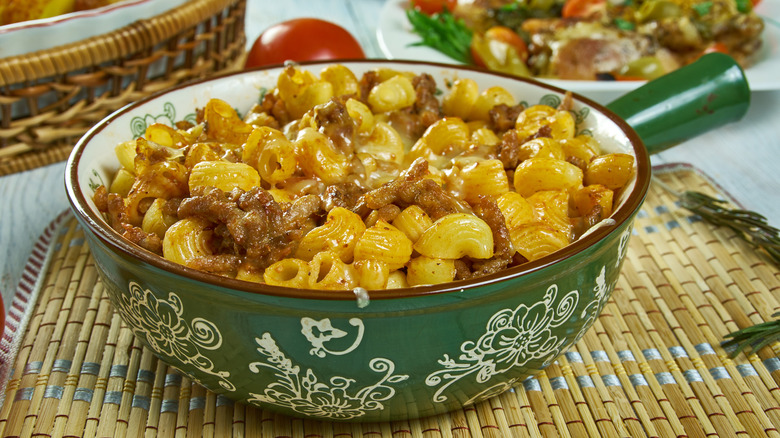
We challenge you to find another dish that shares a full name with a person. It makes for a memorable recipe in its name alone, but this dish is also one for the books for its pure, unadulterated Midwestern-ness. Johnny Marzetti comes to us from Ohio, specifically Columbus. Its origin story is a tad murky, but it was most likely named after a real person. The most widely accepted story is that of Teresa Marzetti, whose immigrant family opened a few Italian restaurants near Ohio State University in the late 19th century. It's said that she invented Johnny Marzetti in one of these restaurants, naming it after her brother-in-law.
In 2018, an editor for Columbus Monthly decided to stir the pot on the Johnny Marzetti story by uncovering another Johnny Marzetti who could potentially be the true creator. This Marzetti was a Columbus businessman who just so happened to own a few restaurants. However, the sleuth who tracked him down found absolutely no references to any dishes that resemble the recipe in question at any of his restaurants.
Johnny Marzetti is a comfort food classic consisting of macaroni noodles, beef, cheese, and marinara sauce baked casserole-style. Chances are, growing up, you ate something resembling this dish, no matter where in the U.S. you were. But now you can put a name to the face — literally.
Gooey butter cake
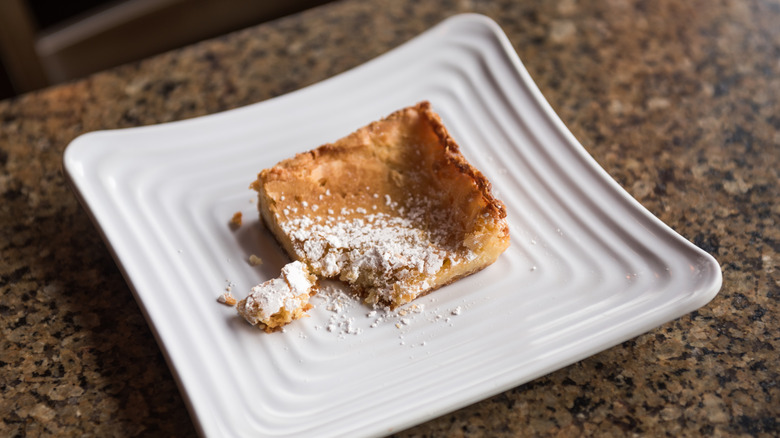
The words "gooey," "butter," and "cake" may be the best three words ever combined in all of dessert history, and leave it to the Midwest to be responsible for such a delicious invention. Actually, the creation of gooey butter cake was a mistake. There are a couple of stories told about its invention, but all the tales lead to a mistake in baking ratios, yielding an ultra-moist, decadent cake that folks in Missouri couldn't get enough of. Multiple bakeries stake their claim in gooey butter cake's creation, but no matter who the real inventor was, the cake was most likely created at a St. Louis, Missouri, bakery with German roots during World War II.
Gooey butter cake doesn't look like much. It's a flat, dense cake that (like so many desserts in the Midwest) is typically cut into small rectangles — "bars" is what they're known as in America's heartland. The cake is made with a yeasted dough and filled with a thick, creamy filling of butter, sugar, eggs, corn syrup, and vanilla. It's only lightly baked, so the texture is iconic: dense and chewy yet flaky at the same time. The shortcut version involves using a boxed cake mix and a cream cheese-based filling. It might look like the real deal, but it doesn't have the famous texture that makes gooey butter cake one of the Midwest's most famous desserts.
Hot dish
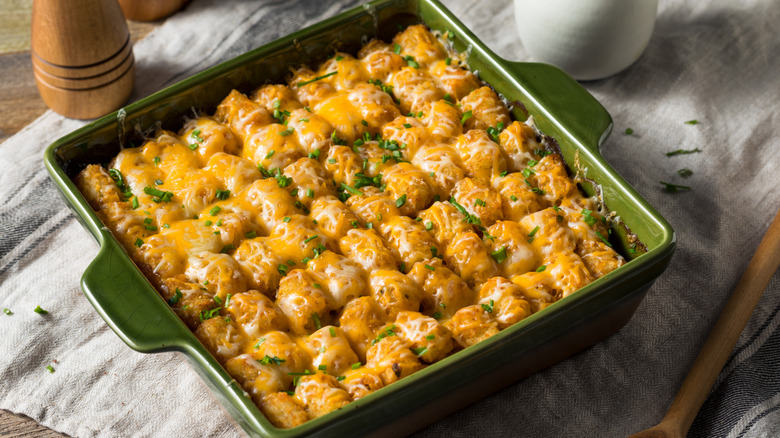
If we had to pick one Midwestern comfort food to act as the quintessential example of all the region's humble cuisine, it would be hot dish — no contest. At its core, hot dish is really just another word for casserole, although there are a few key components that make a recipe a true Midwestern hot dish and not just some garden-variety casserole. First of all, it almost always includes canned soup — cream of mushroom, cream of chicken, or cream of something else is a usual suspect. It often incorporates some sort of meat, plenty of carbs (think pasta or potatoes), and cheese, and is typically layered in a shallow pan. But ultimately, the difference between the two comes down to where in the country you are.
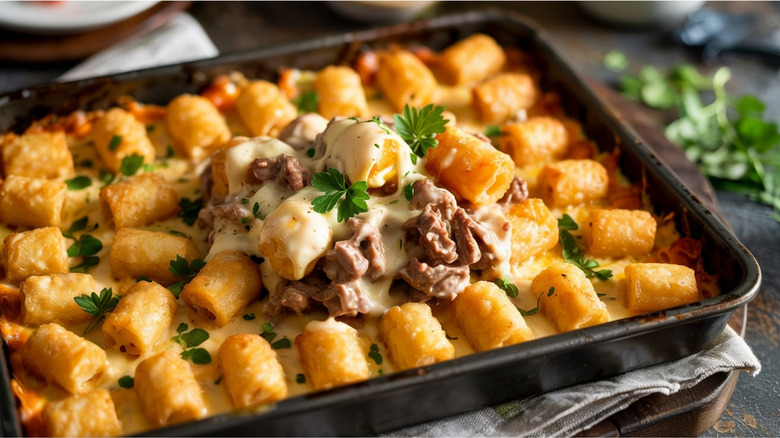
Hot dish is most heavily associated with Minnesota, where everyone's grandma has their own special hot dish recipe that's far better than everyone else's grandma's recipe. Usually, when the topic of hot dish comes up, tater tot hot dish immediately comes to mind. This Minnesotan icon consists of beef mixed with creamy canned soup, canned veggies, and crispy tots on top. Sometimes you'll spot a version loaded with cheddar cheese. But it's not only tots that make their way into hot dish. Minnesota is home to breakfast, ham and cheese, chicken and rice, even Mexican versions of this comfort food classic. Hot dish knows no bounds.
Swiss steak
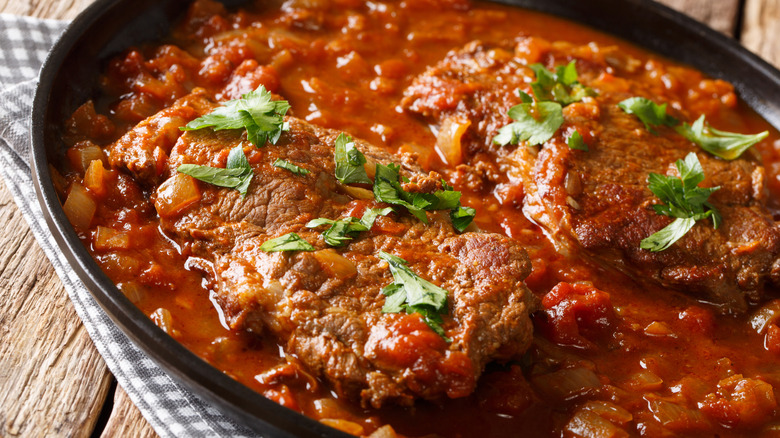
If any region could take a traditional steak-and-potatoes dinner and somehow make it even more hearty and comforting, it's the Midwest — not Switzerland. Despite its name, Swiss steak is actually thought to have come from the Chicago area in the early 1900s. The dish gained popularity around the U.S., particularly in the Midwest, in the 1950s, but eventually fell out of favor with the public. Now it's considered a vintage steak dish — one that might be overdue for a renaissance, if you ask us.
So, if this dish isn't from Switzerland, then where does its name come from? It's thought that Swiss steak gets its name from a unique method called "swissing." "Swissing" is a technique that refers to flattening the meat by pounding it with a mallet or using rollers to make it flat. In the case of Swiss steak, a round steak cut (typically on the tougher side) is sprinkled with seasoned flour and pounded flat with a mallet — or a specialty bladed meat tenderizer — to make the meat more tender and melt-in-your-mouth. It's cooked in butter or oil with tomatoes and onions, and is delicious served over a steaming mountain of mashed potatoes.
Pork tenderloin sandwich
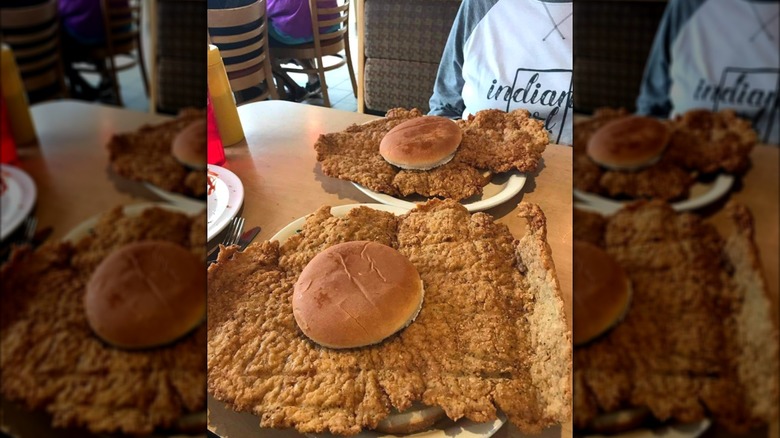
Of all the Midwest's weird, wild, and wonderful dishes, the pork tenderloin sandwich — usually referred to as just "a tenderloin" — is easily the wackiest. At its heart, it's pretty innocuous; it's simply a sandwich with breaded pork and maybe some lettuce, tomato, onion, and condiments on a hamburger bun. But the breaded pork tenderloin sandwich, or BPT for short, gets its legendary appearance from meat butterflied and pounded extremely flat. The breaded pork is so flat and thin that it often exceeds the circumference of the plate that it's served on, further accentuated by a comically small hamburger bun.
If you're looking to take this beast on, you'll probably need to trek out to Indiana, where the BPT is most prevalent. But you might get lucky and find one in Illinois (excluding Chicago), Iowa, and some parts of Missouri.
Most Hoosiers credit Nick Freienstein, owner of Nick's Kitchen in Huntington, Indiana, with the creation of the BPT. The dish takes inspiration from the schnitzel of Germany and Austria, but rather than veal, German immigrants (like Freienstein himself) used pork for the flat, breaded meat since it was more accessible in the U.S. Combine that with America's tendency to create sandwiches out of everything, and you're left with one of the most outlandish meals in all of the Midwest.
Cincinnati chili
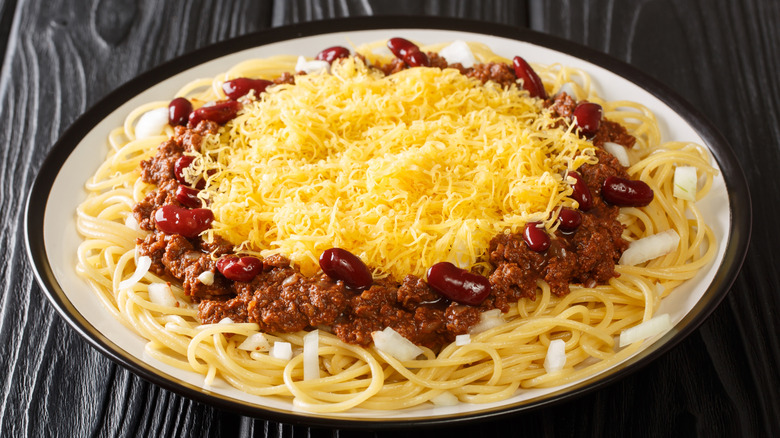
We're not going to pretend that we don't have some reservations regarding Cincinnati chili, but it's a Midwestern legend nonetheless. There are literally entire books written about this stuff, people — check out "The Authentic History of Cincinnati Chili" if you don't believe us. Maybe you need to be an Ohio native to truly appreciate it, because there's a lot (and we mean a lot) going on here, from the dish's history down to its deceivingly innocent appearance.
At first glance, Cincinnati chili looks like some standard meat-and-bean chili and shredded cheese scooped on top of spaghetti noodles. Seems harmless enough. But what makes Cincinnati chili so unique is its use of cinnamon, clove, and nutmeg along with standard chili spices like paprika, chili powder, and cumin. Some recipes include chocolate or cocoa powder in the mix, but there's plenty of debate over whether or not these sweet additions belong in authentic Cincinnati chili.
Cincinnati chili was born to a family of Macedonian immigrants in the 1920s. Brothers Tom and John Kiradjieff set up shop in the downtown area's Empress Burlesk theatre building, where they served their unique concoction inspired by the flavors of their homeland at the Empress Chili Parlor. They poured the fragrant chili over pasta to appeal to the city's large Italian and Greek populations, and the rest was history. The sweet Old World spices married with chili — an established American mainstay — make Cincinnati chili a literal melting pot: a perfect representation of America's immigrant food culture.
Chislic
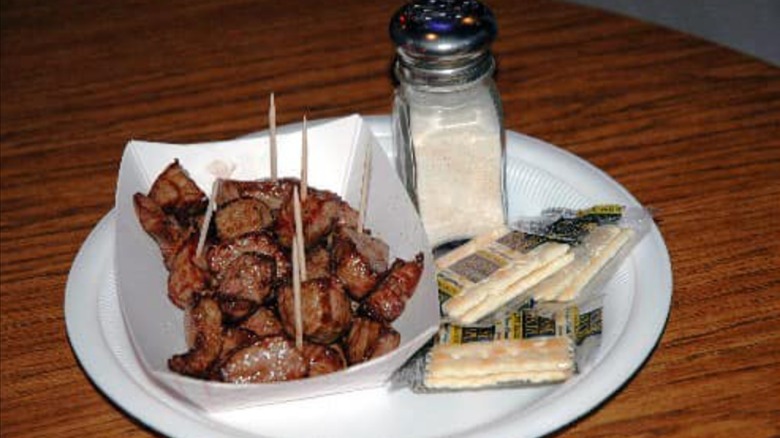
Chislic sounds like it might be complex and unfamiliar, but it's actually the most straightforward dish on this list, and an absolute mainstay in South Dakota. Regions all over the world offer their own take on a grilled meat skewer (kebab, souvlaki, and so on), and chislic is that grilled meat skewer for the Mount Rushmore State. In fact, it's such a hyper-regional dish that most people outside of the Dakotas have never heard of it. It's made with small, bite-sized chunks of meat that are typically deep-fried and coated with a salty seasoning, then threaded onto tiny wooden skewers or served with toothpicks for easy snacking. It usually consists of lamb or mutton, but beef and venison aren't uncommon and still qualify as real, bona fide chislic.
Chislic — brought to SoDak by way of German-Russian immigrants from Crimea — is heavily associated with bars and pub fare. It's almost weird to see someone snacking on this salty meat without an ice-cold brew in their other hand. You'll usually see it served in a small paper basket with some saltine crackers and a dipping sauce on the side. Chislic is so famous in South Dakota that it has its own festival and an entire region of the state dubbed "The Chislic Circle." Freeman, South Dakota, sits inside chislic's sphere of influence, acting as the dish's unofficial capital city since 2005.
Taco pizza
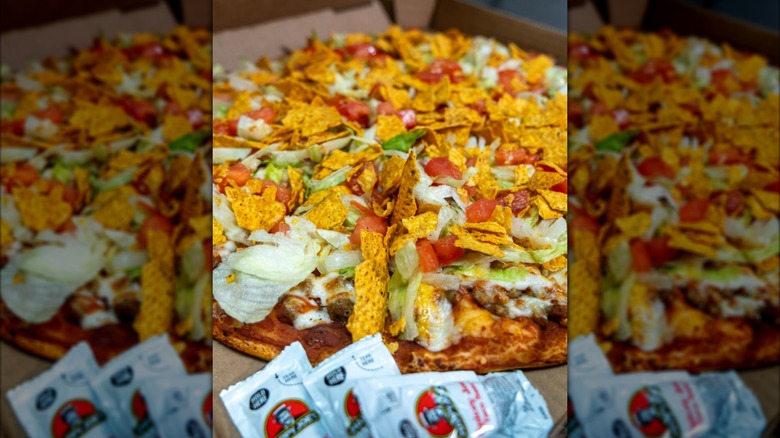
It sounds like something you and your friends might whip up after some "enhanced" kitchen creativity, if you catch our drift. But taco pizza is actually considered by some to be the pinnacle of Midwestern fast food. But not just any old taco pizza counts as a food folk hero of the flyover states. Happy Joe's Pizza is a tiny, Iowa-based chain staking its claim in the creation of the humble taco pie, cementing itself as an Iowa legend since its famous pie was created in the 1970s. Many chains and mom-and-pops alike attempted to create their own version of a Mexican-American-Italian handheld dish, but they could never hold a candle to Happy Joe's original masterpiece — according to your average Iowan, that is.
The taco pizza from Happy Joe's is the focal point of nostalgic memories for just about every Iowa native. It has everything you'd expect: lettuce, tomato, beef, sausage, cheese, and refried beans on a thin, crispy crust with taco sauce packets for drizzling, dunking, or dousing. But the pièce de résistance is the crumbled tortilla chips on top that give the pie its crunch heard 'round the world. These aren't any old tortilla chips: They're specialty taco-flavored chips made exclusively for the Happy Joe's Pizza chain, so good luck trying to copycat this recipe.
Loose meat sandwich
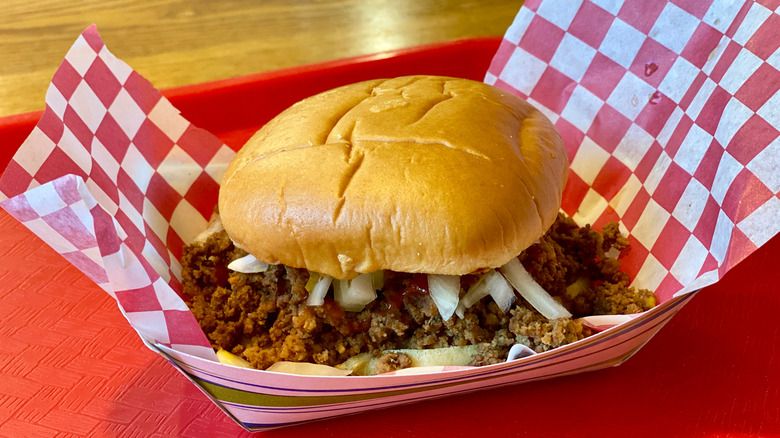
It may not have the most delicious-sounding name, but we implore you to find anyone — Midwestern or not — who wouldn't devour a loose meat sandwich. The loose meat sandwich has a similar vibe to Happy Joe's taco pie (weird, whimsical, with an aesthetic that only a born-and-bred Midwesterner could appreciate), so it should come as no surprise that this legendary dish also hails from Iowa. Legend has it that the sandwich was born to a tavern owner in Sioux City in the 1920s. It was originally dubbed a tavern sandwich, but its modern moniker is a lot more fitting.
A loose meat sandwich is kind of like a hamburger, but the burger patty is swapped out for ground beef. Does this make eating the sandwich a lot more difficult than eating a hamburger? Absolutely. But it's all part of the messy, caution-to-the-wind Iowan experience. A loose meat sandwich usually comes with onions, pickles, and condiments, sans cheese, and is served on a hamburger bun — not too different from the Sloppy Joe sandwich the rest of the country might be more familiar with (minus the tomato sauce). Maid-Rite — an old school sandwich shop chain with a few locations still floating around the Midwest — helped put the loose meat sandwich on the map, although the chain refers to the ground beef sandwiches as "Maid-Rites" (we can imagine as an attempt to be more palatable to Iowa's out-of-town visitors).