

The Microwave Storage Mistake You Didn't Realize You Were Making
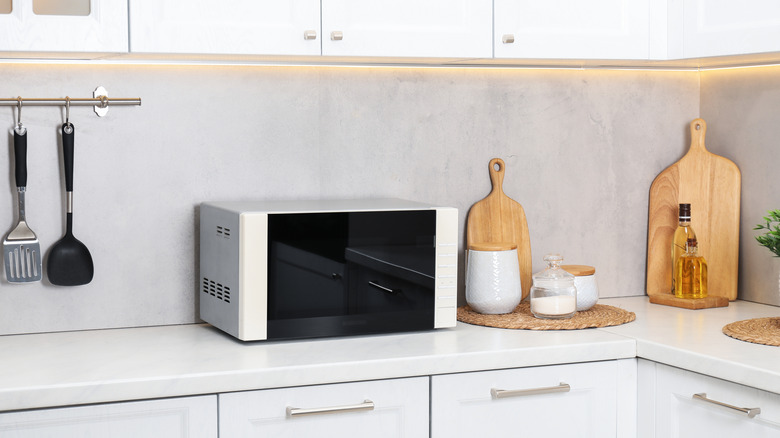
Since their invention in 1945, microwaves have grown to be quintessential kitchen appliances found in more than 90% of American homes, according to the USDA. They offer enormous convenience to daily life, but it is important to care for them properly. That requires more thought and effort than you may think. Perhaps one of the most surprising facts about your microwave is that you're likely storing it incorrectly.
We spoke to Craig Nold, Principal Regulatory Engineer at GE Appliances, about some of the worst places to keep a microwave. The impulse to store it somewhere out of the way and your line of sight — like on top of the refrigerator — is understandable, but Nold says this isn't the best idea for a plethora of reasons. He explained, "First, microwaves should be placed at a height that is easy to access and in accordance with the manufacturer's instructions. For most people, waist to eye level is ideal to avoid spills or burns when moving hot food."
Not only is it potentially dangerous to store your microwave on top of your refrigerator, it can be bad for your appliances, too. Nold continued, "Secondly, it should be placed away from other electronic appliances to avoid electromagnetic interference. Finally, there should be enough space around the microwave, especially around the sides and back, for proper ventilation and the surface should be sturdy enough to support the weight of the microwave with food in it." His final conclusion? The top of the fridge is a definitively bad place to be keeping your microwave for reasons that apply to other common microwave storage spots in the kitchen, too.
How to make sure you're storing your microwave properly
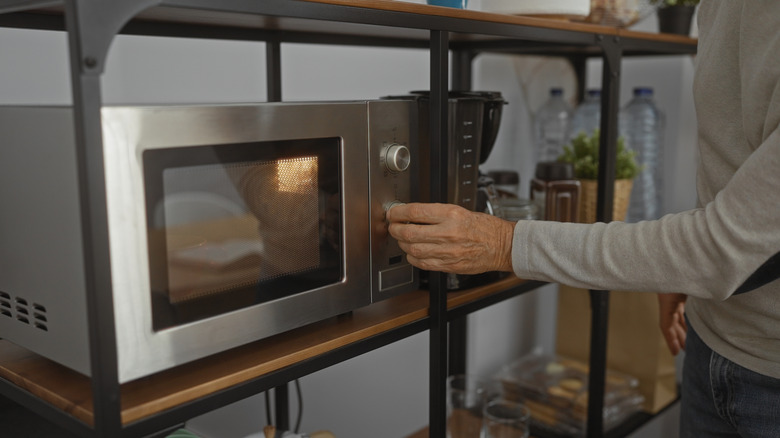
You probably think about the best ways to clean your microwave, but finding the best place to keep it is just as important to the appliance's care and longevity. Craig Nold highlighted some things to avoid when looking for a new spot to keep your microwave.
"Other areas of the kitchen that should definitely be avoided when storing a microwave are near water sources, in enclosed spaces or surfaces that are not level," Nold shared. "To the first point, microwaves are electrical appliances and placing them near water increases the risk of electric shock or short circuits. Water splashes can also damage the internal components of the microwave, leading to malfunction or safety hazards. Secondly, countertop microwaves require adequate ventilation to dissipate heat generated during operation. Placing a microwave in an enclosed space can cause overheating, which may damage the appliance." He also explained that the device shouldn't share outlets with other appliances like refrigerators. Nold further suggested "that users verify that the microwave has its own dedicated electrical circuit to handle its power requirements without overloading other appliances."
So, where should your microwave be stored? We think that one of the best spots to hide your microwave while still keeping it accessible is your pantry. Clear off a shelf near an outlet and use that as the appliance's new home. It frees up valuable counter space while still being right there whenever you need to make a bag of popcorn or warm up some leftovers. If you do decide to install your microwave above your stovetop or inside of a cabinet, make sure you follow all manufacturer's warnings and leave it to the professionals.