

If You Try Using Your Microwave And It Suddenly Stops Working, You May Need A Secret Code To Fix It
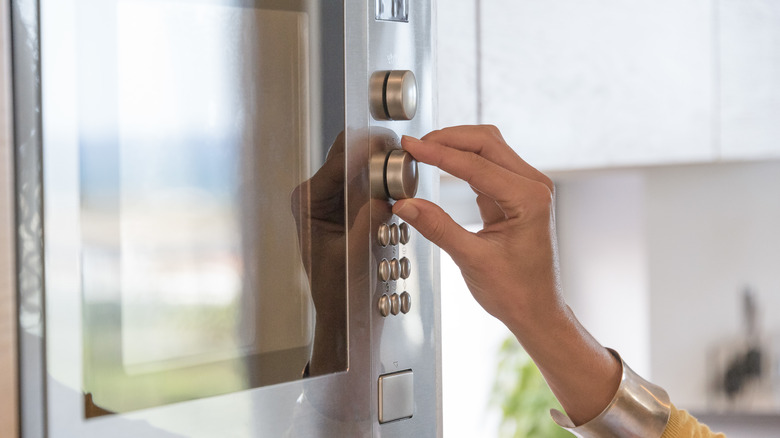
The term "microwave" is synonymous with convenience, delivering fast results with the touch of a button. But nothing's more frustrating than pressing start only to be greeted by silence. Before you throw in the towel and start looking for a replacement device, keep in mind that a malfunction isn't necessarily a breakdown. The simplest reason for the malfunction is that your microwave has locked itself, which may happen because a child safety lock is triggered.
While this is an important safety feature that prevents burns, fire risks, or damage to the microwave itself, it can be frustrating if you don't know how to reset and unlock your device. To solve the problem, you'll need to find a code that regains access, since there usually isn't a "lock" or "unlock" button in plain sight. To get your device working again, locate your microwave's manual in the junk drawer or online, or contact the manufacturer directly if you don't have one on hand.
The exact key combination depends on the type of microwave you have (for example, a countertop model or over-the-range microwave), as well as your machine's specific brand. When in doubt, another option is to unplug the microwave, wait a few seconds, and plug it back in. This feature is not available on all models, and it requires resetting the clock. However, it's a handy way to bypass locating a secret code.
Common secret code patterns to try in a pinch
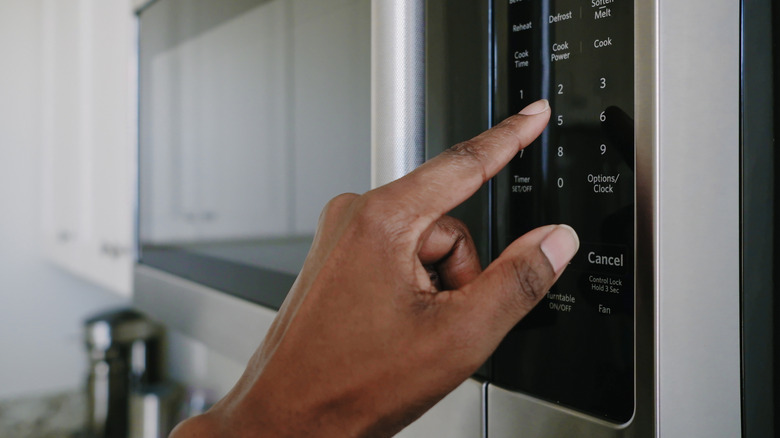
While your exact microwave code will depend on the model you're using, there are a few general patterns that tend to work for each model. GE appliances require you to hold the "pause," "clear," or "off" button for about three seconds or press and hold the numbers "5" and "7" simultaneously for older models. Samsung also has a fairly simple unlock code: hold the "clock" and "more/less" buttons for at least three seconds until the device unlocks.
For those with a KitchenAid microwave, hold down the "cancel" button, and after three seconds, you'll hear two beeps, indicating that your device is now unlocked. Frigidaire's reset process works similarly, but make sure to hold the "cancel" button for five seconds to trigger a reset. Newer models often come with smart features that let you bypass a code entirely. Simply open your device's app or use a voice command with a smart speaker to initiate a reset.
These quick fixes can save you money on kitchen appliances by preventing the need for a trip to a repair shop or the purchase of a new microwave altogether. And once you know your device's code, you can usually lock it using the same pattern. So, not only will you be equipped to solve a keypad issue, but you can also better control usage to keep things safer for children or elderly loved ones.
Other issues that may be preventing your microwave from starting
Of course, your microwave oven's keypad may stall for other reasons, including faulty parts or misuse of your microwave. So, if unlocking it doesn't work, here are the most likely culprits. Firstly, it could be that your number panel is defective, especially if some buttons work while others don't. Alternatively, the main control board may not be functioning correctly. Since this part is necessary for sending voltage to the buttons, you won't be able to get your microwave running if it's damaged or broken. Although the control board can usually be repaired, it may be worth purchasing a new model if your device is already outdated.
When the membrane switch is inoperable, it can also cause issues with the keypad. It consists of several small switches that send signals to the control panel, so if they aren't working, the machine can't detect your inputs. While many of these repairs are possible if you're microwave savvy, it's usually best to bring your oven to a local shop or directly to the manufacturer to determine what's wrong. Also, don't forget to check your warranty, which may cover any issues within a specific timeframe, provided you have your receipt, serial number, and model number. The manufacturer can often repair, exchange, or reissue a new device for you, saving the time and money of troubleshooting if your microwave has a problem beyond an accidental lock.