

How The Classic Sugar Daddy Candy Got Its Name
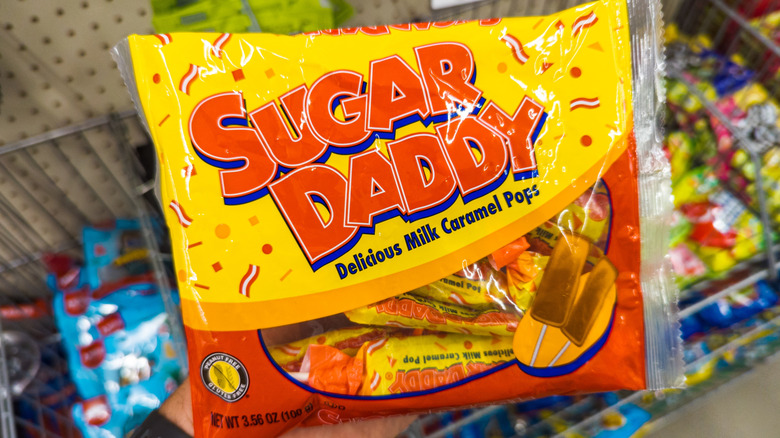
Few candies carry a name as memorable (or as eyebrow raising) as the Sugar Daddy. The retro penny candy was first crafted in 1925 by the Massachusetts-based James O. Welch Candy Company, also responsible for Junior Mints and several other New England confectionary classics. Compared to the sweets of today, the Sugar Daddy is far more simple, lacking any frills or gimmicks. Instead, it is merely a dense, milk caramel pop on a stick, considered the first of its kind. At the same time, its provocative name has endured for a century as one of the most recognizable in the whole candy aisle.
Sugar Daddy was not always adorned with such a head-turning label. When it first debuted, it bore the far-less catchy name "Papa Sucker." But after a few years on the market, the James O. Welch team determined that a rebrand was in order, capitalizing on an already popular phrase. As the legend goes, the term "sugar daddy" itself was first coined in the early 1900s by Adolph Spreckles, a direct descent of the Spreckles Sugar fortune. His partner, Alma, used the phrase to describe Adolph, who was more than 20 years older than her and handsomely providing her with a generous allowance of "sugar," or cold, hard cash. Like so many phrases do, "sugar daddy" evolved over time, and during the Great Depression, it became known for wealthy men who paid young women amid unprecedented financial hardships. In trying times, the company argued the candy brought a "wealth of sweetness."
A whole, sugary family
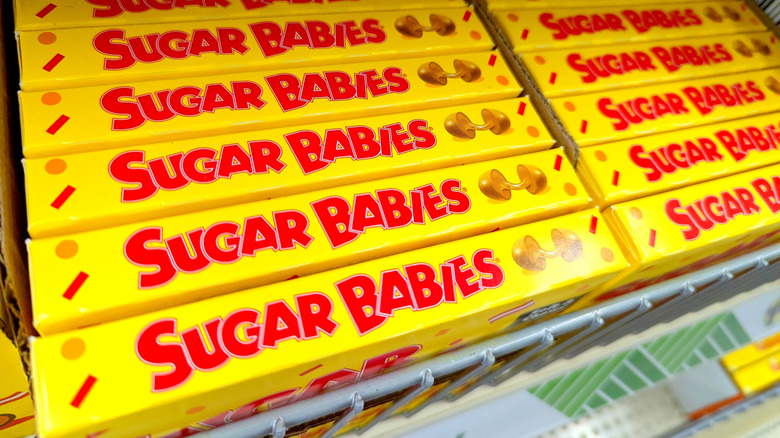
A few years after the now-iconic rebrand, the Sugar Daddy welcomed a new member to its family. Sugar Babies hit the market in 1935, and — as you might have guessed — the candy owes its name to the receiving end of the financially generous relationship, so to speak. It's essentially a bite-sized, candy-coated version of its predecessor, meaning it is so much easier to casually snack on. Unlike the individually wrapped Sugar Daddy, Sugar Babies were served by the bag or box-full, making them a wonderful companion to any trip to the cinema.
Nowadays, you are still likely to find Sugar Babies and Sugar Daddy candies on store shelves. The same cannot be said for the Sugar Mama, a short-lived spin-off of the original. In 1963, Nabisco purchased the James O. Welch company, and with the acquisition came the opportunity to infuse some new life into its older brands. The Sugar Mama, named after the phrase meaning a wealthy older woman who provides financial support to their partner, was launched in 1965, and was simply a chocolate-coated version of the Sugar Daddy lollipop. In theory, the concept should have demonstrated long-term staying power. However, when licked, the chocolate would melt and dissolve into consumers' mouths long before the caramel was soft enough to consume. Nabisco stopped selling the Sugar Mama after about 20 years on the market, making it one of countless discontinued candies of the '80s.