

The Lesser-Known Lettuce That Has To Be Grown In The Dark
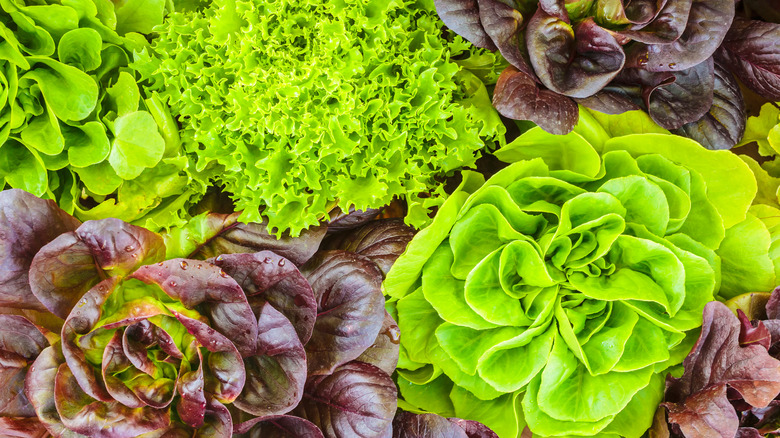
Lettuce is one of the most satisfying crops to grow: it comes up quickly, doesn't demand much space, asks for little in the way of care, and comes in a dizzying range of varieties. All you really need in order for your lettuce to flourish is cool weather and plenty of sun. But there's one curious exception, a lesser-known variety that only grows in complete darkness. Say hello to the Belgian endive, a lettuce that truly stands apart from every other green in your salad bowl.
Unlike most leafy greens, Belgian endive grows in two distinct stages. The first harvest isn't leaves at all, but roots. These are cultivated in the soil through the summer for about four months, until they're strong and well developed. The sturdier the root, the better the chances of coaxing a good second crop. Once mature, the roots are dug up and trimmed, leaving them ready for the next phase, which takes place in complete darkness.
These roots are then packed into sand and placed in warm, humid conditions to force new growth. Over the course of three to four weeks, each root produces a compact head four to six inches long. This is the signature torpedo-shaped head of tightly layered leaves that makes Belgian endive instantly recognizable. It's crucial that the second part of the process happens in absolute darkness, as any exposure to light gives it an overly bitter flavor, which will have to be tempered.
This lettuce was an accidental discovery

This unusual two-step process was discovered by accident in the late 1800s. As the story goes, a Belgian farmer had stored a pile of chicory roots in darkness over winter, intending to use them later as a coffee substitute. To his surprise, the roots began to push out small, pale heads with edible leaves.
At first glance, Belgian endive hardly looks like the kind of leafy green you'd toss into a salad bowl. Instead of open leaves, it grows into tight, pale yellow-white torpedoes, their tips brushed faintly with green. Over the years, though, it has proved itself to be more than just a curiosity. Endives are extremely versatile. They can be used to create show-stopping dinner party salads, roasted and served as an entrée, steamed, caramelized, stirred into soups, or even used as a tiny cup to serve delicate hors d'oeuvres. They're also a powerhouse of nutrition: rich in fiber and phytonutrients, packed with potassium, magnesium, calcium, and copper, and an excellent source of vitamins B6, K, and C. Also, one whole head contains just 87 calories.
Once the star of America's fanciest salads, lettuce — especially iceberg — has got somewhat of a bad reputation when it comes to both flavor (it's been described as "crunchy water") and nutrition (a leading health expert called it "useless" and "pointless"). But the Belgian endive is slowly but surely emerging from the dark shadows to change the narrative.