

The Internal Temperature That Means Your Ribs Are Done
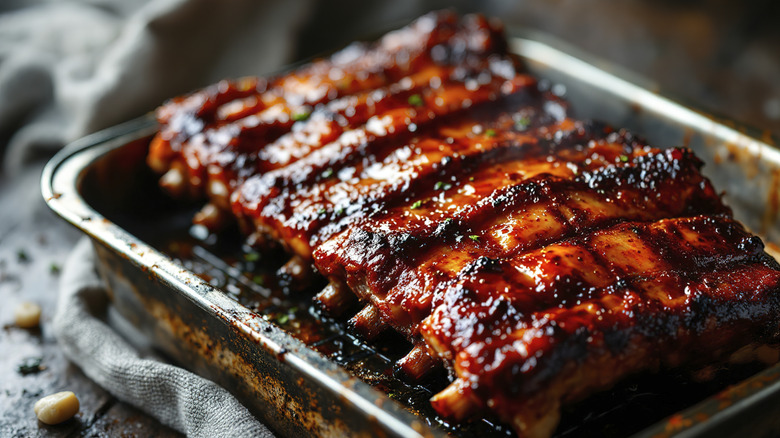
Everybody loves perfectly tender ribs, but few have the patience to wait for the right temperature to cook them that way. Full of connective tissue, ribs demand low and slow cooking, but after hours of waiting, you can be tempted to jump the gun and dig in. The problem is that cooking perfect ribs isn't like other meats; it's a matter of precisely balanced temperature and time. So, we reached out to an expert, Scott Thomas, the owner of The Grillin' Fools, to ask exactly which temperatures you should be aiming for when cooking ribs.
Thomas tells us that you want to aim well past the normal recommended temperature for cooking pork when you're making ribs. "Just because it is safe to eat doesn't mean it's good to eat at 145 degrees Fahrenheit," he explains. "Cuts that have a lot of connective tissue and/or fat and/or collagen are not good at 145 degrees Fahrenheit." Instead, Thomas offers two ranges to aim for, depending on your personal taste. "There are those who love fall-off-the-bone ribs," he notes. "For those folks, 200 degrees Fahrenheit to 205 degrees Fahrenheit."
However, some prefer a tender (but firm) rib that is tender and leaves a clean bite — also known as "competition-style ribs." If that's you, Thomas has another suggestion. "Look at 185 degrees Fahrenheit to 190 degrees Fahrenheit," he explains. "At this temp, the ribs will be plenty tender and juicy, but all the meat won't slide off the bone and slap against the chin on the first bite."
Ribs should be cooked between 185 and 205 degrees depending on your preferred texture
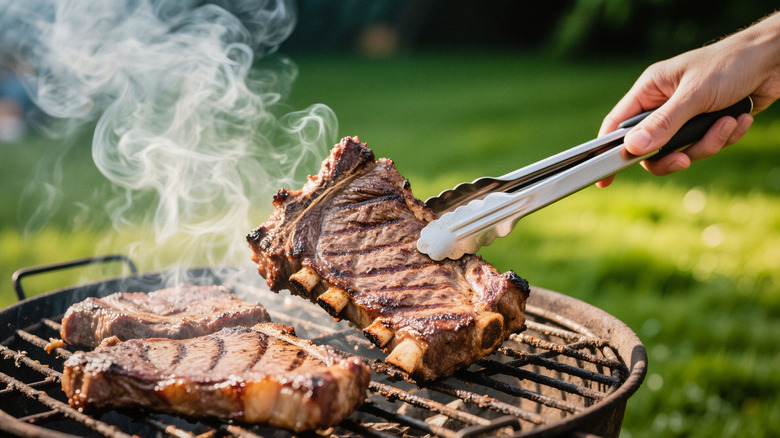
Why such a precise temperature for ribs? It all has to do with collagen, which is what the connective tissue in the meat is made of. While your meat is technically done at 145 degrees Fahrenheit, collagen doesn't start to melt until 160 degrees, at which point it becomes rich, moist gelatin. And even once you hit that temperature, melting collagen takes time. It can be several hours before enough melts into gelatin to make your ribs tender. Thankfully, that gelatin keeps things juicy, even while the temperature in the meat is rising. 185 to 205 degrees is the sweet spot where enough collagen has broken down, but the temperature is still low enough to avoid overcooking your ribs and drying them out.
But you don't have to wait long to dig once your ribs hit that range. While it's good to let ribs rest for a bit so they can reabsorb some lost moisture, Thomas notes that the process is relatively quick. "How long do they need to rest?" he asks. "Just long enough to not burn the fingers when picked up." This can be 10 minutes or less, and since there aren't too many crispy bits to worry about, you can wrap your ribs in foil during the resting process to keep them warm. All these temperatures and tips will work whether you are making ribs in the oven or over a smoking grill, and they'll ensure that you never bite into a tough rib again.