

Don't Let This Common Myth Deter You From Eating Fried Food
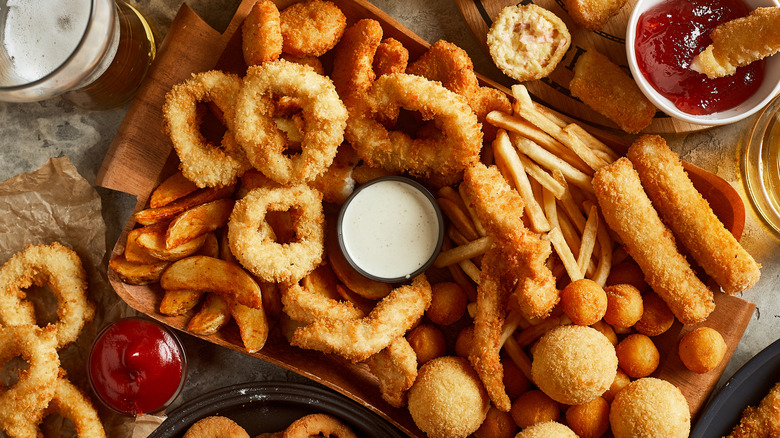
For years now, "greasy" has been one of the go-to terms to describe fast food and, in particular, deep-fried food. References to restaurants described pejoratively as "greasy" date back to the mid-1800s. Fast food is unhealthy because it's so greasy and full of fat, right? That seems reasonable. If you put a basket of chicken or french fries in an entire vat of oil, how could it not end up being greasy? But, when you think about the best fried chicken or fries you've ever had, would you describe them as particularly greasy — or is that how you would describe the bad ones?
The truth is, properly fried foods should not be greasy. That's just a myth. Don't get us wrong, fried food is going to have oil in it. That's impossible to avoid. But there's a difference between your dish absorbing some oil and being considered greasy. According to Oklahoma State University, fried foods absorb 8% to 25% oil when fried in the optimal temperature range between 325 and 375 degrees Fahrenheit. However, if the oil temperature drops too low, excess oil is then absorbed by the food, making your fried chicken greasy.
When food is deep-fried in the right oil and at the right temperature range, the moisture inside the food heats up and becomes steam. It escapes through the food's exterior, and the internal pressure (together with steam release) prevents excessive oil absorption. It's only at low temperatures that the oil can fully penetrate. Most of the oil in well-fried foods enters during the first moments in the fryer, with additional absorption occurring during the cooling process.
The key to reducing grease
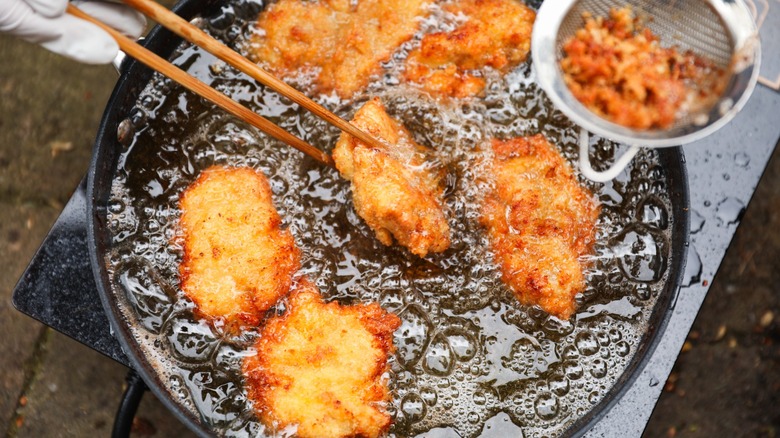
When the temperature of oil is set too low or drops low due to overcrowding, it isn't hot enough for the Maillard reaction to occur, preventing that brown, flavorful crust from forming. This also means that pressure can't build, steam isn't released, and the food absorbs too much oil, ultimately becoming greasy. It could still end up being cooked in the end, but it will have become saturated and unpalatable in the process. Avoid this and many of these other deep-fried myths.
Additionally, you can also use lighter oils to fry your foods to prevent them from feeling as heavy and greasy when they're done. Refined coconut oil is sometimes considered a good option for deep-frying because of its high smoke point. It doesn't break down or oxidize as readily as other oils. However, it is a saturated fat, which may make it undesirable. Refined avocado oil also has a high smoke point but is mostly unsaturated fat, which is considered healthier. Refined safflower and sunflower are good options, but even refined canola, which is much cheaper, can be a healthier choice than lard or peanut oil. Don't forget to filter your oil, too.
One final thing you can do to reduce the potential for greasiness in your deep-fried treats is to remove excess oil. Place your fried foods in a basket or on a tray lined with paper towels (or on a wire rack) to allow excess oil to drip away or be absorbed. Every little bit helps to ensure a tasty, but not greasy, bite.