

When It's Not Like Mom's: The Reason You Can't Get That Treasured Family Recipe To Taste The Same
We may receive a commission on purchases made from links.
It's hard to explain how you feel when you finish cooking a beloved childhood dish for the first time and something is off. Maybe it was something your mother made, one of your grandma's old recipes, or a family secret that only comes out during the holidays. A dish that is tied to feelings of family, comfort, and tradition. You finally got the recipe, you followed it exactly, and the dish you made is just wrong. It might not even be bad — but it's not right. You look over the instructions again and you can't figure out what happened. The problem may not be you or even the recipe. The problem might be your measuring spoons.
There's no regulation governing measuring cups and measuring spoons. We take it for granted that when we buy a set, they're going to be accurate. If it says one tablespoon, we expect it to hold exactly one tablespoon. But research has shown this is not always the case. Unless you have a calibration-certified set of spoons and cups that guarantee they are correct, they could be off by a little bit or even a lot. Some cups are off by a quarter of an ounce, tablespoons by a third, and overall measurements by as much as 30%. As you might expect, this is often a "you get what you pay for" situation.
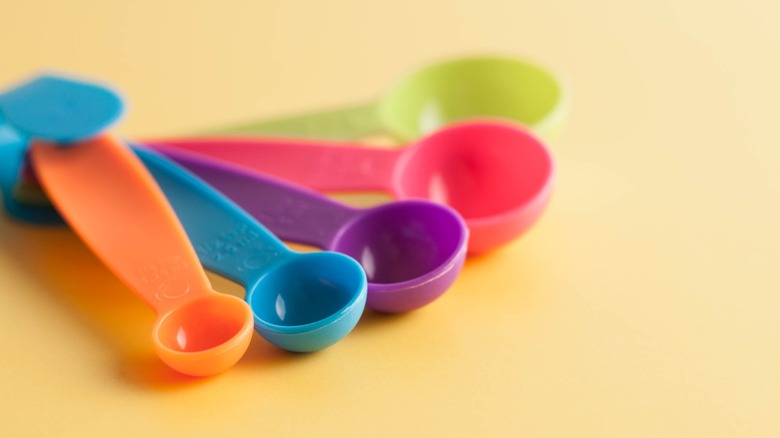
Cheap measuring spoons from dollar stores are often the least accurate. This is especially true if they are plastic, since the shape can change during the molding process and throw the final measurement off. They can also crack, bend, and suffer damage that renders them inaccurate.
Getting your measurements right
If you're not sure your measuring cups and measuring spoons are accurate, all hope is not lost. For many recipes, this might not matter. If you're adding a teaspoon of salt to your spaghetti sauce, a little more or less probably won't hurt the final product. But if you're baking and need precise measurements and ratios of sugar to yeast, you need accuracy. For those measurements, you should really be using a scale rather than just measuring cups.
For measuring spoons, you need to invest in a reliable set. Look for stainless steel rather than plastic. Thin metal spoons can warp as well, so don't be fooled by cheap aluminum ones. When you can, test your spoons to make sure they are accurate. It takes a few minutes, but it's worth the time. A tablespoon is three teaspoons, so can you use the teaspoon three times to fill the tablespoon. You can test all of your spoons this way to ensure they measure accurately. A sensitive digital kitchen scale that measures milligrams can also be used. The weight of a teaspoon of salt should be close to 6 grams.
Having accurate tools in the kitchen can get you one step closer to making that perfect dish. There is one caveat to keep in mind here. If you're still struggling to recreate your grandma's recipe, maybe her measuring spoons were inaccurate too. You might need her exact tools to get the same result.