

The International Origins Of The Word 'Coffee'
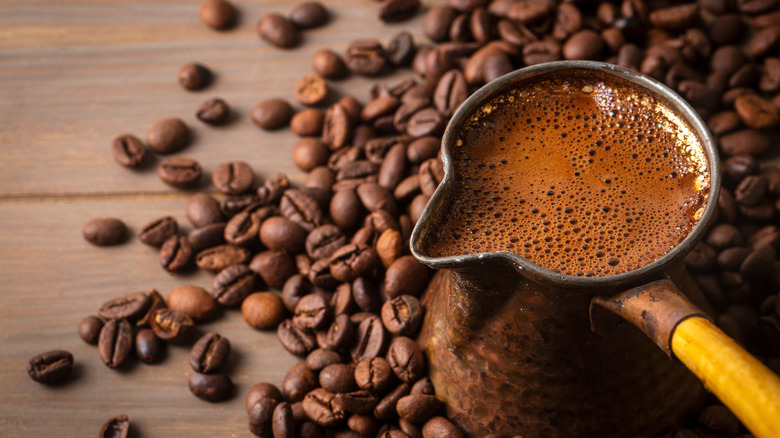
If you're a coffee lover, you may be more likely to ask what's in a cup of joe, rather than what's in a name. But learning the roots of our favorite food and drink can bring more meaning to simple joys like sipping a latte. For instance, the English word "coffee," as well as the customs, proliferation, and daily rituals related to the roasted bean drink has international origins as rich and nuanced as the beverage. According to Etymology Online, the word itself likely originated around 1600 from the Dutch word "koffie," which is said to have been derived from the Turkish and Arabic names for the steamy drink, "kahve" and "qahwa" respectively.
Further, the historic origins of roasting coffee beans span all the way back to 15th century East Africa and the Middle East. So, it's also possible the word "coffee" could be linked to the Kaffa region of Ethiopia, where the seeds from coffee plants (Coffea arabica) were roasted and ground to form the flavorful drink, referred to as "buna." In the 16th century, drinking coffee became commonplace in Ethiopia, where it was (and still is) the center of ceremonial traditions, and also in countries like Turkey, where fortune-telling customs evolved around the beverage. Records show that coffee was shipped to Europe in the 1600s, where it reached Amsterdam and later became "koffie." It then spread throughout the Netherlands and other European countries like France and England, where the name evolved into other dialectal variations, including the English word "coffee."
The proliferation of coffee, in vernacular and custom

Though your barista-made cortado may seem as ubiquitous as the beans used to make it, it's important to remember coffee's Arabic and African beginnings — both in the origin of the word and the development of the drink. Throughout the 1600s, coffeehouses began cropping up all around Europe. The Grand Cafe and Queen's Lane Coffee House were reportedly established in Oxford, England, in the 1650s, likely giving way to the name "coffee" and its proliferation in the English-speaking country. Soon after, coffee made its way to the U.S. and other regions of the Americas, with patterns of colonization, agriculture, and trade. Eventually, the bitter drink became a staple in homes and cafes worldwide.
Today, coffee can take on many different names and forms. Whether you're in Argentina ordering a café con leche, or Italy ordering your caffé in the form of a traditional breakfast of cappuccino and bread or pastries, the beverage is a staple across lives and cultures. Coffee in Turkey (referred to as "kahvesi" or "kahve") can even take on different names depending on the occasion for drinking it, from morning to simple enjoyment to fatigue. Though the drink can take on many translations, forms, and origins — from espresso to drip to traditional renditions of preparation — at the end of the day (or rather, in the morning), coffee is coffee. It will always be unique, specific, and likely called something different, depending on the region.