

The Word 'Lobster' Is Built Upon The Crustacean's Creepy Appearance
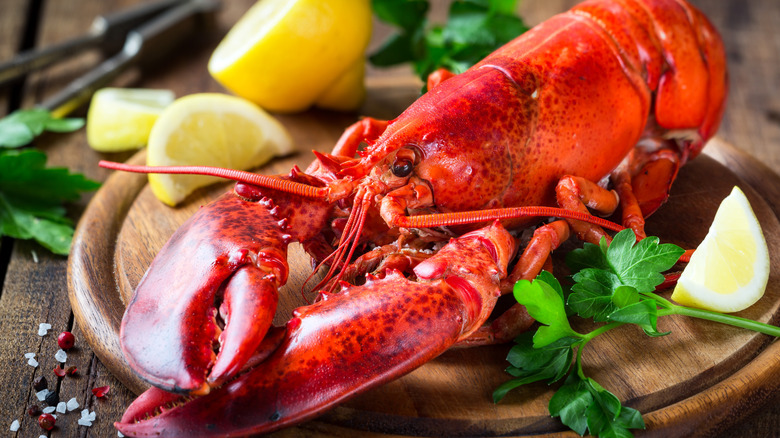
The lobster: Jurassic sea bugs donned in hard-shelled pinchers, no shortage of wiggly little legs, and exoskeleton for gourmands to spelunk with a nutcracker. They're a little alien-like, and a little insect-like, with their pairs of jointed legs, antennae, and eyeballs that sit perched on stalks. Still, their bugginess makes them no less delicious, from buttery lobster rolls to steakhouse-worthy lobster mac and cheese. But the point stands that lobsters look pretty creepy — and it's for this aura that the creature first got its name.
Lobsters look like prehistoric creatures of the past, before the since-evolved oceanic aliens of the Cretaceous period started spurting legs and crawling onto land. Indeed, when the lobster did make it onto land, the ancient Romans started calling the lobster "locusta," the same word they used for locusts. Throughout time immemorial, humanity has looked at lobsters and thought "sea bug." During the Middle Ages, the French similarly extended the same word to both creatures (langouste, later langoustine). The anglicized version of the Latin "locusta" first emerged as "lopystre" or "loppestre" in the medieval English language, an ostensible fusion with the Old English "lopp" meaning "spider" (an apt comparison). Today, the Spanish language still calls lobsters and locusts by the same name (langosta).
The chief taxonomical caveat here is that lobsters are classified as crustaceans, and crustaceans are not insects ... right? In reality, beyond their in-water versus on-land dwellings, the difference between these groups is actually fairly minimal.
Foodies have been likening lobsters to insects for centuries
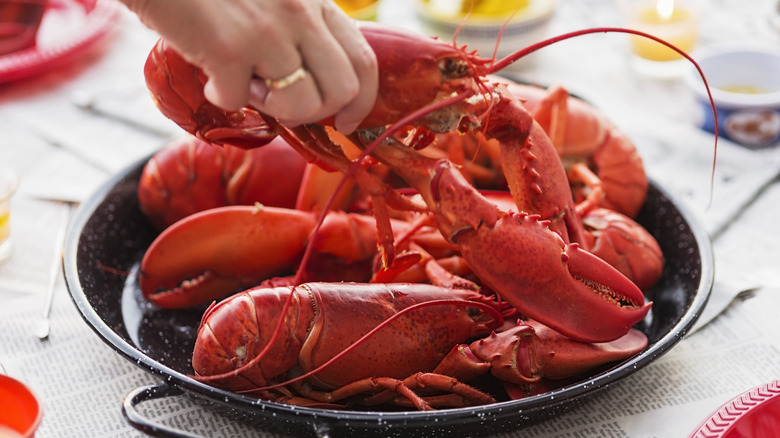
In David Foster Wallace's landmark essay "Consider the Lobster," the author notes, "[A] crustacean [like the lobster] is an aquatic arthropod of the class Crustacea ... of the phylum Arthropoda, which phylum covers insects, spiders, crustaceans, and centipedes/millipedes, all of whose main commonality, besides the absence of a centralized brain-spine assembly, is a chitinous exoskeleton composed of segments, to which appendages are articulated in pairs. The point is that lobsters are basically giant sea-insects." Also not helping lobsters beat the bug allegations is their nickname as the "cockroaches of the sea," thusly called because lobsters are bottom feeders and scavengers. Notably, most insects do not have claws or tails, both of which are defining features of the lobster. Although, like roaches, lobsters need to molt their exoskeletons as they grow.
Crawly appearance notwithstanding (or, rather, in tandem with any creepiness), epicures still prize the lobster for its knockout flavor and tenderness. In the iconic lobster-cooking scene from "Annie Hall" (1977), protagonist Alvy Singer exclaims, "One crawled behind the refrigerator! It'll end up in our bed at night! ... We should have gotten steaks, they don't have legs. They don't run around." Either way, according to USDA data, foodies in the U.S. consumed an impressive 20.5 pounds of seafood per person on average in 2021 — so, let the buggy comparisons roll. If "sea bug" is just fine in your book, thank you very much, we've rounded up 10 lobster recipes that seafood lovers will adore.