

The Beloved Childhood Cereal That's Actually Gluten-Free

We may receive a commission on purchases made from links.
Breakfast doesn't have to be a headache, even if you're trying to reduce your gluten intake or have celiac disease. There are plenty of cereal brands out there that are gluten-free, and all you've got to do is pick your favorite, give 'em a splash of milk, and tuck in. The last time our team did a review of these brands, though, a beloved childhood cereal surprisingly came second: Lucky Charms – and with oats being a key ingredient of this colorful cereal, you're probably very surprised to hear that it's actually gluten-free.
Pure oats themselves don't contain any gluten. However, during production, traces of gluten-containing grains such as barley, wheat, and rye could be mixed in and render them unsafe. In fact, very often, oats are produced on fields that rotate between oats and wheat, which is why oats are often put into the "best be wary of" bucket for celiacs.
General Mills — the company behind Lucky Charms — did admit that there could be cross-contamination during production even if gluten isn't listed on the label. However, the company did explain that the oats used in Lucky Charms undergo a sifting process to remove any gluten contamination, which is how they're confident enough to tack the "gluten-free" phrase on the label.
The process through which Lucky Charms becomes gluten-free
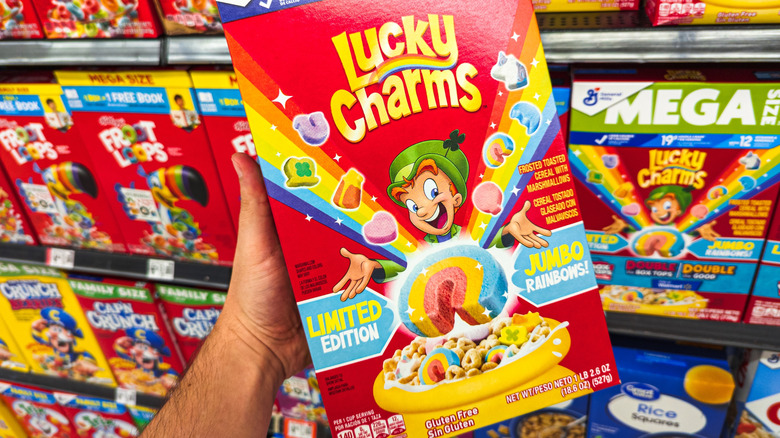
Gluten-free doesn't actually mean "absolutely zero trace of gluten." Instead, for most food producers, it's making the concentration of gluten in the food so low that it'd have a negligible effect on health — typically, this is below 20 million parts per million (ppm) according to the National Celiac Association. That's the first thing General Mills did: testing the oats to make sure it's below this limit. The company doesn't mention specifically how they managed to do it, but, per the Gluten Intolerance Group, other than ensuring the oats are grown in a gluten-free environment, they may use machines to separate oats (which have distinct shape, size, and color) from gluten-containing grains.
In any case, after ensuring that it's below 20 ppm, the company did another test after the oats are milled into oat flour, which is shipped to Lucky Charms factories using "dedicated gluten-free trucks and rail cars." Lastly, after the Lucky Charms cereals are produced, they're checked one last time for gluten before they're boxed and shipped off. That's how, in the lower right of the box, you'll find the term "gluten free."
But if you go outside of the U.S. (into Canada, for example), and buy a box of Lucky Charms there, you'll find this phrase suspiciously missing. What's the deal?
Lucky Charms' gluten-free label isn't as ironclad as they'd have you believe
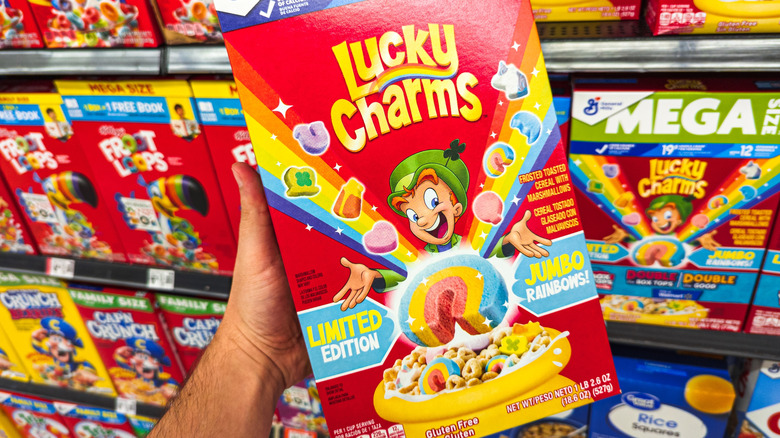
Lucky Charms isn't certified by any authority, such as the Gluten-Free Certification Organization (GFCO), to be truly gluten-free or celiac-safe. Despite the procedures in place to minimize contamination, you basically have to take their word for it that the gluten concentration in the box is safe. For exactly this reason, in most other markets outside of the U.S., General Mills isn't allowed to put the "gluten-free" phrase on the box.
We've taken a look at reviews online, and lots of celiacs, such as this Reddit user, have reported that they were symptomatic after eating Lucky Charms. However, there are others who reported that they're able to eat Lucky Charms just fine. It's up to you to decide if you'd like to bet on Lucky Charms or not ... but just bear in mind that it's not as safe an option as General Mills said it is.
If you want to leave absolutely nothing to chance, your best bet is to buy cereals that are certified gluten-free or celiac-safe, so brands like Nature's Path Organic Whole O's Cereal and Organic Hazelnut Cocoa Pillows from 365 by Whole Foods Market. They may be slightly more expensive and don't have the nostalgic factor as Lucky Charms or Froot Loops — but hey, peace of mind is priceless.