

Green Goddess Dressing Owes Its Name To A Hollywood Role Better Left Behind
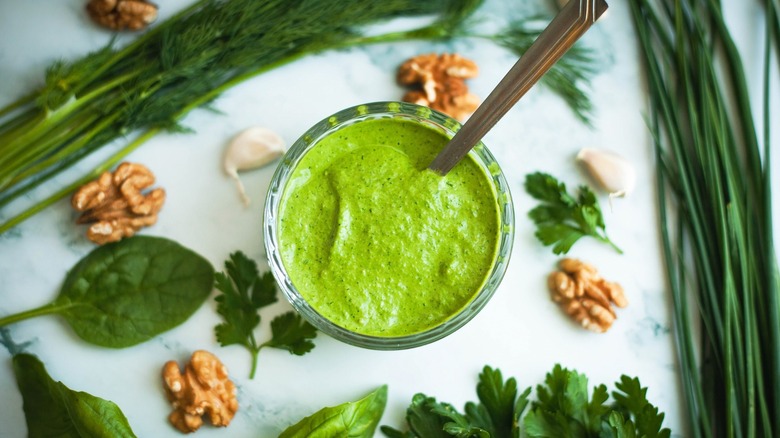
When you want a fresh, herbal, creamy complexity in your salad, ranch dressing just isn't going to cut it. Green Goddess is a standout simply because of the vibrancy the recipe brings to a dish. Still highly underrated when compared to mainstays like Italian or a vinaigrette, what few people know is that it was named in honor of 1921 "The Green Goddess" play that starred George Arliss. According to KQED, Arliss was staying at the Palace Hotel in San Francisco sometime during the play's initial run, and head chef Phillip Roemer created the traditional Green Goddess dressing recipe in honor of the star.
The hotel has changed its recipe significantly in the last century, specifically using olive oil rather than mayonnaise along with tarragon vinegar, Dijon, capers, and other bold flavors. But Roemer's version was mayonnaise-forward and served on top of a canned artichoke, which was considered something opulent in 1923. But where things get especially unsettling is in the original play itself, where Arliss played Raja of Rukh. While the character is meant to be Indian, Arliss was a white British actor. He reprised the role in 1923 in the silent film adaptation and then again in the 1930 sound remake, but each version essentially had Arliss in brownface. While he won the Academy Award for Best Actor for the part in 1930, it comes across as highly problematic these days.
Typically, works with racist roots struggle to thrive. Even the silent "The Green Goddess" is loaded with offensive stereotypes and imagery. Reviews are not kind either, since modern audiences see the racism, colonialism, and poor storytelling as major flaws. While the play was an absolute hit in 1921, with over 400 performances, making it what Vanity Fair called "the most exciting melodrama of the season."
The impact of Green Goddess
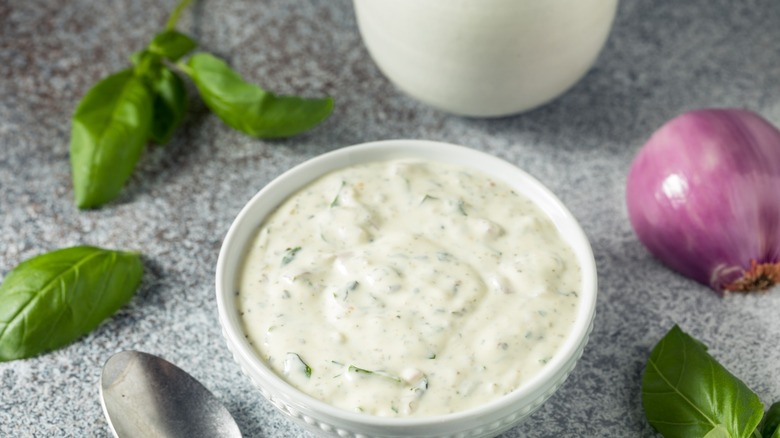
Copycat Green Goddess recipes showed up in the 1930s, speaking to its popularity. Bottled versions hit stores in the late 1960s, and by the '70s, new recipes were everywhere. By this time, the film was decades old, and, in a world without physical media or streaming, it was largely forgotten. But the dressing persevered and over time was adapted to dishes like a Green Goddess sandwich and Green Goddess baked chicken.
A traditional Green Goddess dressing has mayonnaise and lemon juice as its base. It often includes fresh herbs like tarragon, parsley, or chives as well, along with sour cream and anchovies. Some versions call for onion and garlic too. One very dated recipe from 1949 cautions not to include too much onion if it's being served to ladies, since they apparently don't enjoy onion as much as men.
Green Goddess is still seen by some as old-fashioned, but in recent years its popularity has risen again with its focus on fresh, healthy ingredients that contrasts with dressings like ranch, which are often perceived as less healthy. Food industry titans like Rachael Ray, Martha Stewart, and Ina Garten have all shared their own recipes. Even though the history gets a little ugly, the recipe rises above its murky origins to be something delicious and memorable.