

Why This 140-Year-Old Condiment Has Yet To Make A Big Splash In America
We may receive a commission on purchases made from links.
The Maggi brand started in Switzerland in 1886 as an alternative to using expensive meat products or lengthy braising times. It began with powdered soups, followed by a liquid seasoning, and was later bought by food giant Nestlé in 1947. It's difficult to overstate the popularity of the seasoning, but according to Maggi's website, the brand's wide array of products were used 4,600 times globally every second during the 2000s. Maggi's products now include everything from instant noodles to bouillon cubes, but the liquid Maggi Seasoning — available on Amazon — is the most prolific worldwide, recognizable by its red and yellow label and dark bottle. Despite massive success around the world, Maggi hasn't taken off in the United States as it has in Africa, Asia, and beyond.
There are a few reasons Maggi isn't as widely popular in the United States as it is globally. The first is that it was simply later to market than its early competitor, Lea & Perrins Worcestershire Sauce, which had already become popular in America in the mid-1800s. Secondly, Maggi was made to replicate the taste of meat without the need for costly animal parts, while Americans (as well as Canadians) were generally able to afford more meat than other populations around the world. Today, Americans are eating about twice as much meat now as they were 100 years ago, consuming an average of around 317 pounds of meat per person in 2022 (per Our World In Data). With so much meat in daily diets, the need for rich, meaty seasonings is not as prevalent.
Maggi brings a bit of magic to food
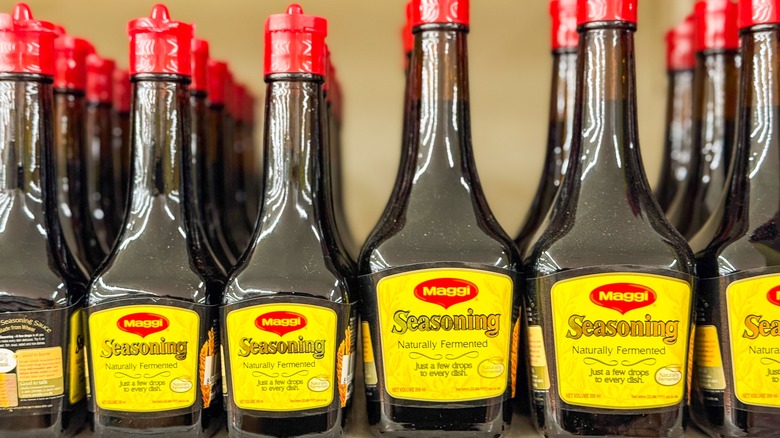
Maggi seasoning transcends culinary borders — it's made and sold around the world in over 15 countries. Maggi tweaks its recipes ever so slightly depending on where the product is being sold, so the seasoning varies from country to country. The names also change, but the Maggi brand itself is constant.
The uses for Maggi seasoning are endless. Personally, I think that even the most garnished michelada is not complete without a dash of Maggi, as it imparts a boost of umami that's difficult to achieve without it. You can swap Maggi seasoning for pantry staples like Worcestershire, fish sauce, and soy sauce. If you can't find Maggi, Bragg's liquid seasoning is a decent substitute, but it's not quite as potent.
One thing to note is that Maggi seasoning is not gluten-free, as it's made with fermented wheat proteins. Some Maggi seasonings and products get their flavor from MSG, the king of umami, which contributes to the hard-to-describe but meaty, rich, salty flavor it adds to food. Maggi is also fairly high in sodium, so it can be overpowering when used in excess, but thankfully a little goes a long way in flavoring a dish.