

How To Clean Pans With Bar Keepers Friend Without Leaving Powder Behind
We may receive a commission on purchases made from links.
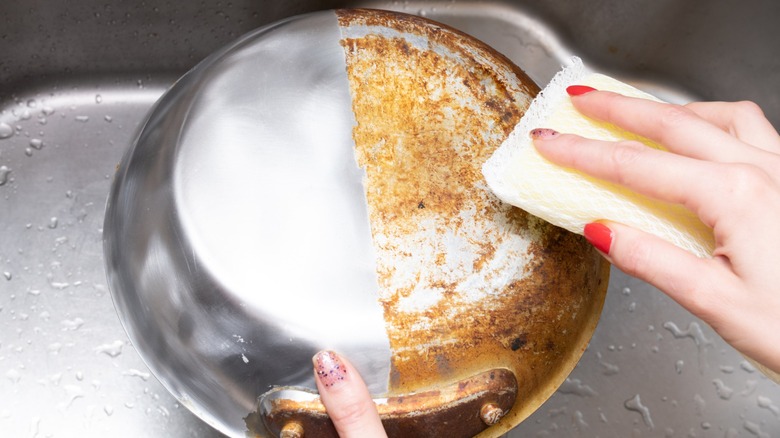
If you spend enough time in any kitchen, you will see the grim fate of many pots and pans. A baked-on black coating builds up over time until you can barely tell if the pan was stainless steel, nonstick, or enamel. You can still wash it to the point that it's clean and usable, but that carbon buildup is almost impossible to remove with traditional cleansers and sponges. That's where a product like Bar Keepers Friend comes in. Although it's formulated to remove the most stubborn baked-on stains, some people have trouble getting the residue off once they use it. Luckily, there's a solution for that. During a Reddit AMA hosted by the Bar Keepers Friend marketing team, the brand helped out some users who had tried the product but swapped one mess for another.
The problem was that the powdered cleanser left residue on the pan even after it had been rinsed. According to the team, residue happens when too much cleaner is used for the size of the pan or when the pan isn't rinsed thoroughly. Ironically, if it's dried on and you can feel it with your fingers, the solution is a little more Bar Keepers Friend Superior Cleaner and Polish. Just use a bit this time, along with a non-scratching sponge and a thorough rinse in warm water. The brand also suggests using a microfiber cloth as an option. Part of the problem is that poor water pressure may prevent full rinsing. Because this stuff is designed to remove serious stains, it has some bulk to it. That means removing the residue takes a little elbow grease, too.
What is Bar Keepers Friend?
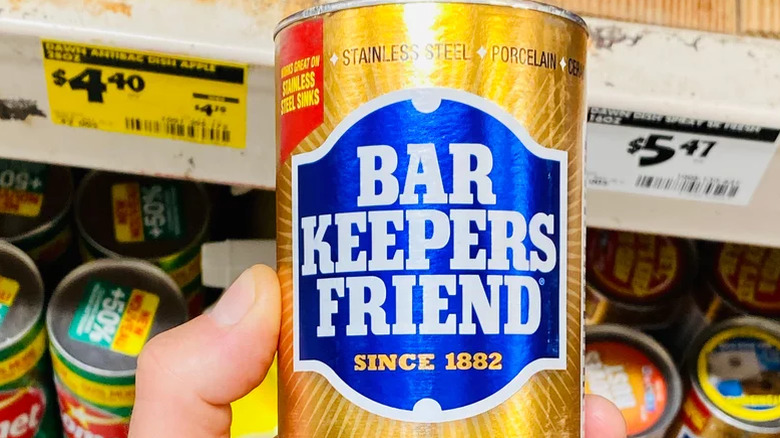
A dish soap like Palmolive contains mostly surfactants and detergents, thickeners, anti-streaking solutions, and stabilizers. On the contrary, Bar Keepers Friend is mostly made of glass oxide abrasive and oxalic acid with a surfactant, making it one of the best kitchen cleaners you can buy. The glass oxide is a strong abrasive to scour baked-on stains and grime, while oxalic acid, which comes from plants, can dissolve rust and tarnish to give surfaces that like-new look. Even chefs like Michael Symon recommend using it to clean Dutch ovens. Just remember it's not safe for every surface. The Bar Keepers Friend website warns not to use it on gold or silver, painted surfaces, or polished stone.
It's often harder to gauge how much powder you're using compared to a liquid. On a wet surface, the powder may dissolve and become harder to see. As the team said in their AMA, less is more when it comes to using Bar Keepers Friend. You'll prevent that buildup of residue by being conservative with your use. If you happen to need more, you can always add a little extra. As with cooking, it's easier to add something than to take it away if you use too much. It may just be that you need a little trial and error to determine how much powder you need for any given job. Good water pressure, thorough rinsing, and a non-scratching sponge or cloth should be all you need to ensure nothing is left behind when you're done cleaning.