

9 Absolute Best Apple Varieties For Pie
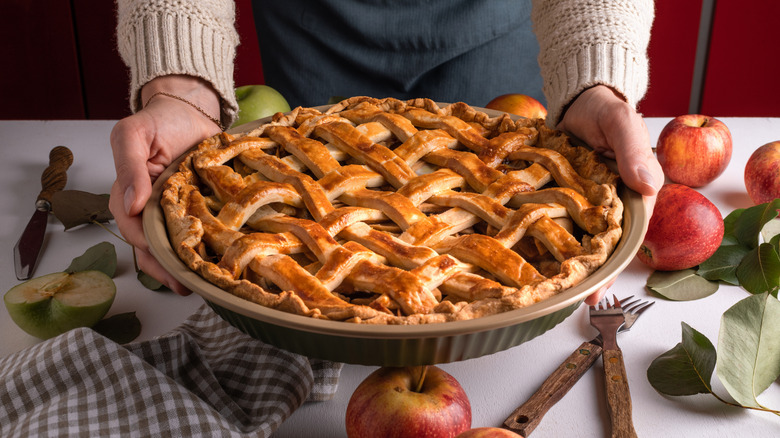
Nothing makes a kitchen smell more like fall than an apple pie in the oven. Folks may be divided on what constitutes the best apple pie — some like their pies soft, while others prefer them crisp — but it's hard not to fall in love with any combination of cinnamon, nutmeg, apples, and pastry crust. There are a few things you should keep in mind when making apple pie, but the biggest decision remains which apple varieties to include. Do you want your pie to be sweet or tart? Al dente and chewy or creamy and soft?
If you are buying apples directly from a farmer, you should ask for recommendations. If you are shopping from the grocery store, however, you'll need to research in advance. Growing up in the foothills of the Appalachian Mountains, my family and I would pick our own apples every fall and use them to make apple butter, applesauce, and, of course, apple pie. I have continued to bake them into adulthood for my job, as well as in my home kitchen.
In this article, we'll go through some of the most popular apple varieties available in the United States, providing notes on flavor, texture, growing regions, seasonality, and storage. As a rule of thumb, you can combine up to three varieties in a single baked good, to ensure the pie is well-rounded and has a wide range of flavors and textures. At the end of the day, though, so much of what makes a great apple pie is up to personal preference, so feel free to experiment — you can never have too much pie!
Northern Spy
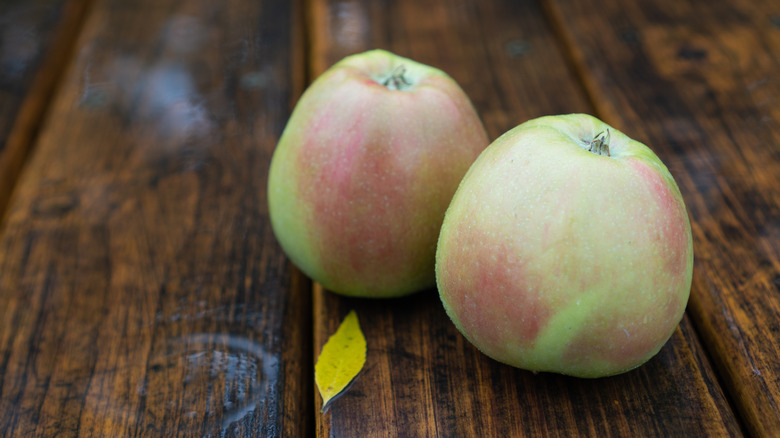
Depending on where you grew up, you may have heard your grandparents say, "spies for pies." atchphrases like this were common when Northern Spy apples (also called Northern Pie apples) were in their heyday. Northern Spies received their fair share of media attention during the 19th and 20th centuries, especially when Senator Joseph McCarthy posed for a photograph with a box that had been sent to him by the Toronto Globe and Mail in 1953. Though the gift seems to have been a reference to rumors that communist spies were operating in Canada, it is true that this apple variety thrives in northern latitudes. Northern Spies are sweet with a hint of tartness, and they feature a strong, cider-like flavor. Plus, the slices retain their shape once baked.
The harvest season for Northern Spy apples occurs from the tail end of October until the beginning of November, so once you have eaten all your early fall apples, Northern Spies are an ideal choice for Thanksgiving and Christmas pies. The only problem is that, depending on where you live, it may be difficult to get your hands on this heirloom variety. Northern Spies were first bred in New England in the early 1800s, and aren't well suited to other climates. Today, they are widely available in the Northeast and the northern latitudes of the Midwest, but not so much elsewhere. Additionally, they are easily bruised when transported and therefore not popular among commercial vendors. Luckily, Northern Spy apples star in Trader Joe's Teeny Tiny Apple Pies, giving consumers nationwide a chance to revel in their flavors.
Braeburn
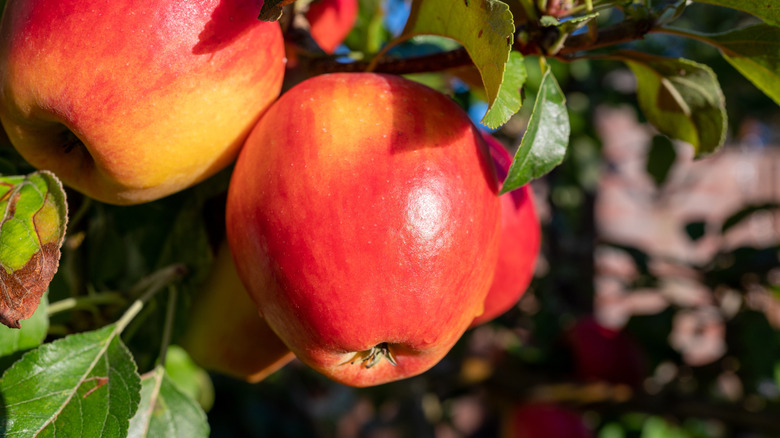
For a crisp apple pie, turn to Braeburns. Their ability to retain a substantial amount of shape is why this variety is commonly recommended for making compote. Additionally, Braeburns are neither too sweet nor too tart, making it a crowd-pleasing variety. You may be able to detect a slight citrus aroma in these apples, plus a pear-like flavor that arises after their stint in the oven. The flavor of a Braeburn is also reminiscent of cinnamon and nutmeg, helping elevate two autumnal spices that you'll probably be including in your pie anyway. Braeburns are bi-colored apples, meaning their skin can vary along the spectrum from green to brown and red. Generally, the Braeburns that will give you your money's worth are the ones that feature a pink to red hue alongside a yellow-green base.
One reason why I recommend using these apples in pie is that they are a commercial variety common enough to be found in many grocery stores across the country. After all, Braeburns are grown in both hemispheres, and their tough skin makes them good candidates for shipping. As a result, they are more regularly available than other apple varieties. Of course, if you can find Braeburns from a local farmer, that's even better. You'll have better odds of this in the Pacific Northwest, especially in the state of Washington. However, even there, they are far from being the most common apple variety. It's best to bake these apples into your pies sooner rather than later, lest they lose their flavor in your refrigerator.
Golden Delicious
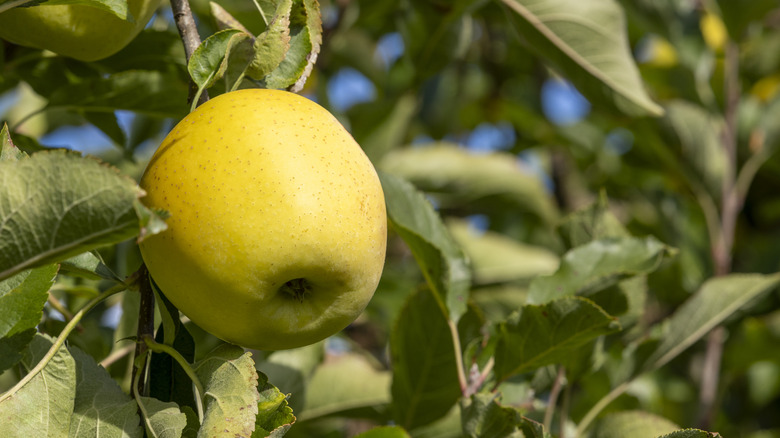
For a more buttery flavored pie filling, use West Virginia's state fruit: the Golden Delicious apple. This mellow variety is relatively low in acidity and tastes sweet, offering hints of honey and even warm spice. A bit of tartness rounds it all out. Though Golden Delicious apples tolerate warm climates, the cooler the growing environment, the sweeter the apple. For the most flavorful pie, use truly golden apples — green ones are likely underripe. You should be able to detect this apple's lovely fragrance, too; Its aroma is partly why Golden Delicious is one of my favorite baking apples (who needs candles when you can have pie?). Because Golden Delicious apples offer so many tasting notes, they can be the only variety in a pie. However, I still recommend pairing them with a variety like Braeburns for textural contrast; While Golden Delicious apples will not turn mushy, they will soften considerably.
Although you may not need to peel this apple variety when making applesauce (its skin is thin and tender, almost blending into the apple's flesh), I do recommend peeling it for pie. I once tried leaving the peels on for more fiber, but I ultimately found that having to chew through apple peels detracted from an experience that was otherwise meant to be indulgent. The best time to bake with Golden Delicious apples is when they are in season, in the fall. If you are ever in doubt, check the dates for the Clay County Golden Delicious Festival, which celebrates the apple's birthplace. However, these apples can stay fresh over the course of several weeks at home and up to about five months commercially. That means they are potential candidates for both Thanksgiving and Christmas pies, too.
Jonagold
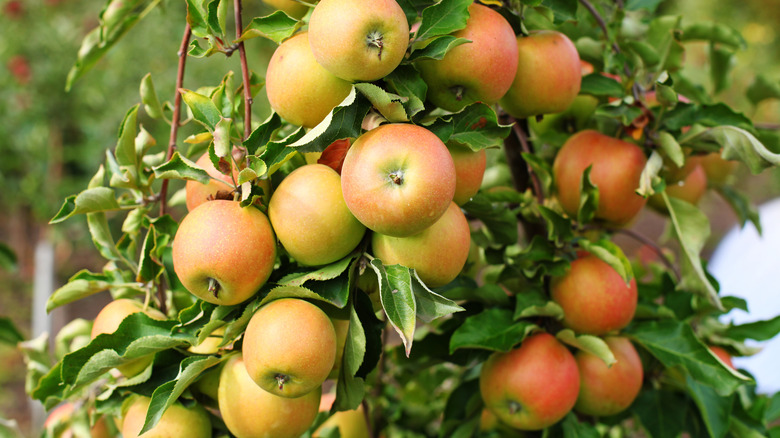
Jonagold apples are a cross between the Jonathan and Golden Delicious varieties, and they were first bred by a Cornell University program at the New York State Agricultural Experiment Station in the 1940s. Despite it taking until 1968 for Jonagolds to enter commercial markets, it's easy to see why they were met with such success, and why they are so perfect for apple pie: Jonagolds are balanced in taste, with both sweetness and tartness working in their favor. These apples also soften nicely once baked without disintegrating, which is why these are one of the preferred apples for canning. Like Golden Delicious apples, Jonagolds can be quite large, making my least favorite part of making pie — the peeling step — considerably easier.
The harvest season for Jonagolds can begin in the early fall and last until winter, especially because these apples are so cold-hardy. After being picked, they can stay fresh for several weeks at home in cool, dark conditions. That's why they are great choices for holiday baking. Their winter-hardiness does come with a flip side, however: Their trees might not survive as well in warmer climates. You'll find these apples in larger quantities if you live in cooler regions, such as the Northeast, the northern Midwest, and the Pacific Northwest. And for those who live abroad, here's some great news: Jonagolds grow in abundance in New Zealand, Belgium, and other parts of Europe, too.
McIntosh
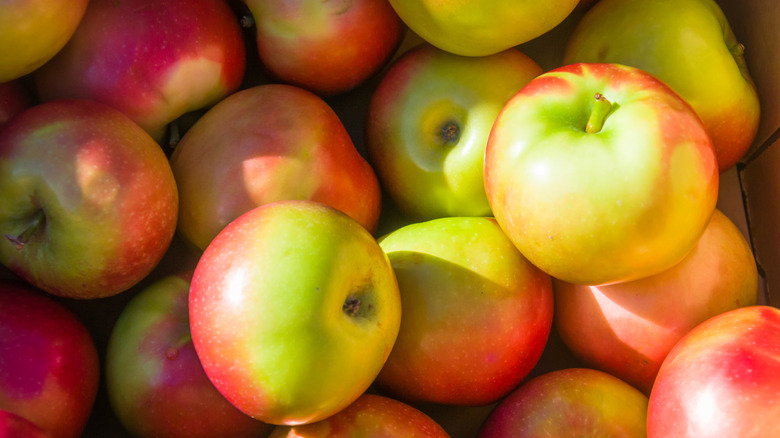
If you ever doubt the merits of the McIntosh apple, just consider that this variety was not only the namesake for Apple's Macintosh computer, but it is also the national apple of Canada. This apple has a balanced flavor profile and is the perfect choice for adding body to pies since it is incredibly juicy and breaks down under heat. This is why McIntosh apples also make for an incredible homemade apple butter. I find the flavor of the McIntosh to be rich, agreeing with the popular sentiment that it is cider-like or wine-like. Though some folks don't recommend this variety at all, it is one of my favorites for baking because I am a fan of gooier pies. I really don't like raw McIntosh apples, which goes to show how much the cooking process can change an apple's flavor and texture. I wouldn't go so far as to bake a pie solely with McIntosh apples, though.
Bolder, tangier McIntosh apples can be harvested early in the fall, but the weeks spanning late September until early October are usually the best time to grab them off the shelves if you want a well-balanced fruit. As the season progresses, they tend to lose their acidity, so the McIntosh apples you get in early winter will be milder and sweeter. Because of this flavor variation, your McIntosh apple pies might taste quite different from one month to the next. Furthermore, McIntosh apple trees like cold weather, and their fruits taste better when grown in sweater weather, too. Finally, these apples are best bought locally, lest they become bruised during transport.
Bramley
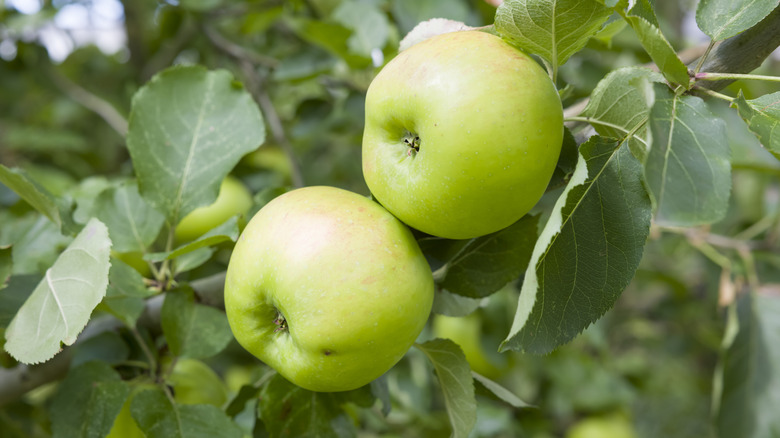
Did you know that apple trees can live for centuries? You can visit one such specimen at the Bramley Apple Festival of Food and Drink, which celebrates the mother tree that is responsible for all the Bramley apples we eat today. To be fair, you might not have eaten many Bramley apples in your life yet. This apple is particularly famous in the United Kingdom, and aside from pie, it is used in traditional British recipes like apple Charlotte, apple crumble, applesauce, British Christmas pudding, and even Bramley apple soup. However, in modern times, you can find Bramley apples grown in the United States, as well as in countries like Ireland, Canada, Japan, Denmark, and Australia. Harvest season can begin as early as August or as late as November, depending on the region.
Apples of this variety are tart, tangy, and acidic, especially when they have not ripened fully. Heat, however, helps draw out some of the apples' requisite sweetness, and I find that this can result in a unique apple pie with fresh, light, and floral flavors. This is in contrast to the dark, cidery flavors lent by many other apple varieties. Bramley apples are soft and juicy once baked, without becoming too tender or breaking down. When picking or shopping for Bramley apples, choose ones with a yellower hue; the green ones will likely be too tangy for pie, especially if you are used to sweet desserts. Mercifully, if you don't like peeling apples, this one should be easy to handle.
Gravenstein
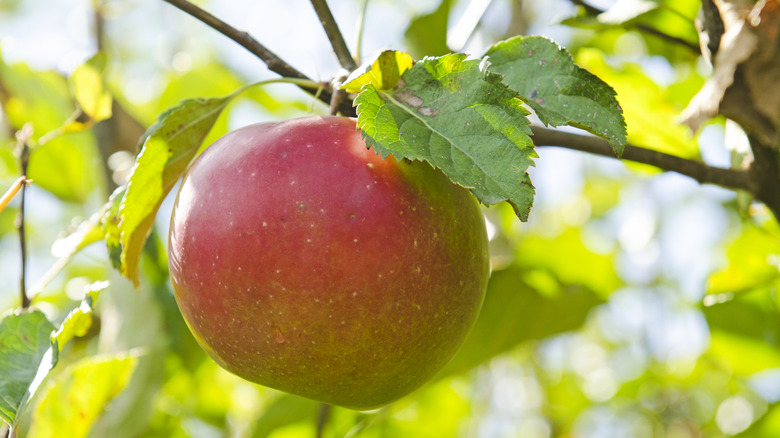
Gravensteins are one of my favorite apples for pie because they lend a strong, well balanced flavor that is not too sweet. They also soften beautifully without turning to mush. I specifically recommend using standard Gravensteins; They taste tangier and more complex than their counterparts, Red Gravensteins. Living on the East Coast, I don't have easy access to Gravensteins. You have much better chances of finding them in Sonoma County, California, which has hosted the Gravenstein Apple Fair for the last 50 years. It is here that the Slow Food Foundation for Biodiversity has instituted a Presidium to protect this heirloom crop.
With their fragile skins, Gravensteins are not the best candidates for shipping. Besides, because their trees are relatively susceptible to disease, ripen unevenly, and drop apples to the ground during the summer months before harvest (sometimes to self-thin, sometimes due to factors like heat and pests), they are not favored commercially. It's best, therefore, to get Gravenstein apples in season from a local farmer. That's usually around the time of July or August. Depending on their state, you could use the dropped apples to make pie, but that's assuming you have direct access to a tree and aren't buying your apples from a farmer. Furthermore, the window to pick these apples is only around three weeks long, and if they become too ripe, they are more likely to break down in your pie. Keep in mind that the storage life of Gravensteins is also pretty short; The fruits only last around two to three weeks in your refrigerator.
Honeycrisp
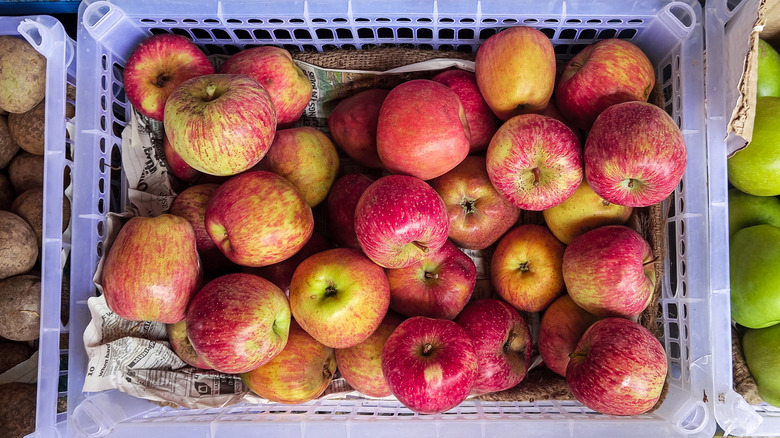
Honeycrisps are some of the easiest apples to buy at the grocery store. They are simultaneously sweet and tart, with more emphasis on the sweet. They are my favorite apples to eat raw, and their flavor profile plays nicely with feta and other sharp cheeses. That's why this is the perfect opportunity to try incorporating cheddar into your apple pie, perhaps in the crust (it sounds weird, but it works). True to their name, Honeycrisps stay pretty firm once baked and have a bright flavor, too. I love their almost floral aroma and the fact that they are easy to peel because of their large size. If you have noticed that Honeycrisp apples don't taste like they did in the good ol' days, you might have better luck when sourcing them locally from a small-scale farmer, particularly in colder regions.
The Honeycrisp season generally lasts from September until October in Minnesota, where the variety was originally developed. In fact, Honeycrisps are now Minnesota's state fruit and are grown prolifically there. However, these apples may be harvested until early winter in warmer areas. If you live in Wisconsin, Michigan, New York, or Washington, the odds are in your favor for finding a local farmer who grows Honeycrisps. Those living abroad can take heart in the fact that Honeycrisps can be found around the world, including in New Zealand, Australia, and South Africa (in Europe, the variety is commonly known as Honeycrunch).
Jonathan
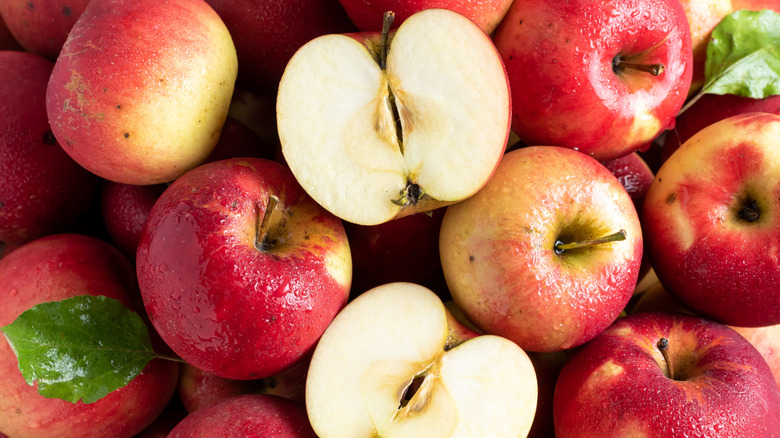
The small- to medium-sized, dark red Jonathan apples are humble in appearance, so you might be surprised at their vigorous flavor. Though Jonathan apples taste superb when cold, they can also add plenty of flavor to a hot apple pie. They fall on the tarter end of the spectrum, while simultaneously carrying a bit of a spiced flavor. As is the case with other apple varieties, the earlier in the season you pick a Jonathan, the tarter it will taste. Despite being so juicy, slices of a Jonathan apple tend to retain their structure well in the oven. If you have any doubts, though, you can always cut them in thick slices. This heirloom fruit helped give birth to the Jonagold apples described earlier, as well as other varieties like Jonamac and Jonafree.
It is widely believed that the Jonathan variety hails from Woodstock, New York, where it was presumably discovered in 1826. By the late 1800s, business was booming for farmers cultivating Jonathan apples, but they have since fallen out of commercial popularity. However, you can still get them from farmers in the Pacific Northwest, Midwest, and Northeast. They're even grown in Japan, where they are called Kogyoku apples. Jonathan apples are among my top picks for baking Thanksgiving and Christmas pies; The harvest season falls between mid-fall and mid-winter, and the apples can keep for up to a month in the refrigerator. I don't recommend keeping them longer than that, though, or else their signature tart flavor will noticeably diminish.