

The Adorable Old-School Tea Maker We Don't See People Use Anymore

Everyone has seen those quirky kitchen gadgets that feel like something your grandparents might've owned, yet they evoke such irresistible nostalgia you can't help but smile. Imagine something that sits quietly by your bedside, blending sleepy‐time comfort with a promise of morning warmth. You know, something that seemed almost magical, especially on cold mornings?
Enter the Teasmade. This retro contraption combines an alarm clock with an automatic tea‑making device — set it before bed, and come morning, your tea is bubbling and waiting for you. In the U.K., particularly in the 1960s and 1970s, it was the epitome of domestic convenience and even a staple wedding gift. Looking under the hood, the original mechanism is beautifully low‑tech: you'd fill a kettle, place tea in a pot, and set the alarm. When it went off, steam pressure would force boiling water into the teapot, the kettle shut off, the alarm buzzed — and tea was ready.
At its height, the Teasmade was a staple in many British homes. It encapsulated mid‑century design and convenience, offering a steaming cuppa without lifting more than a finger before breakfast. Early electric models (from around 1937) featured art‑deco styling, lamps, and even glow‑in‑the‑dark paint — a fixture of modern bedrooms back then. But its popularity waned as electric kettles and the ritual of making tea by hand became quicker and more flexible. By the 1980s, it felt increasingly quaint — more kitsch than convenience — and largely disappeared from kitchen counters.
The charm of the Teasmade persists
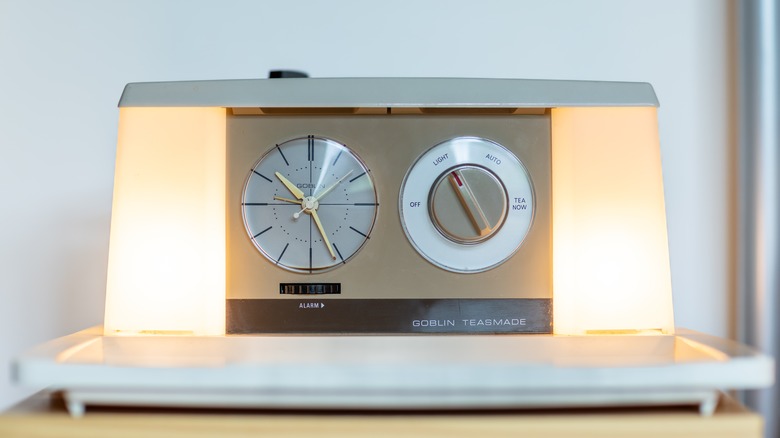
Despite its decline, the Teasmade endures in nostalgia and collector circles. It's become a symbol of retro‑futurism — practical, imaginative, and delightfully eccentric. Science museums acknowledge its place in domestic‑technology history as a stepping stone toward our modern smart‑home gadgets. Enthusiasts and vintage‑tech lovers still praise early Goblin models for their design.
Production slowed significantly after the 1980s, as manufacturers folded or shifted toward modern devices. Nonetheless, niche brands like Swan (and later successors) have periodically resurrected limited runs, and the Teasmade saw a retro revival in the 2000s as "novelty" homeware. Still, an original mid‑century example is quite rare and treasured.
The Teasmade faded partly because modern living made it redundant: central heating, ready‑availability of hot water, and quicker ways to brew tea reduced its utility. Yet, it remains adorable in memory — a playful nod to a time when waking up meant more than just opening your eyes. Today, it endures as a collectible, conversation‑starter, and relic of an era when tech was mechanical magic.