

The World's First Birthday Cake Dates Back To Ancient Greece
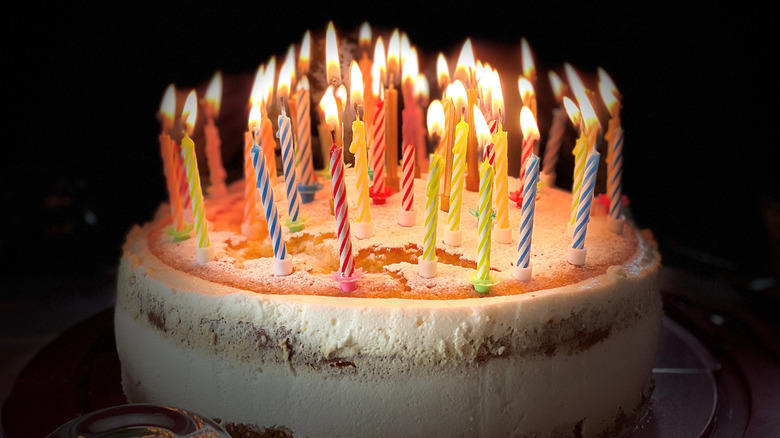
A humble confection, born of devotion and celestial symbolism, lies at the root of a tradition we now take for granted. Though its form may seem simple — round, unassuming, perhaps modest in flavor — its origins are profound, and woven into ancient religious rites. The early iteration of what would become a celebratory sweet was far more than a treat — it had meaning.
We're referring to the earliest known birthday cake. In Ancient Greece, circular cakes were offered to honor Artemis, the goddess of the moon and childbirth. These cakes — crafted from dough, honey, and sesame seeds — were lit with candles to illuminate them like the moon itself, serving as votive offerings in devotional ceremonies. These sweet, luminous offerings were known as ammilos, and they symbolized not birthday indulgence but worship, the candles symbolizing stars, and the smoke carrying prayers skyward.
Beyond this, Ancient Greeks more broadly created sacred cakes used in rituals across centuries. These were often sweetened with honey, baked with cheese, nuts, herbs, and fruits, and offered in religious contexts such as festivals or shrines. While these weren't birthday cakes per se, they laid the foundation for sweet ritual offerings in Greek society.
From ritual to celebration
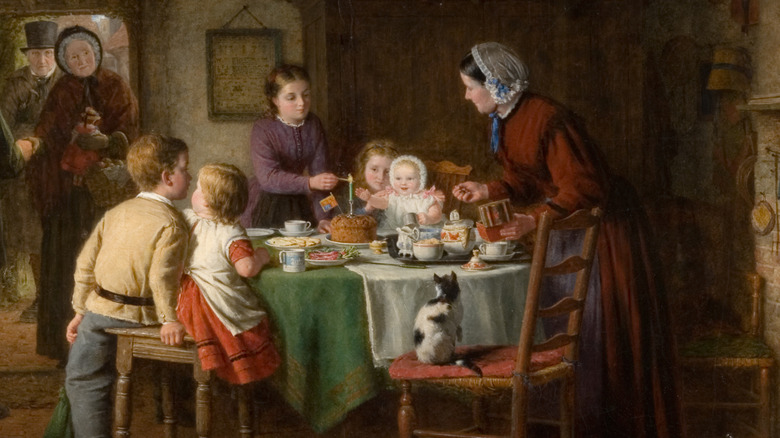
As time passed, the role of cake shifted from sacred devotion to personal celebration. In ancient Rome, celebratory cakes marked significant events, such as weddings or the 50th birthdays of prominent citizens. These cakes were made with flour, nuts, yeast, and honey, carrying forward the sweetness of Greek traditions into daily life.
Centuries later, Germany transformed these rituals into a form recognizable today. In the 18th century, children's birthdays were marked with Kinderfeste, where a cake was topped with a candle for each year of life — and one extra to symbolize the year ahead. The candles were lit in the morning, left to burn, and only blown out at day's end, often accompanied by a silent wish — precursors to our modern customs.
Finally, the Industrial Revolution democratized birthday cake. Technologies and mass production made sugar, baking supplies, and prepared cakes widely affordable. Lavish, frosted, multi-layered cakes once reserved for the elite became accessible to the masses, cementing the birthday cake as a beloved centerpiece of celebration across social classes.
This journey — from sacred, candle-lit offerings to Artemis, through Roman milestones, German children's rites, and industrial-era accessibility — reveals how the concept of the birthday cake blossomed across cultures and centuries. Each stage contributed a layer: spirituality, symbolism, personal commemoration, and accessibility. The modern birthday cake, glowing with candles, carries echoes of ancient devotion, a sweet reminder of our shared human history.