

The 3 Cities Anthony Bourdain Called The World's Food Capitals

It's no secret that Anthony Bourdain traveled around the globe, stepping foot on all seven continents and 80-plus locations. With his four television shows — "A Cook's Tour," "No Reservations," "The Layover," and "Parts Unknown" — Bourdain introduced the world, and in many cases, himself, to both familiar and exotic cuisines. In a 2011 interview with National Geographic, he offered travel tips and insight into the reasons for traveling where "No Reservations" was filmed.
Over the course of this fascinating Q&A, Bourdain revealed the three cities that he considered to be the food capitals of the world. Other than San Sebastian, Spain — a gorgeous seaside resort, known for its beaches and pintxos (Basque tapas) — he cited Singapore, Hong Kong, and Tokyo, where "they have a maximum amount of great stuff to eat in the smallest areas." Each locale is known for a particular cuisine, and in his usual fashion, Bourdain did a deep dive into their culinary, cultural, and political influences that are surprising and illuminating to their national identities.
Singapore
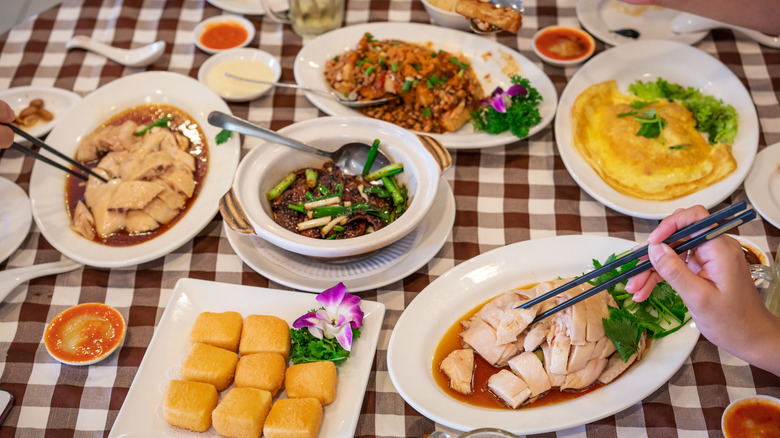
Bourdain filmed four episodes in Singapore, a country that he recognized as "possibly the most food-centric place on Earth" (via Anthony Bourdain Parts Unknown). Singapore is a tiny country/city-state that relies on imports to feed its ever-ravenous population. One of the wealthiest countries in Asia, it's a unique amalgamation of skyscrapers, high-end fashion, and haute cuisine. Food is promoted by Singapore as a must-see tourist attraction, and depending on your budget, you can dine at exclusive restaurants, as Bourdain did in "A Cook's Tour," where his menu was customized to balance his seriously unbalanced yin and yang, or explore Singapore's food diversity at "hawker centers."
Akin to food courts, you'll find anything you could possibly want to eat at a hawker center, where small vendors cook their street-food specialties that blend the flavors and spices of China, Malaysia, and India. Noodles and rice are often served together, slathered in a gravy, chili, or curry sauce and topped with whole crabs, prawns (shrimp), or poached chicken, a national dish known as Hainanese chicken rice. Bourdain hated food porn, but it was inescapable when he shot in Singapore, because everything was unbelievably delicious and delicious-looking.
Hong Kong
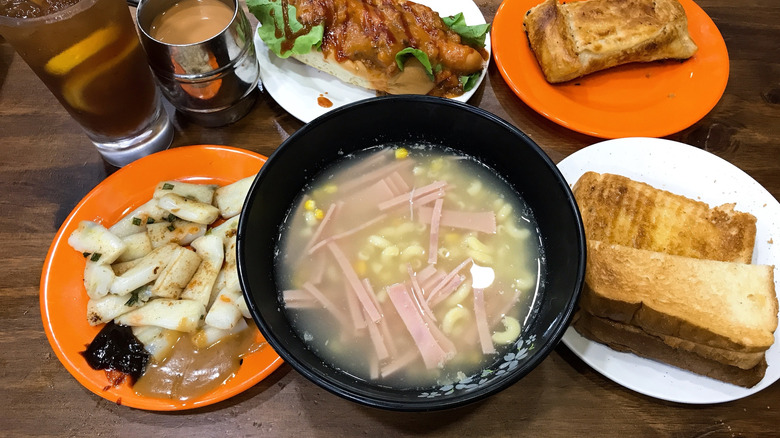
Hong Kong has long been a cultural and political hotbed, and as Bourdain noted, the city and its people continually adapt to change. In his third visit to Hong Kong, while filming a 2018 episode of "Parts Unknown," directed by his then-partner Asia Argento, Bourdain was struck by how the city he loved was gradually vanishing because of political incursion. Cuisine in Hong Kong was diverse, ranging from high tea (a leftover ritual from the British colonization) to Cantonese cooking from China's mainland. But the city's true culinary identity could be found at the dai pai dongs, the outdoor street-food vendors, where in green tin-roofed shacks one could dine on food prepared by working-class immigrants.
Where there had once been hundreds of dai pai dongs in Hong Kong, at the time of filming, Bourdain was shocked to find that, because of government crackdowns, only 28 remained. Some of the meals he featured were a rich noodle soup topped with braised beef brisket, roast goose with prune sauce — one of Bourdain's particular favorites — and bamboo noodles, an especially labor-intensive dish. Today, only 17 dai pai dongs are still in operation, and it looks like a hostile government will phase them out entirely, thus potentially wiping out what Bourdain loved so much about Hong Kong.
Tokyo
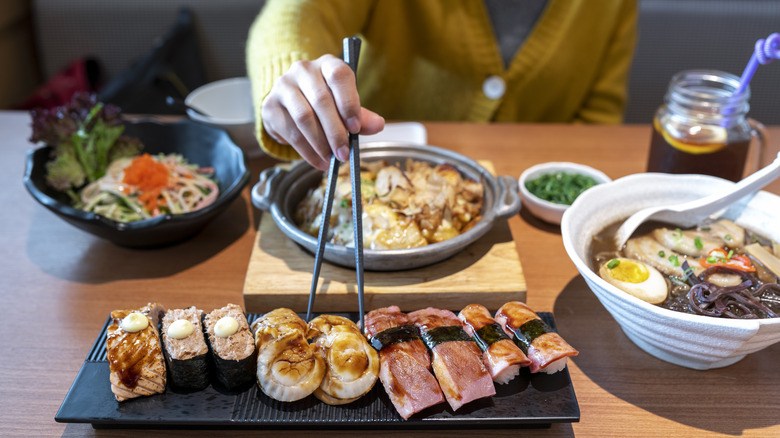
"If I had to eat only in one city for the rest of my life, Tokyo would be it," Bourdain wrote in his field notes for the "Parts Unknown" episode in Tokyo. He became obsessed with Tokyo, comparing it to a transformative, almost religious, experience on his first visit. He filmed in Japan nine times — seven times in Tokyo — and he later admitted that he had barely scratched the surface of the country he found endlessly fascinating.
Bourdain credits New York City sushi chef Naomichi Yasuda as his teacher and mentor in his education — and edification — in sushi, and during one of his visits to Tokyo, he achieved sushi nirvana at the tiny, ultra-exclusive Sukiyabashi Jiro, whose iconic chef had been the star of the documentary "Jiro Dreams of Sushi." Among the many Japanese dishes that Bourdain likely sampled, his favorites were uni (sea urchin), soba noodles or buckwheat noodles with duck dipping sauce, and chicken yakitori. He later wrote that he could "spend the rest of his life in Tokyo, learn the language, and die happily ignorant."