

The Italian Way To Layer Your Lasagna
A homemade lasagna, bubbling with layers of melted cheese, savory sauce, and fresh meats or veggies, is one of the most comforting meals you can make. When looking up classic lasagna recipes, you'll encounter many that claim to be the authentic Italian way to make lasagna. To get to the bottom of which method is most authentically Italian, Tasting Table spoke to Chef Billy Parisi, renowned chef and owner of Parisi's Italian Kitchen, whose grandparents came from Terrasini, Sicily, and were always cooking something special.
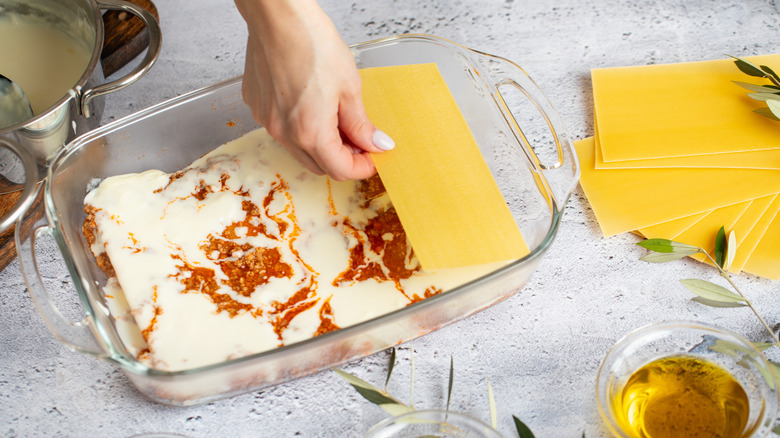
Parisi tells us that the number of layers of sauce, noodles, and filling should be between three and five. While the exact method of layering lasagna varies according to personal preference, Parisi starts with a layer of sauce on the bottom of the pan. "Then, I do a layer of lasagna pasta," he adds. "This can be dried and parboiled, or fresh." Next, Parisi said that he adds "another thin layer of the red sauce, followed by a layer of béchamel, which indeed would be the classic ingredient to use instead of ricotta, like we do here in the States." Afterwards, an even sprinkle of mozzarella and Parmigiano Reggiano completes this layer.
"From there, I repeat the process 3 to 4 more times, resulting in a 4- or 5-layered lasagna," the chef continues. When the final layer is placed, Parisi spoons the remaining sauce on the top and adds the remaining grated cheese. "I try to save a little extra of the sauces just to get a decent amount on the top," he explains, "maybe the equivalent of 2 layers of the sauce together."
Alternate the noodle direction with each layer for a more authentic Italian lasagna

Upon asking Parisi if the more traditionally Italian way to make lasagna is to place the lasagna noodles in the same direction for each layer or to alternate directions, he explained that, "In Italy, you will definitely see folks alternate the directions of the layers of pasta." To use this "Old World" Italian method for making lasagna, start with your base layer of sauce in your pan and then add a layer of noodles horizontally in the pan, placing them so that the edge of each noodle slightly overlaps the next. Then, add another thin layer of sauce and top it with ricotta or béchamel sauce.
When placing the next layer of noodles, alternate their direction so that you place them vertically. You may need to trim the edges of the noodles so that they fit in the pan properly. You can use the trimmed edges to fill in empty spaces, eat them, or discard them. Repeat this process until you reach the perfect number of layers for your lasagna.
According to Parisi, using alternating layers of lasagna noodles "is done so that the slices hold together better." However, he also acknowledged that in the end, "it doesn't matter." He adds, "I've done [it] both ways plenty of times and still get the same results." Parisi's ultimate tip for making authentic Italian lasagna that is firm, uniform, and easy to cut is "letting the lasagna cool slightly so that the sauces aren't piping hot, which can cause the lasagna to fall once cut out." The chef concludes that "cooling it also allows the cheese to tighten up a bit to help with the structure of the slice."