

The SoCal Fast-Food Founder Who Cooked 2 Million Chickens, Bought A Town, And Opened A McDonald's Museum
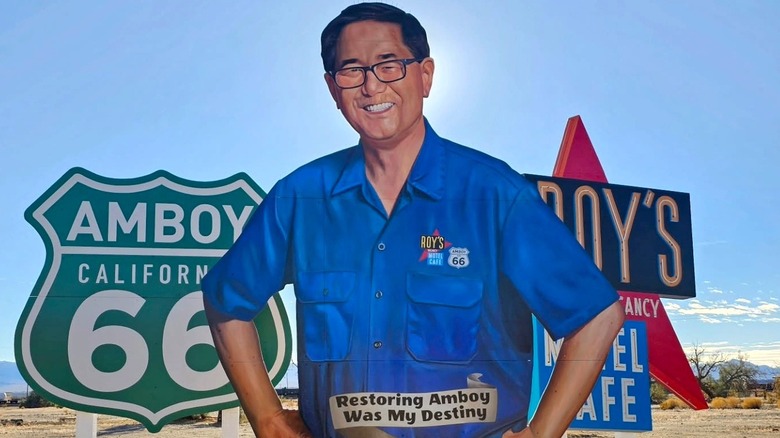
When speaking about the many facets of his fascinating life, Juan Pollo founder Albert Okura once said that it was his "destiny" (via The New York Times). The self-styled "Chicken Man" claimed to have personally cooked 2 million chickens in his day. But Okura wasn't only a savvy entrepreneur; he was also the savior of a long-abandoned ghost town in the California desert. Talk about an incredible life.
Okura was raised in Wilmington, California, an industrial town in the Harbor area of southern Los Angeles. His father had been a semi-professional baseball player, but during World War II, while serving in the U.S. Army, he and his wife were transported to a Japanese-American internment camp. However, Okura's parents did not become embittered toward America and instead instilled in their four children the ideal of the American dream. Okura wasn't exactly a grade-A student, but to avoid the draft during the Vietnam War, he enrolled in a junior college. He got a job at a Burger King working for $1.35 per hour and was such a dedicated worker that his manager offered him a management position.
After dropping out of college, Okura wasn't sure he wanted to stay in the fast food business, but then in 1983, destiny called when his uncle offered him a vacant restaurant in a shopping center. His brother-in-law Armando Parra created the marinade for a Hispanic-style rotisserie chicken, and Okura opened his first Juan Pollo fast-food restaurant the following year. Competitor El Pollo Loco has always attracted lower-income families, but Juan Pollo's chicken appealed most to the Hispanic communities.
Okura found his destiny on Route 66
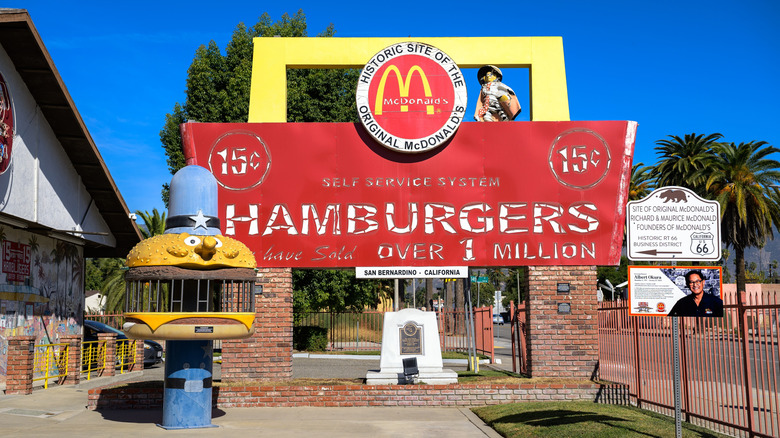
Over the next 20 years, Juan Pollo expanded to 25 locations throughout Southern California and the Inland Empire. Destiny again came a-knocking when Okura heard that the site of the original McDonald's in San Bernardino, California, was up for sale. Okura had studied the trials and tribulations of the McDonald brothers and how Roy Kroc built up McDonald's restaurants, so he purchased it in 1998. The original octagonal shack had been demolished, but Okura converted the existing storefront into an unofficial McDonald's museum with free admission. Stuffed with thousands of pieces of McDonald's memorabilia that Okura had collected from around the world, the museum is still a hugely popular tourist attraction. The museum is situated on California's famous Route 66, where, once again, Okura found his destiny.
In its heyday, Route 66 was the main artery connecting the East Coast to the West Coast, and the towns and cities that sprang up served as rest spots for weary travelers. By 2005, the once-prosperous Mojave Desert town of Amboy had been abandoned and put up for sale. When Okura noticed, he purchased it for $425,000 in cash, promising to restore and maintain the area. Amboy's most famous feature was Ray's Motel and Cafe and its iconic mid-century Googie-style neon sign, which, today, is photographic fodder for social media. Okura worked side-by-side with his son, Kyle, to renovate many of Amboy's decrepit structures until 2023, when he died suddenly of complications due to sepsis. Following his death, a 14-foot-tall painting of Okura was erected to honor his tremendous achievements, standing outside the town he believed he was destined to restore.