

What's Really Inside Your Pepperoni
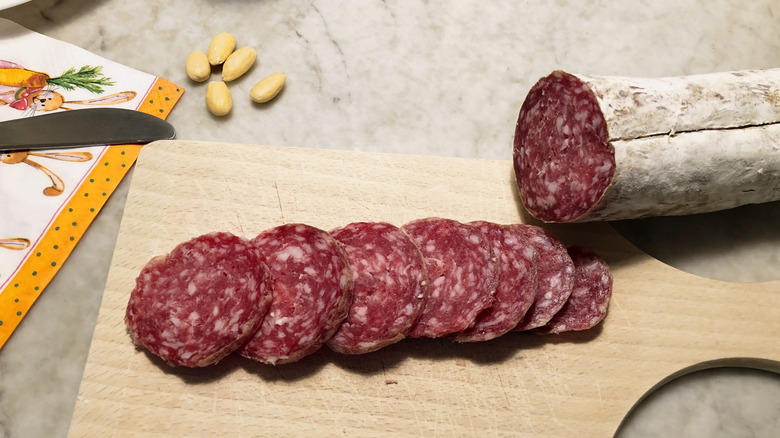
While people will wholeheartedly argue with you about whether pineapple belongs on pizza, you won't find anyone questioning pepperoni. From Chicago-style to New York, and even in its homeland of Italy, you'll find slices of this dried sausage scattered on top of countless pies. But if you've ever wondered what exactly this savory and delightfully chewy sausage is made from, well, you wouldn't be the first.
Pepperoni is made from a mixture of meat, typically a ratio of around 70% pork to 30% beef. However, if you dig, you can find pepperoni that is made with different ratios and even pure-beef or pure-pork versions. Once the meat is nice and blended, spices are then added, including paprika, chili flakes, and cayenne pepper, which give the sausage that bright, brick red color, as well as the warm, licorice-like notes of fennel seed and garlic.
From there, the seasoned mix is then cured, stuffed into casings, and fermented to give it a nice tang. Once it's been smoked and dried, a process that can take anywhere from weeks to months, a new stretch of pepperoni is made and is ready to go on top of your pizza or your Pepperoni Lover's Pizza Pasta recipe!
Old World versus New World pepperoni
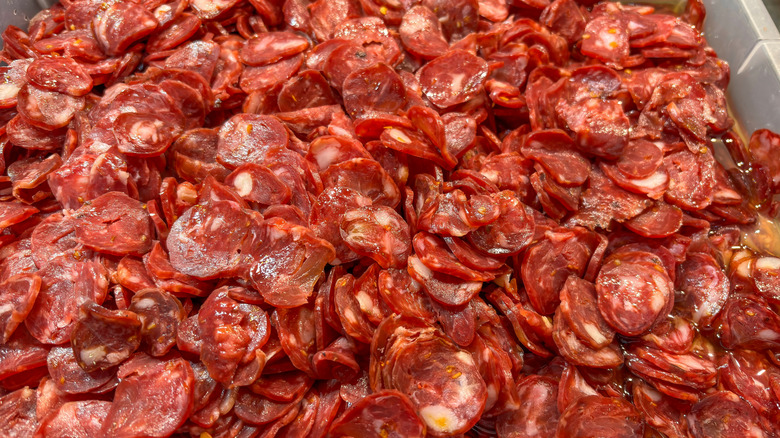
You probably have never noticed it (and we don't blame you; this is some super-niche trivia), but there are actually two kinds of pepperoni out there. One follows the original Italian formula of pepperoni, called "Old World" pepperoni. The other version, understandably called "New World" pepperoni, has undergone a couple of changes in the hands of Italian Americans, which is why it's sometimes referred to as "regular" or "American-style" pepperoni. The main difference between them? The casing.
While Old World pepperoni is made using natural casings from animal intestines, the New World variant is made with casings made from artificial materials like cellulose. Before you freak out when you hear the word "artificial," these casings are totally safe to eat. The only drawback is that they aren't as elastic, so when you place them on a pizza, instead of curling up beautifully in the heat into "cups," they just lie flat. Of course, flavor is a factor, too. Old World pepperoni will usually taste much stronger, since it's often made with the full bouquet of spice and seasoning as in the original recipe. By comparison, New World cuts out some spices like fennel seed, since it's often much too strong for Americans.
And last but not least, New World will undergo fermentation naturally, while in the New World, lactic acid is used to give it the signature tang. Don't get us wrong — New World pepperoni isn't bad at all. If you prefer something milder and less intense, it's a great choice. But if you want to experience pepperoni in all its bold, traditional glory, you can't go wrong with Old World-style.