

The Discontinued Budweiser Beer You Might Not Remember
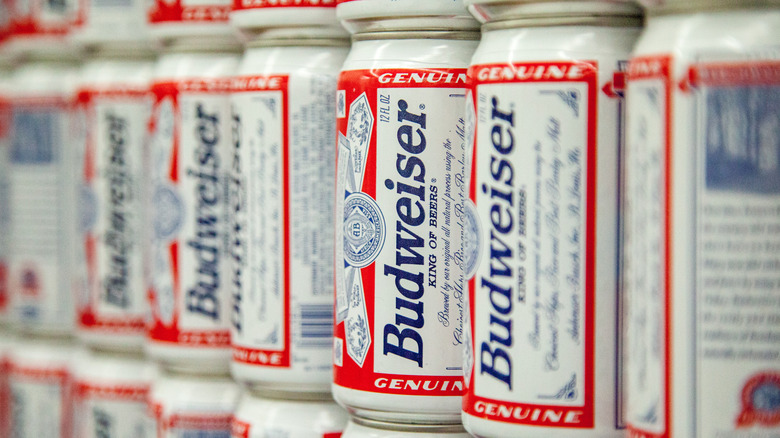
Budweiser is easily the most iconic beer brand in the United States. It remains among the top five top-sellers in American beer, especially thanks to Bud Light. Its producer, Anheuser-Busch, has been brewing beer since the 1850s, and Budweiser became the first brand to distribute nationally in the 1870s. But perhaps considering that significantly lengthy history, it may not come as a shock that even a titan like Budweiser has some missteps throughout its timeline. Beers have come and gone — one in particular is Bud Dry, a brew that closed out the 20th century and that remains remembered by some fans and totally forgotten by other imbibers.
Budweiser rolled out Bud Dry in 1989. Anheuser-Busch had unveiled Michelob Dry in 1988 and wanted to replicate that beer's success under the Budweiser umbrella. "Dry beer" refers to beer that has been highly attenuated during its fermentation — this means the yeast has effectively converted a large percentage of the malt's sugars into alcohol and carbonation, yielding a crisp finish with virtually no residual sweetness. It's light and refreshing, so it's easy to see why "dry beer" succeeded when it first began flowing from breweries in Japan in 1987. American creations like Bud Dry attempted to recreate that magic stateside. These crisp, clean lagers are still some of the most popular beers today, but under other names. Bud Dry was discontinued in 2010 — but why? What could have derailed such a winning formula?
The competition heated up for cold, dry lagers
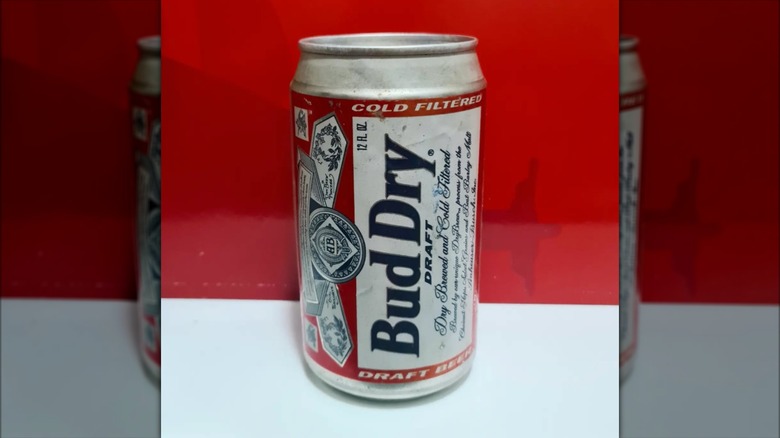
Per a 1991 Bud Dry commercial shared on The Classic Sports' YouTube channel, Budweiser explained that it used a "dry brewing" process — referring to the aforementioned highly attenuative fermentation method — rather than watering the beer down. But other breweries were doing this, too, and non-watery beer was more of an expectation among consumers rather than a unique selling point. Essentially, there was too much competition and no real niche demand for Bud Dry to fulfill.
In the mid-1990s, Budweiser introduced Bud Ice, again utilizing a special practice — essentially freezing beer to crystallize and filter out more water, leaving a crisper, drier, higher-in-alcohol-content lager — to offer consumers something new and ideally something they weren't already getting from other breweries. Bud Ice seems to have knocked Bud Dry from its throne, if it ever reigned in the first place. After all, beer drinkers already had Budweiser and Bud Light, which debuted in 1982, to choose from, under the Budweiser flag alone.
While Budweiser has clearly survived the 2010 discontinuation of Bud Dry, we know how product disappearances can crush fans. Drive-thru enthusiasts yearn for once-popular fast food items now retired, and those with a sweet tooth wish they could revive a whole slew of discontinued candies. If you're among those who miss Bud Dry, you'll be happy to know you can still find Bud Ice — or you can seek out a tasty, crisp lager from a craft brewery near you.