

How Jack Daniel's Rewrote The Rules To Claim Tennessee Whiskey
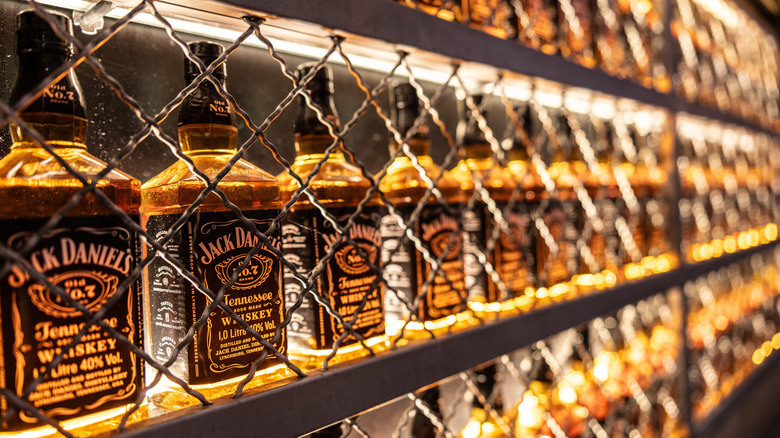
Designations on the ingredients and techniques used to make alcoholic beverages, as well as the locations in which they are made, are nothing new. Champagne can only be made in a particular region of France, single malt Scotch whiskey can only be made using barley, and bourbon must be aged in new charred oak barrels. For the most part, these are good rules that ensure a product bearing a particular designation will fit with the customer's expectations. But when it comes to Tennessee whiskey, things are a little fishy, given that the rules just happen to match up exactly with the Jack Daniel's method.
Right now, in order to label a product as Tennessee whiskey, it must be made in Tennessee, have a grain bill of at least 51% corn, be filtered through maple charcoal prior to aging, be aged in new, charred oak barrels, and be bottled at no less than 80 proof (40% ABV) — among a few other rules. All together, this is known as the Lincoln County Process, itself a reference to where Jack Daniel first bottled his brand.
But the specifics of this designation adhering exactly to the Jack Daniel's method didn't just happen by chance. In 2013, the liquor giant successfully lobbied the Tennessee House of Representatives to make it so. Prior to the passing of this bill, any whiskey made in the state could be labeled Tennessee whiskey, but no longer. Since then, other whiskey distillers in the state have brought arguments to loosen these rules, but Jack Daniel's has fought back. To date, lawmakers have taken the side of the creators of the Lincoln County Process.
Why do Tennessee distillers want to change the law?
So long as Tennessee whiskey remains defined by the Lincoln County Process, Jack Daniel's whiskeys are likely to remain the go-to choice for consumers. When one producer defines the methods, the rest must be, by default, knock-offs. That doesn't mean that they can't add their own elements and make a better product — or at least one that is more appealing to a certain sector of consumers — but they do still have to play by the rules that Jack Daniel's laid out. Well, except for Prichard's Distillery, the only brand granted an exemption to the rule.
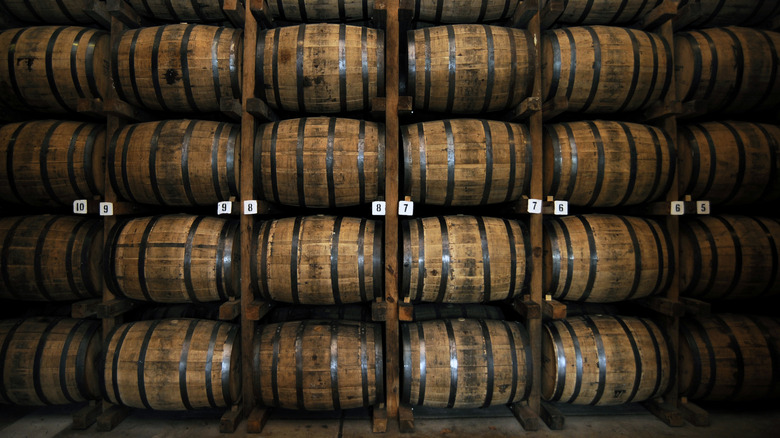
One of the primary concerns from other Tennessee whiskey distillers is the use of new, charred oak casks. These barrels don't come cheap, and the single-use method can rack up a large bill quickly. It is not hard to see how smaller distillers might consider this to be an anti-competitive law, as these high costs can be more difficult to manage as a fledgling business. Then again, that same requirement is built into the designation of bourbon, and distillers all over the country have managed to make the numbers work and launch their own bourbons.
But this point also dictates another complication of the Tennessee whiskey debate. While bourbon whiskey originated in Bourbon County, Kentucky, it can be produced anywhere in the U.S. To be labeled Kentucky bourbon, it must come from the Bluegrass State. Of course, some of the best bourbons aren't produced in Kentucky at all.
Should Tennessee whiskey be specific to the state or the method?
Right now, the designation of Tennessee whiskey is perhaps the most restrictive in the world. The rules for Scotch, Irish, and Japanese whiskeys are much more lax, and even bourbon — which is pretty specific in its requirements — is less rigid than Tennessee whiskey. In fact, Jack Daniel's No. 7 whiskey, the company's flagship product, could be bourbon; it follows all the same rules, but the Lincoln County Process adds a few additional requirements, such as the maple charcoal filtering.
It is understandable that other distillers in the Volunteer State might feel creatively hamstrung by the rigidity of these rules, with only Jack Daniel's really standing to lose by loosening the regulations of Tennessee whiskey. Especially as more and more folks lean into eating and drinking locally, there is no doubt that these distillers would like to proudly display where their product is made. However, if they were to do that under current regulations — with a whiskey that didn't meet the Lincoln County Process standards — they would face having their license revoked for no less than one year, according to the Tennessee Code.
There seems to be an obvious answer here, but one that will likely never come to pass. Just as bourbon whiskey took its name from Bourbon County, so too could the specific style of Jack Daniel's be regulated as "Lincoln" whiskey. After all, the county name is already used to outline the specific distillation processes. But, while it makes plenty of sense, it will likely never come to pass. Jack Daniel's built the fame of Tennessee whiskey around the world, and for now it seems that the brand is poised to defend it.