

The Absolute Best Fish To Use For Salt Baking
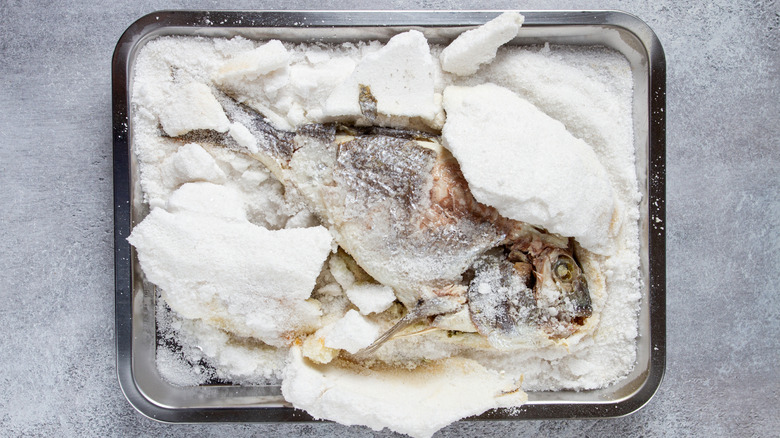
Baking a whole fish in a crust of salt is a culinary illusion of the highest order. On the table, it is not only delicious, moist, and tender but also absolutely stunning — a show-stopping centerpiece for any dinner party. But in the kitchen, it is actually remarkably simple — if you have the right fish, that is. The question of choosing a fish doesn't necessarily come down to species, however. When we're talking about salt-baking a fish, size is actually the most important factor. You are looking for a fish that will easily fit onto a sheet pan with plenty of extra room to make the crust. That means something in the 1 to 3 pound range, depending on how many mouths you are looking to feed.
The reason that size is so important with this method is that salt baking requires a good seal around all sides of the fish. The salt is typically moistened with either water or egg whites so that it can form a good shell. This seals in the moisture, effectively steaming the fish along with any aromatic ingredients, like herbs and lemon, which are included in there with it. If your fish is too large to fit on the pan, you won't be able to seal the edges and the moisture will escape. This leads to a final dish that, while still totally edible, will lack the signature tender juiciness of salt-baked fish.
Other factors to consider with salt-baked fish
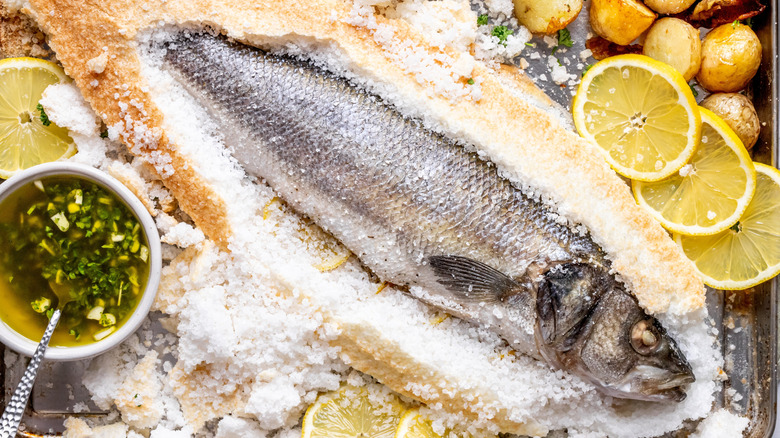
The technique is relatively simple, but there are still a few decisions to make. You know the right size of fish, but you will still need to choose a species as well as a particular type of salt. And then there are a few tips around prep that will ensure you end up with a stunning and delicious meal. As for the species, you can really cook just about any round fish that fits the size specifications, so let your palate lead the way. Fish like snapper, branzino, dorade, small salmon, striped bass, and trout are all popular options. Your best bet is to talk with the fishmonger at your local market and see what they have on offer. From there, it's all down to your tastes.
You can use either coarse or fine-grained salt to make the crust, but you may want to use a different dampening agent for each of them. With coarse salt, you can get a solid crust using just water, but for finer salt, you may need egg whites to accomplish the same result. The best type of salt for salt-baking is also on the inexpensive side, as you will use a lot of it. As for prep, the first step before salt-baking is to remove the fins from the fish to keep yourself from getting poked by sharp spines. Some folks say you should scale the fish, while others skip this step entirely, instead removing the scales or the skin after it is baked — that one is down to personal preference. However you do it, once you see how simple this meal is, it'll definitely find its way onto your regular list of baked fish recipes.