

Jimi Hendrix's Last Meal Was A Classic American Sandwich
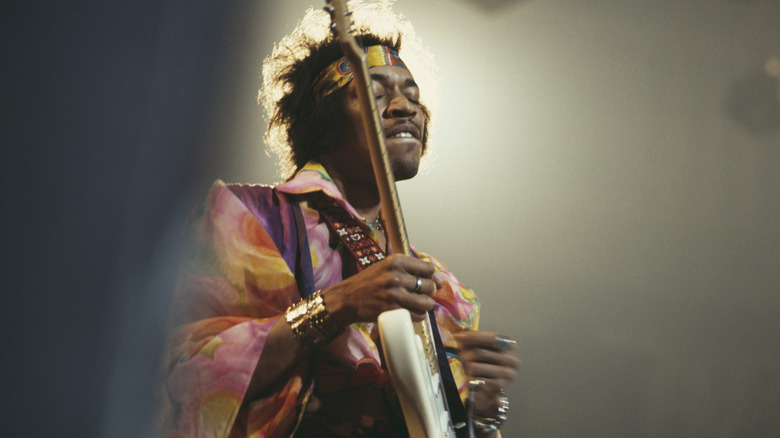
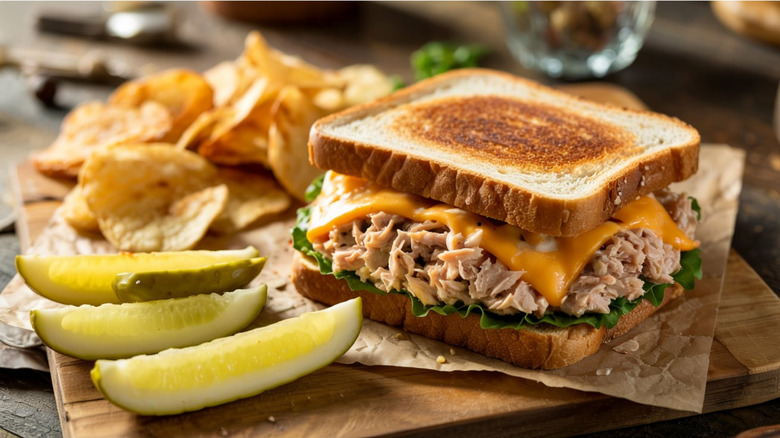
In the cult-classic film "Singles" (1992), two smitten protagonists handwash dishes while listening to Jimi Hendrix's "May This Be Love." Kyra Sedgwick gazes into Campbell Scott's eyes and says, "I love this song." This is perhaps one of the only times in which the great Jimi Hendrix's name is uttered in tandem with dining. The singer is known for changing the electric guitar as an instrument forevermore, not for being a foodie. Although, it's fitting that Hendrix's last meal was such a distinctly American one: a tuna salad sandwich, washed down with a glass of wine.
September 18, 1970 saw Hendrix's untimely death from an overdose while staying in London with girlfriend Monika Dannemann. After returning to her room at the Samarkand Hotel, Dannemann prepared Hendrix the sandwich as a late-night snack. The two had been at a party and came home around 3:00 a.m. For a last meal, a tuna salad sandwich has admittedly less pomp than one might expect. But, notably, the tuna salad sandwich itself is a symbol of revolutionary American history.
The now-staple sandwich didn't become popular until women began leaving the home and entering the workforce in the late 1800s. Prohibited from entering male-occupied bars and saloons during lunch breaks (ooh, "Foxey Lady"), the workers had to find something portable to eat. It's an aptly patriotic homage in light of Hendrix's now-iconic performance of "The Star-Spangled Banner" at Woodstock in 1969. His subversive reimagination of the national anthem remains piercing and energizing decades later.
Hendrix's last meal was a tuna salad sandwich, distinctly and fittingly American fare
Not unlike a classic tuna salad sandwich zhuzhed up with a wine pairing, Hendrix's version of the national anthem was a moving, electrified performance art piece with a tradition-rooted springboard. Further cementing his cover's importance is the fact that Hendrix performed as the headliner, so his set closed the festival. The rendition caught backlash for its apparent protest of the Vietnam War; notably, Hendrix himself served as paratrooper in the U.S. Army during the early 1960s.
The singer appeared on "The Dick Cavett Show" a few weeks after Woodstock, and when asked about his decision to play the cover, Hendrix said, "I don't know, man. All I did was play it. I'm an American, so I played it." Responding to further questions regarding the controversy for playing the song "in an unorthodox way," Hendrix replied, "It's not unorthodox, I thought it was beautiful." Years later, Cavett reflected on his interview with Jimi and expressed regret for not praising the late singer's imagination and bravery. Quoth Cavett (as reported by Today in 2009), "I suppose I could have added that since we somehow acquired the most dismal, virtually unsingable dirge of a national anthem of any known nation, we should decorate Hendrix for turning it into music." For foodies hungry to honor an American icon, we suggest whipping up a tuna salad sandwich with these vibrant Purple Haze cocktails, and popping "Electric Ladyland" on the record player.