

10 Unique Cakes You'll Only Find In Certain Parts Of The US

Cakes are an integral part of many celebrations in the U.S., especially milestone moments like weddings and birthday parties. It is also an integral part of our country's history, having arrived on our shores with English colonists in the form of 50-pound sweetened breads known as great cakes. By the early 19th century, American bakers had begun to develop their own distinct set of recipes, including the lady cake, which was flavored with bitter almonds, and the precursors to cupcakes. The Gilded Age prompted an escalation in fancy cake innovation, from frosting and layers to marbling and caramel fillings. Since then, American cooks have added countless cakes to the baking canon, many of which remain popular.
Given this rich history, it's hardly surprising that some of these sweet innovations have either fallen into obscurity, like election cakes, or never managed to gain popularity outside their region of origin. This usually has nothing to do with their merit. Most people who have been lucky enough to visit the Midwest and take a forkful of gooey butter cake would agree that it's worth recreating across the country. For whatever reason, though, it hasn't become ubiquitous in other parts of the U.S.
Some secrets are just too good to keep, though, so we're rounding up a list of the most delicious regional cakes from around the country that you can bake at home. Some are more well-known than others, but all of them are delicious enough to deserve nationwide acclaim.
Hummingbird cake (the South)
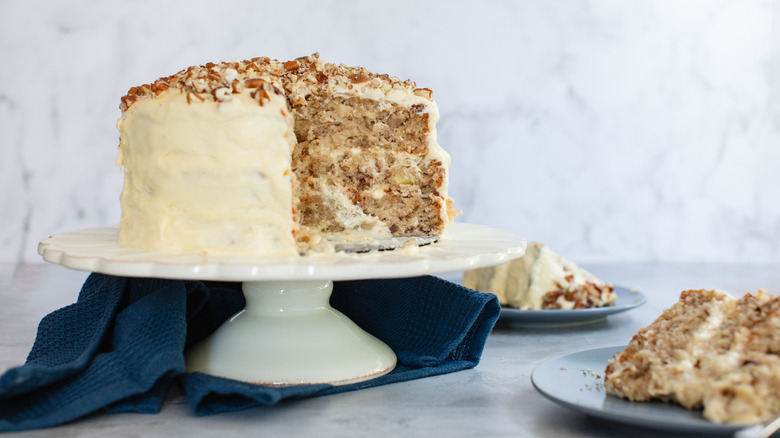
Hummingbird cake is a Southern staple with a not-so-Southern past. Made with bananas, pecans, and crushed pineapple, the deliciously moist, layered confection is slathered with cream cheese frosting for a decadent and eye-catching dessert. Sweet, delicate, and bursting with bright flavor, it is a distinctive recipe that you'll find throughout the South. If you want to make it seem a little less extravagant without compromising on taste, you can opt for baking a hummingbird loaf cake instead.
Despite its Southern associations, the cake was created in the beachy climes of Jamaica. In the 1960s, the country was seeking to boost its reputation as a tourist destination, and one of the tourism board's most ingenious P.R. innovations was to create a cake that showcased the island's delicious foods. Made with dairy and famous for its airy texture, the hummingbird cake was far removed from traditional Jamaican cake recipes, which were often dense and contained coconut milk rather than cow's milk. This may be one of the main reasons it became so closely associated with the American South, where dairy was widely used.
When the recipe made its way into the pages of Southern Living in 1978, its texture and recipe formula fit right alongside familiar favorites like Lane cake and yellow cake, but with the advantage of a novel combination of flavors. It quickly became the magazine's most popular cake recipe of all time. In Jamaica, however, it never really caught on.
Kuchens (South Dakota)
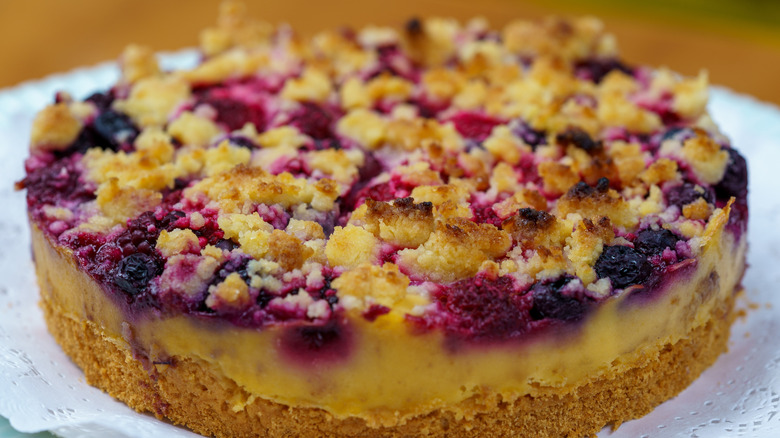
If you ask for a kuchen in Germany, you will probably be met with some follow-up questions. The word means cake, and therefore covers everything from a humble apfelkuchen (apple cake) to a decadent Schwarzwälder Kirschtorte (Black Forest cake). In the Dakotas, however, kuchen refers to a very particular type of baked good — one that you would probably struggle to find anywhere else. Kuchen is the official state dessert of South Dakota, and despite the name, they don't resemble a classic light, spongy cake. Made of dense, sweet, yeasted dough and a custard filling, kuchen might appear more like a pastry than a cake to an outsider. To Dakotans, however, they have no equal.
They were brought to the region by German immigrants in the late 1800s. In the southeast part of the state, the town of Delmont hosts a Kuchen Festival every year, and throughout the area, many bakeries and even grocery stores carry the familiar treat.
Despite their small geographic footprint, kuchens come in a wide range of flavors, textures, and compositions. Some resemble dense coffee cakes filled with custard and fruit and topped with streusel. Others are more similar to squares of shortbread with fruit or cream cheese toppings. Still others are more like fruit danishes. Whichever version you get, you're bound to want seconds.
Boston cream pie (New England)
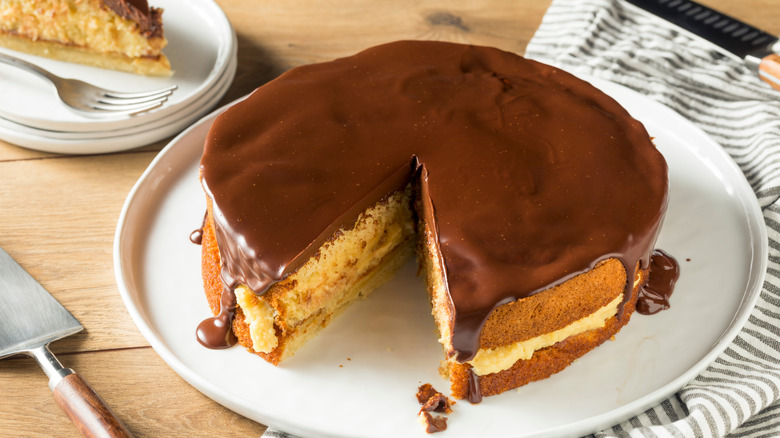
You might be wondering how a rogue pie got onto this list, but Boston cream pie is a misnomer. It's a cake, through and through, no matter what its name suggests. Made from two layers of sponge cake, a lusciously thick vanilla custard filling, and a dark chocolate glaze, it is one of the more luxurious cakes you'll find. It is also the official state dessert of Massachusetts and has been gracing tables for nearly two centuries.
The most common story of the cake's origin goes back to the opening of the Parker House Hotel in Boston in 1856, where the French chef known as Sanzian is said to have created the sweet. Why he made it and how he came up with it remain a mystery, but the hotel (now the Omni Parker House Hotel) still has it on the menu and has published his original recipe for all to admire. Since baking powder was not widely available until decades later, Sanzian used nothing but butter, flour, sugar, and lots of eggs for the cake, and the pastry cream contained the ingenious addition of a single teaspoon of dark rum, a whisper of flavor that makes all the difference.
As for the name, it remains a mystery. Some have speculated that it stemmed from the fact that pie pans were more common than cake tins in the 1800s and that the original cake would have been baked in one. However, there is still no definitive explanation.
Gooey butter cake (the Midwest)
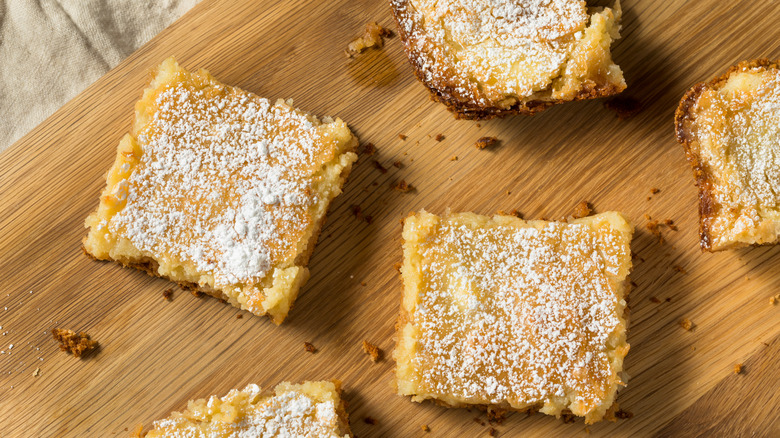
If you have a sweet tooth, St. Louis' own gooey butter cake is likely to hit the spot. Yet again, we have German immigrants to thank, though the precise origins are elusive. The most common story tells of a German baker (though his identity is disputed) who was trying to make a coffee cake but got the measurements wrong, adding far too much butter to the streusel topping. What came out of the oven was texturally mixed, with a dense bottom layer and a gooey, pudding-like interior. Whether his creation was a mistake or a deliberate innovation, however, one thing was clear: it was delicious. Full of rich butteriness and sugar, it's so irresistible that many Midwesterners still choose it over pumpkin pie for their Thanksgiving menus.
Despite its supposedly humble origins, gooey butter cake is no walk in the park if you're planning to make it from scratch. Mastering that dual consistency of a biscuit-like base and the sticky filling requires several steps that are not part of making a standard vanilla or pound cake. For one thing, it requires two batters – one for the yeasted cake base and the other for the topping. For another, it will need rising time. Last but not least, you'll need to throw out all your intuition about what a cake looks like when it's done baking. A gooey butter cake will still move like liquid when shaken just out of the oven.
Mississippi mud pie (the South)
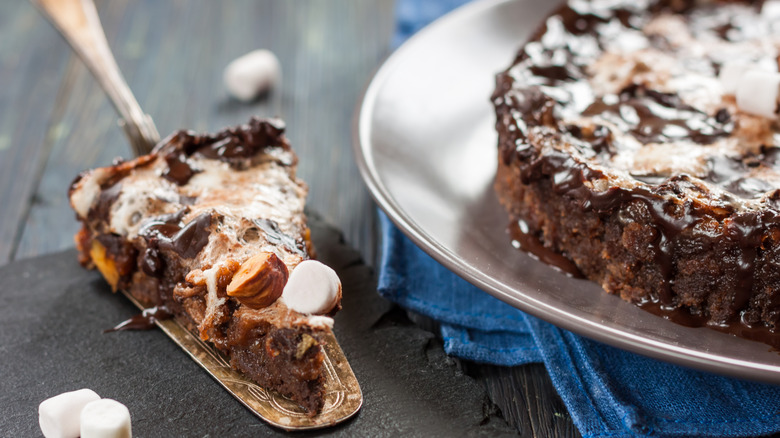
If you were forced to categorize Mississippi mud pie, it would probably belong in the cake category more than the pie category, but it's best to just refer to it as a dessert because this magnificent confection defies pigeon-holing. Part of the reason for this is that there are so many versions of it. You'll find it made using an assortment of pudding, cake, cookies, ice cream, whipped cream, and marshmallows, usually assembled in a cookie-like crust. The unifying factor, however, is its appearance. When removed from the oven, the cake looks like dried clay from the Mississippi River, dark brown and cracked as if it had been baked in the sun. A more cake-like version foregoes the cookie base for a result that looks a lot like a Texas sheet cake.
Given its flexibility, you'll find Mississippi mud pies with a wide range of creative additions, from Nutella and Oreos to bourbon and miso. However you choose to make it, though, the pie should be thick, decadent, layered, intensely sweet, and full of chocolate. Not surprisingly, given its range of potential ingredients, Mississippi mud pie's origins are hotly disputed, with some claiming that it dates all the way back to the 1920s and others arguing that it was born out of World War II rationing when housewives had to make do with affordable pantry staples. Either way, it has become a decadent treat of the South that is mercifully easy to freestyle at home.
Lane cake (Alabama)
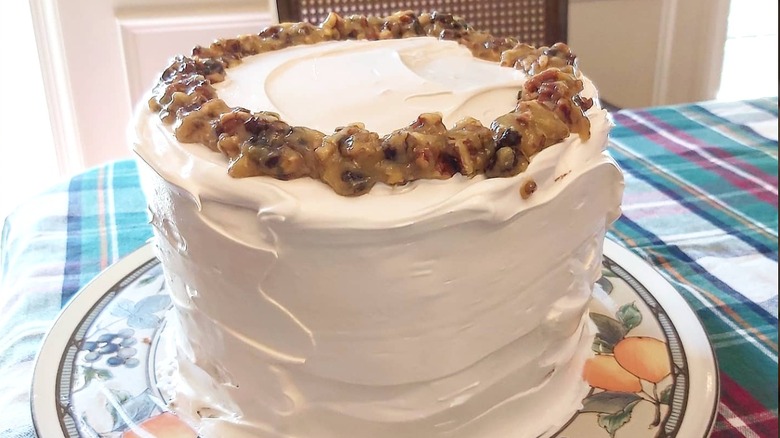
Unlike many classic recipes, whose origins are not only disputed but completely unknown, Lane cake has a relatively well-documented history. It was the invention of Emma Rylander Lane, a resident of Clayton, Alabama, who presented the cake in a baking competition at the Columbus county fair sometime in the late 19th century. It earned her first place, and she would go on to call it "Prize Cake" in her 1898 cookbook, "Some Good Things To Eat." More than a century later, Lane cake can be found throughout the South, though it is particularly prevalent in Alabama. It's even their official state dessert.
So, what's so great about Lane cake? Suffice it to say that it combines familiar, crowd-pleasing ingredients into a magnificent, towering creation that is indulgent and stately in equal measure. It is made of three layers of white cake held together with bourbon-spiked custard that's filled with dried fruit and nuts, like pecans and coconut. Finally, the cake is wrapped up in sumptuous meringue frosting.
Although it's been around since the 1800s, Lane cake earned a new level of stardom and Southern pride when it featured in Harper Lee's classic 1960 novel "To Kill a Mockingbird." Without this literary shoutout, Lane cake might have gone the way of many other recipes that fell into permanent obscurity, giving us yet another reason to appreciate Lee's seminal work.
Texas sheet cake (Texas)
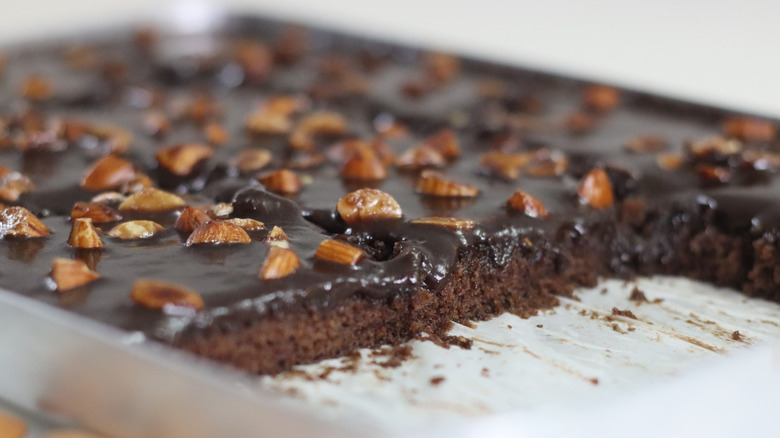
For those of us who grew up in Texas, sheet cake was an integral part of growing up. Birthdays, family gatherings, and school parties often featured one of these chocolatey, pecan-studded confections, and no matter how many fancy restaurant desserts you have in adulthood, nothing can take away your affection for this humble homerun of a cake. Baked in a sheet pan to achieve its signature unassuming shape, the decadent creation is a chocolate cake covered in fudge frosting and sprinkled liberally with pecans — a nut that grows throughout the Lone Star State.
Texas sheet cake has a less celebratory tradition as well. For many, it is known as a funeral cake because of its popularity as a dessert to serve at these somber occasions. Thanks to its generous size, the sheet cake could feed a large gathering and doesn't look tactlessly celebratory. The precise origins of the cake are murky. A newspaper in Galveston published a similar recipe in 1936, but it was a pecan-topped recipe in a Dallas newspaper in 1957 that seems to have clinched the sheet cake's place in Texans' hearts.
Made with buttermilk to provide a hint of tanginess and added decadence, Texas sheet cake might look simple, but its formula is nothing short of masterful. As long as you stick to its tried and tested hallmarks, there is still plenty of room for creativity, as proven by our deliciously sweet and spicy gochujang sheet cake.
King Cake (New Orleans)
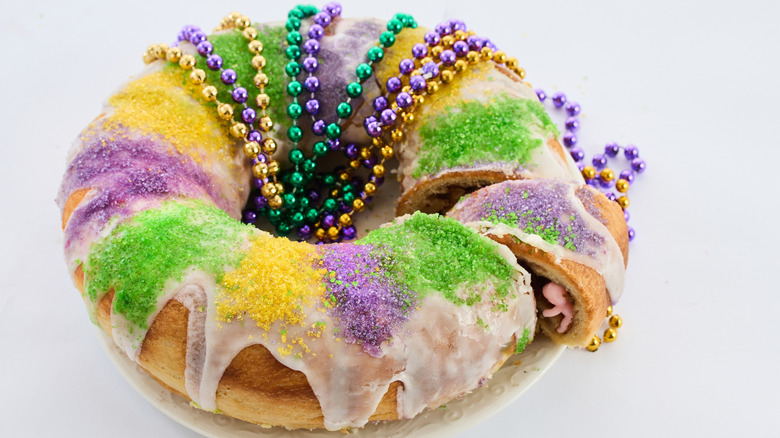
If you're lucky enough to be in New Orleans during Mardi Gras, there are a few things you can count on. Crowds, parades, music, and light displays called flambeauxs will be all but inescapable, as will a colorfully decorated pastry called king cake. It's made of brioche dough shaped into a ring and filled with everything from simple cinnamon and sugar to cream cheese, nuts, and dried fruit. It's also covered in purple, green, and gold sprinkles. Perhaps the most unique thing about the cake, though, is that it usually contains a tiny plastic baby hidden somewhere in the dough.
King cake isn't just a playful and delicious way to kick off the festivities before Lent, but a food with a rich history. Its name refers to the Three Wise Men who brought gifts to Baby Jesus on the final day of Christmas, otherwise known as Twelfth Night or Epiphany. You might assume that the plastic baby is meant to symbolize the holy infant, but that connotation has largely been attributed in retrospect. There have been king cake parties in New Orleans since the 1870s, but it wasn't until the 1950s that the plastic figurine became a traditional element. Initially, a bean or pecan would be placed in the cake, but these items were easy to accidentally eat. Small porcelain dolls were adopted after that, but they were expensive and prone to chipping teeth, so plastic ones became the norm.
Smith Island cake (Maryland)
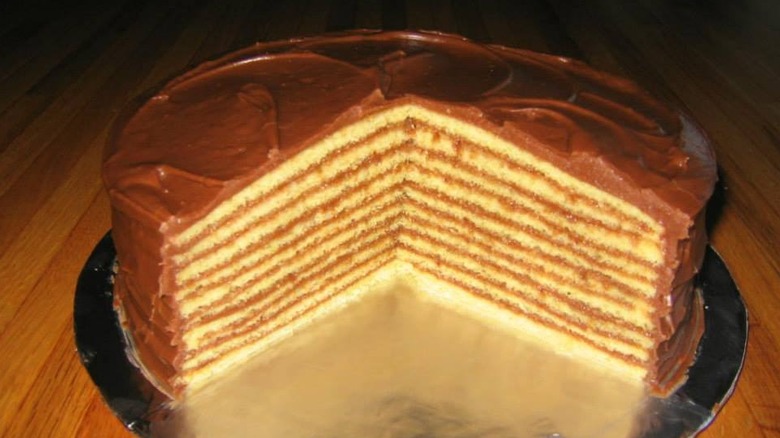
It doesn't get much more geographically specific than Smith Island cake, a many-layered dessert topped with chocolate icing. Although it is the official state dessert of Maryland, it originates from a small island in the Chesapeake Bay that is only about four square miles and has a population of 340. Comprised of three villages, the island was a bustling place in the 19th century thanks to its prime location for fishing. Oysters and blue crabs proved to be particularly lucrative quarry, and the economy centered around them. Wives would send their fishermen husbands on their oyster harvests with pieces of Smith Island cake to remind them of home.
It's unclear when the cake was concocted or why such an intricate dessert was created for such an unglamorous excursion, but in the island's official cookbook, you can find the closest thing to a definitive recipe, attributed to one Mrs. Frances Kitching. It calls for 10 layers of yellow cake and a chocolate icing made with lots of butter. Baking all those layers takes time and patience, but the effect is worth it. Plus, you can make things faster by dividing the batter into a few cake tins and then slicing each sponge to produce multiple layers. Ideally, those layers will be as thin as crepes, giving your guests (or traveling spouse) something to gasp in awe over even before they take their first delicious bite.
Bumpy cake (Michigan)
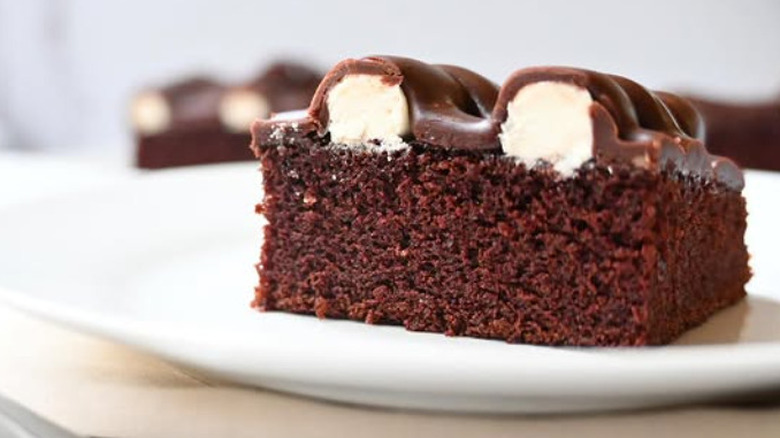
If you're in Michigan, especially in or around Detroit, do not miss the opportunity to buy a freshly made bumpy cake. It might sound modest and even a little unappealing, however, it is anything but. Made of thick, fluffy chocolate cake topped with two logs of buttercream (giving it its signature bumps) concealed under a ganache-style chocolate frosting, this creation isn't just a humble comfort food but a genuine culinary knockout.
The genius of finding a way to incorporate two types of frosting into one cake without creating sludge is one of its greatest strengths, but it's the combination of flavors and textures that really stands out. Bumpy cake has a lusciously moist crumb, but it isn't overly dense. The buttercream offsets some of the chocolate to avoid flavor fatigue, and the contrast between the rich buttercream and the thin, velvety ganache is pure heaven. For those who haven't had a bumpy cake, the ganache also hides the buttercream so that when you slice into it, this extra layer comes as a delightful surprise.
Bumpy cake was created in 1913 by Detroit's own Sanders Confectionery, which expanded from its humble beginnings as a candy manufacturer in the 1870s to become a bakery and ice cream brand with close to 60 locations around Motor City in the mid-20th century. The company was sold to Morley Candy in 2002, but you can still purchase Sanders bumpy cakes online or make your own version from scratch.