

The Unique Seafood Dish Anthony Bourdain Refused To Ever Try Again

What is the single worst thing you have ever eaten? The one dish, out of everything you've tasted, that you would never eat again under any circumstances? Anthony Bourdain discovered that dish on camera, and viewers got to watch it happen in an episode of his show, "No Reservations." On a trip to Iceland, one of the countries that eat the most fish, Bourdain was encouraged by the locals to try a dish known as hákarl. It's one of those foods people call a delicacy, though the term seems euphemistic, since hákarl is fermented shark that smells strongly of ammonia.
Hákarl is prepared using Greenland shark meat, which must be fermented because the shark's flesh is poisonous otherwise. Since these sharks live in such cold waters, their tissue contains high levels of urea and trimethylamine oxide. These chemicals function like antifreeze, helping the sharks survive in freezing depths, but they are also incredibly toxic to humans. And urea — a key component of urine — has a pungent ammonia smell that saturates the shark's flesh.
As Bourdain prepared to eat the shark, he noted that someone had advised him not to touch it with his bare fingers. It was recommended he used gloves to handle the food, yet he was supposed to eat it. After trying a small cube of shark on the end of a toothpick, he described it as "unspeakably nasty."
The story of hakarl
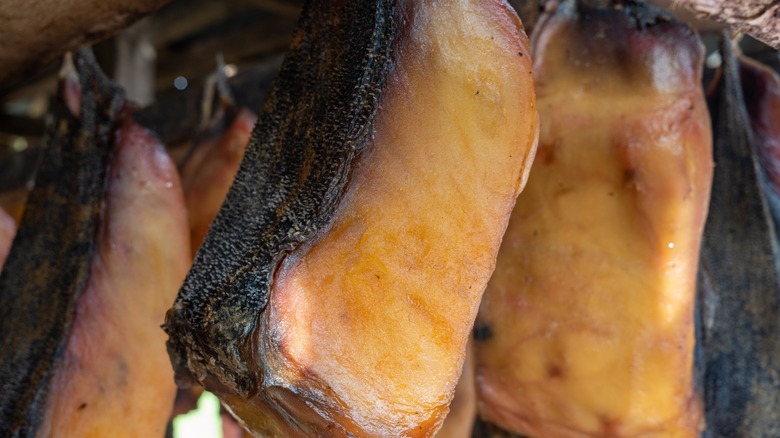
Hákarl is also a dish that Andrew Zimmern couldn't stand — at least at first. The chef, who has eaten almost everything, tried it in an episode of "Bizarre Foods" and said that the smell reminded him of "some of the most horrific things" he'd ever breathed in his life. But after sampling it, he said that it tasted much better than it smelled. He described it as sweet and nutty, but just faintly fishy. Clearly, he and Anthony Bourdain didn't see eye to eye on hákarl.
The texture of hákarl varies depending on which part of the shark you're eating. Some parts can be chewy while other parts are likened to soft cheese. The meat must ferment for months to reach this point. In the past, it was buried in gravel and stones and hung to dry. Today, fermentation boxes are used, but the meat is still air-dried. Hákarl is hardly an everyday item, even in Iceland. Viking settlers developed the method after arriving on the island because the harsh conditions demanded a way to prepare and preserve otherwise toxic shark. Now, it's a special occasion food, and usually enjoyed during a midwinter festival called Þorrablót. Still, you can find it in many Icelandic supermarkets.
One thing worth noting is that, despite Zimmern's praise for the taste, when he takes a second piece, he visibly winces and groans. In his words, it's "hardcore" and not a food for beginners. Take from that what you will. If you ever get a chance to try it, expect that you will find the smell offensive, and possibly the taste as well. But sometimes, a culinary adventure is worth the risk.