

Find A Hair In Your Food? Here's How To Politely Send It Back

It's a universal dining experience: You're enjoying your meal and spot something amiss, something glinting in the light, something that shouldn't be there. It isn't meat, vegetable, or sauce. Hair! Seconds after it catches your eye, your stomach sinks, and your mind goes into panicked strategy mode. What should you do? Definitely stop eating; don't take another bite. What if there are more of them? Have you eaten them already? What other foul intruder could be hiding amongst the lettuces?! Should you push your plate away, frowning and crossing your arms like a toddler, or maybe just get up from the table and run away screaming?
First, take a deep breath. It's going to be okay. You will enjoy food again one day — maybe even sooner than you can imagine, if you can master the art of politely interacting with your waiter and sending your food back. Basically, don't be a diva, and don't be a doormat. Stay calm, discreet, and kind. Flag your server, explain the issue without theatrics, and give them a chance to fix it.
Most restaurants will remake the dish or offer a comp without hesitation. While it may feel awkward in the moment, you're actually doing the kitchen a favor, because they need to know. If you're in a group, don't over-apologize or encourage everyone else to scrutinize their meals, too. Now, repeat after me: "Excuse me, I found a hair in my food. Could I get a new plate, please?" It's really that simple, folks.
Kitchen food prep and return etiquette
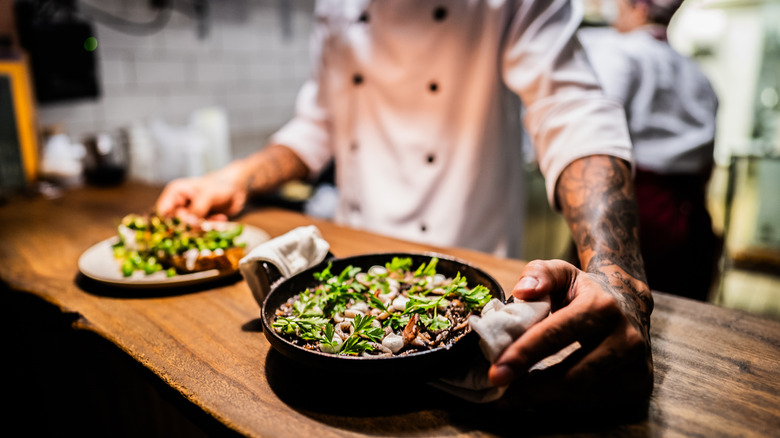
Hair happens. Food is made by humans, and humans shed. Food is also prepared in kitchens, which are chaotic and fast-paced environments, with numerous complex moving parts. An errant hair can happen at any point in the production process. However, kitchens still want to know when it does, because it's part of maintaining standards and practices. If it's a one-off, they'll likely remake the dish and thank you for bringing it to their attention. If it happens often, it's a signal of health code red flags, and someone may need to tie their hair back, wear a hairnet, or stop running their hands through their luscious locks on the line.
High-end restaurants actually have a specialized staff member, called the expeditor, entirely devoted to vigilance. The "expo" gives the plates that come through the pass from the kitchen one final hawk-eyed look, picking through fresh oysters for shell bits and adjusting the plating of microgreens with tweezers before the server drops the plates at the table. This role exists because even in the most meticulous kitchens, mistakes can happen.
Sending food back politely, and for a valid reason, doesn't make you high-maintenance; it makes you hygienic and discerning. It means you're someone who values a good meal and understands that the people making it do, too. Just remember that hospitality goes both ways. Servers are messengers — they didn't cook your meal and probably didn't plant the hair, so be nice. A hair in your food isn't a personal attack. Be kind and respect the fact that someone is working hard in a hot kitchen for your leisure. Restaurants are in the business of hospitality, and they want you to enjoy your meal, and a chance to fix things when you're not.
The legal reality of food defect levels

Food is kind of gross when you look at it close up. Not in a "don't eat it" way, but in a "you live in a microbial, hair-shedding, insect-fragment-filled world, and always have" kind of way. According to the FDA's Food Defect Levels Handbook — which is exactly as charming and cursed as it sounds — certain contaminants are legally allowed in your food.
A can of mushrooms, for example, can contain up to 20 maggots. Paprika is permitted to have 75 "insect filth" fragments per 25 grams, while ground cinnamon may include up to 400 per 50 grams. Chocolate may contain up to 60 insect parts per 100 grams, and peanut butter is allowed one rodent hair and 30 insect fragments in the same amount. These are legal guidelines, not violations. They are the accepted limits of what's considered safe and unavoidable in the production and processing of food products.
When you're dealing with massive volumes of food grown in soil, air, and water, some tiny tagalongs will make it through. Most of the time, they're harmless, perhaps adding a little extra protein enrichment to your meal. At worst, it's a reminder that your food comes from the real world, not a sterile lab. A hair in your salad is unpleasant. But it's guaranteed that you're already consuming stranger things every single day without even realizing it. Don't panic, and don't let it ruin your night. Say something (graciously), get it fixed, and then move on to (hopefully) enjoying your restaurant meal.