

Want To Develop Your Own Recipes? Learn About Ratios First

We may receive a commission on purchases made from links.
The term "recipe development" may evoke images of seasoned chefs tirelessly testing dishes in professional kitchens, but in reality, anyone can learn to develop solid recipes of their own. To find out how to start a personal repertoire, Tasting Table spoke to Dan Pelosi, author of the cookbooks "Let's Eat" and "Let's Party" (who is also on Instagram), who advises that we begin with tried-and-true ratios for the type of dish you want to create. "Developing your own recipes can be so joyful," Pelosi says, "and can also get frustrating and tedious!"
To cut down on the challenge, he believes in starting with trusted formulas to "give you a framework for your own adventure in the kitchen." A basic vinaigrette, "3 parts oil to 1 part acid," is his example. "If you follow that ratio, you can rest assured your dressing will be balanced," Pelosi explains. "The fun part is which oil and which acid you will choose. This is where you get to add your personality to it." The cookbook author also points out that consistent ratios help you adapt recipe yields to more or fewer servings without disrupting the flavor balance.
"Ratios are your starting place," Pelosi adds. "They help you make adjustments and you taste your dish, scale the amount you're making without losing flavor, and give you a framework for your own adventure in the kitchen." Pelosi's advice applies to nearly every recipe category, from the absolute best ratio for marinade — 3 parts fat, 1 part acid, and 1 part seasoning — to a more complex yet infinitely adaptable ingredient ratio for perfectly balanced salads. Start with these formulas and tweak ingredients from there, and you'll have a recipe that's uniquely yours but also harmonious and reliable.
What to keep in mind when changing recipe ratios
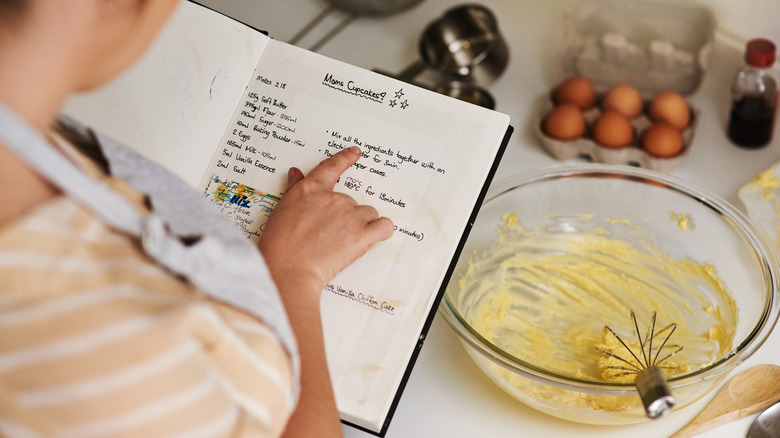
Before riffing on ratios to draft recipes, figure out if any parts serve essential functions and be careful with them. For instance, in David Lebovitz's easy ratio for making jam, the fruit mainly determines the taste, so you can customize it pretty freely. However, sugar is functional, helping to thicken preserves and stave off spoilage. If you reduce the sugar or swap it for honey, you might wind up with a runny goo that goes bad easily.
Similarly, baked goods are famously temperamental, so beginners might want to stick to proven ratios like the 3-2-1 rule for the best pie crust. To customize formulas with care, try swapping ingredients for ones that function similarly (like muscovado sugar in place of brown); play with the shape or format of the dish; or add flavors with herbs, spices, condiments, and extracts. It also helps to make changes to your recipe one at a time, testing it in-between, to see which tweaks improve the dish and which ones may be causing issues.
Even with these tips, developing recipes is rarely easy. To stay motivated, Pelosi recommends starting with dishes you truly enjoy, those that have warm memories attached to them. "Having that core memory that is positive helps me stay excited and curious as I develop," he reveals. Also, keep in mind that you'll have to smell and taste test the dish many, many times. "There's nothing worse than trying to develop a recipe for something you don't care to eat," Pelosi adds.