

The Kitchen Appliance The Property Brothers Approve Of For Cleaner Air

A home kitchen is all about quality meals — but it can (and probably should) also be about quality air. Property Brother Drew Scott isn't a fan of laminate countertops, but he's a huge proponent of induction stovetops. In a YouTube video posted by the official Drew & Jonathan channel, Drew takes foodies on a walkthrough of his newly renovated home, which is equipped with an induction range. Beyond sustainability and efficiency (which are both major benefits), Drew's biggest praise for the appliance is about indoor air quality. "The air quality in our home is already so much better because we're not running a gas range. Ignore the old commercials that made you think that 'cooking with gas was the way to go.' That's all marketing," he explains, in the video. "This is better."
Induction stoves are equipped with a smooth glass surface. Beneath that glass surface, a network of electromagnetic receptors transfers heat to magnetic surfaces upon direct contact (i.e. placing a metal pot or pan on the stove). This design makes induction stoves up to 10% more energy efficient, per Consumer Reports, compared to standard electric stoves (which are both sustainable and can lower your utility bill). By contrast, gas stoves can release pollutants like carbon, nitrogen dioxide, and PM2.5 particles that compromise air quality. Compromised gas ranges also have an infamous tendency to leak methane gas even when not in use, and their pipelines can trap and house hazardous benzene gas. Opting for induction skips the toxic emissions.
More benefits of induction stoves over gas
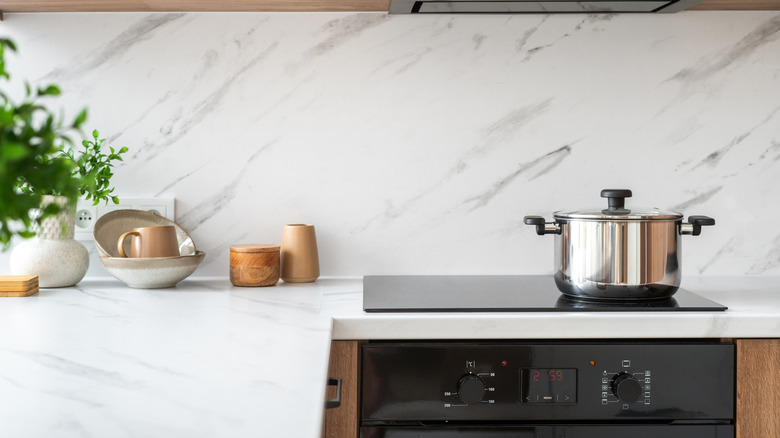
In addition to promoting air quality, induction stoves also boast easier cleanup than gas stoves. Simply wipe down that smooth surface and you're done. No grates to remove or burners to scrape. They're also ultra-speedy, heating up faster than gas stoves and reducing overall cooking time by 20% to 30%, as reported by Forbes. When it comes out, that heat is not just faster but safer. Induction stoves' electromagnetic design means they don't actively emit heat without metal-to-metal contact. So, you can't place your hand flat on the stovetop and get burnt (which is great for households with kiddos). Also, since nearly all of the heat gets transferred directly from the stove to your cookware, a far smaller amount of radiant heat gets emitted into the surrounding air. Still, as Drew Scott is quick to note, "Even though this [induction stove] is getting rid of all the off-gassing that you have from a gas range, it's still important to put your vent hood on, because you do have some of that off-gassing from the food that you're cooking, as well."
It's worth noting that induction stove appliances are pricier than gas ranges ($1,000 to $2,500 compared to gas stoves at $300 to $1,500). Converting from gas pipelines to the necessary power outlet for induction is also a costly renovation. But, it can be worth it for improved air quality and sustainability.