

10 Mistakes You're Making With Drop Biscuits
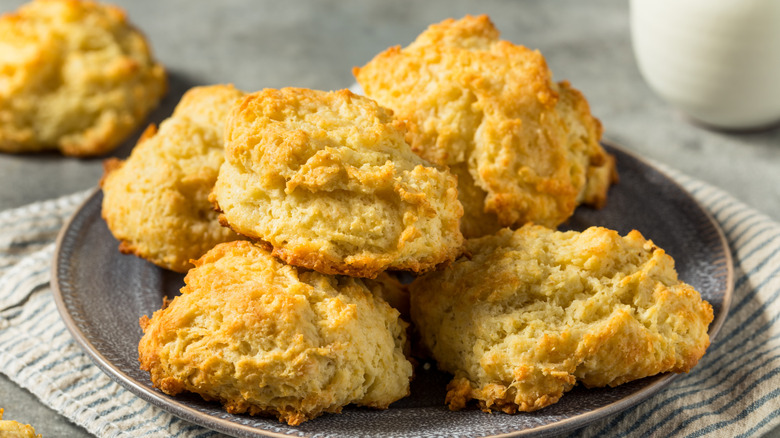
When made properly, drop biscuits are dense, buttery, and utterly delicious. Serve them with butter and a drizzle of honey, spread jelly on them, or pour your favorite sausage gravy (see a simple recipe) over them for a tasty dinner side. As with baking other goods, you always want to use fresh ingredients to ensure your drop biscuits taste incredible. This includes using baking soda or baking powder, as called for by the recipe. If these have expired, the biscuits won't rise properly.
If you're deciding between making drop biscuits and roll-and-cut biscuits, the former are generally considered the easier option since kneading, rolling, or cutting is not required. However, don't let that give you the impression that preparing drop biscuits is foolproof. There are still several mistakes you can make, which could cause all sorts of problems. The biscuits might come out of the oven with the wrong texture, their taste might be off, or they could be burned or overly doughy. Ahead, we'll share some of the most common mistakes people make when preparing drop biscuits and help you learn what to do instead.
Adding too much flour
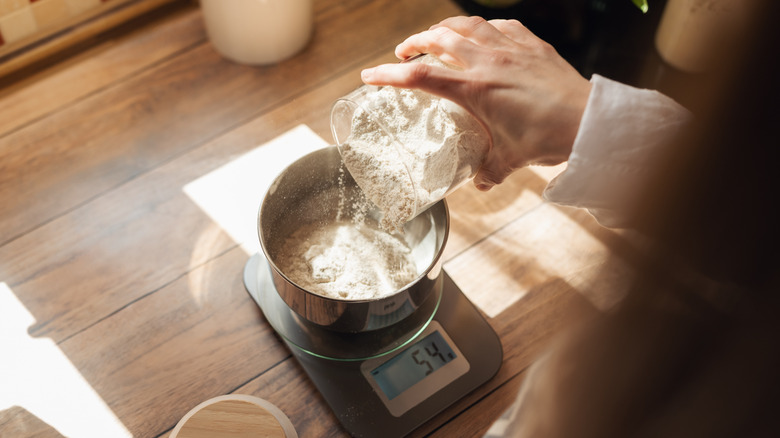
Precision may not be important for every recipe. For example, the world is not going to end if you add a little more than a teaspoon of onion powder that a tomato sauce recipe calls for. However, baking is a different beast. If your measurements are off, even slightly, it can have a significant impact on how the recipe turns out. Flour is one ingredient you should never try to eyeball when preparing drop biscuits. If you add too much to the bowl, the resulting dough will not hold properly and will likely crumble after baking. Not only will the texture be drier than desired, but it will also be very difficult to spread butter or jelly over something so crumbly.
Instead of estimating how much flour to add, it is essential to measure the amount the recipe calls for. While it might be easier to use a dry measuring cup, it will not yield the most precise measurement. There is just too much variability based on how tightly or loosely packed it is in a measuring cup, which could mess up your recipe. The most accurate way to measure flour is to weigh it. Using one of the best digital kitchen scales will make it easy to add precisely what the recipe calls for. Remember, 1 cup of flour weighs 120 grams. So, ½ cup would weigh 60 grams, and 2 cups would weigh 240 grams.
Being heavy-handed with the liquid

Flour isn't the only ingredient you need to measure carefully. A drop biscuit recipe will also call for liquid, typically buttermilk or milk. If you pour too much into the bowl or your measuring cup, it can cause different problems. If the dough is too wet when you drop it onto the baking sheet, the biscuits will spread out much more than they should. Instead of coming out with a shape that resembles a ball, they'll look much more like a disc. Too much milk or buttermilk can also make the batter overly tacky. You may find it difficult to get it off your fingers or the spoon when trying to drop it onto the baking sheet.
To avoid this problem, never try to guesstimate how much milk or buttermilk you need. Follow the recipe and pour the milk into a separate liquid measuring cup to avoid disaster. Additionally, remember, the best way to measure liquid ingredients for baking involves a mini-workout. Squat to confirm that the milk is at the appropriate line on the measuring cup instead of lifting it to look. Lifting the cup will cause the milk to slosh around, making it impossible to get an accurate reading.
Using warm butter
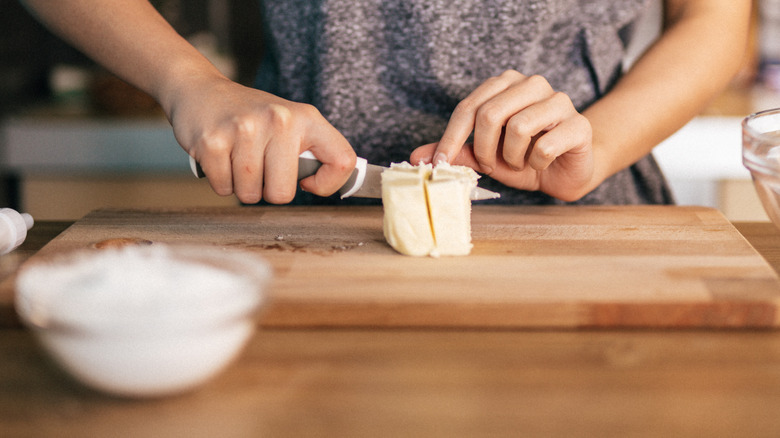
You can make drop biscuits with just three ingredients: flour, buttermilk (or milk), and butter. However, you'll want to set aside the procedure you typically follow when making cookies or other types of baked goods. These recipes typically call for softened butter that you'll cream with the eggs and sugar before adding the flour. However, the butter in a drop biscuit recipe serves a different purpose. It helps ensure that the biscuits turn out flaky and slightly crumbly.
If you start with softened butter, this goal will be impossible to accomplish. Once you put the biscuits in the oven, the butter will melt too quickly. This can cause the biscuit to turn out overly dense, which is not exactly what you're looking for. When you start with cold butter, it will take longer to melt. As a result, it will release more steam throughout the melting process. This steam is what is crucial for ensuring the flakiness you anticipate in biscuits and prevents them from turning out too dense. You can even use frozen butter and grate it into smaller pieces before mixing to provide even more steam and, thus, deliciousness.
Overmixing the dough
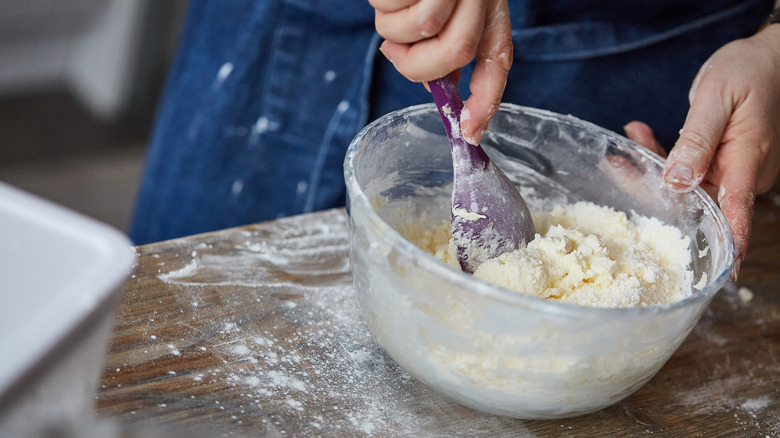
There are a few cardinal rules to follow when baking. One of these is to avoid overmixing the dough for baked goods. Overmixing the batter for your dropped biscuits can result in them turning out overly dense and lacking the crumbliness you seek. The problem with mixing dough too much is that it causes high amounts of gluten to develop. You want gluten to make sure the baked goods don't lack elasticity and structure. However, if too much gluten forms, it can have the disastrous effect mentioned above. The finished biscuits will be gummy, tough, and just generally unenjoyable.
So, what should you do to ensure all of the ingredients in your drop biscuit dough are fully incorporated without overmixing the dough? As a general rule, you want to mix until all the ingredients are just combined. This means that you shouldn't see the individual ingredients, and the batter in the bowl should have a consistent look. One mixing secret for making tender drop biscuits is to use a fork instead of a whisk when combining the dough. With a fork, you won't be able to beat the batter as fully as you would when using a whisk, which can prevent overmixing and cause excessive gluten to form.
Thinking preheating the oven isn't necessary

We've all been there. You get so caught up in mixing the ingredients for your drop biscuit recipe that you forget to preheat the oven when you're ready to put the baking sheet in it. Will it make a difference if you put the biscuits in at the same time you start heating the oven? While you're welcome to try it yourself, we'll save you the time and let you know that, yes, it will make a big difference. Preheating is such an important cooking step for biscuits and other baked goods.
If you stick the biscuits into a cold oven, they will not be heated evenly. Instead of the heat coming at them from all directions, as is often the case with a preheated oven, they'll receive more heat at their bases. This can result in a tray full of biscuits with burnt bottoms. But don't think you'll be able to get away with just cutting off the burnt areas. Not only will the bottoms be burned, but the rest of the biscuit will likely still be overly doughy due to insufficient heat to fully cook the batter. As much of an inconvenience as it may be, wait for the oven to preheat completely before you put those biscuits in.
On a related note, make sure the oven is set to a high enough temperature. While many baked goods call for an oven temperature of around 350 degrees Fahrenheit, that just isn't hot enough for biscuits to turn out properly. Check the recipe's requirements, but you'll want to set the oven to at least 400 degrees Fahrenheit, if not 425 degrees Fahrenheit. This will help the butter produce that steam, which gives the biscuits their flakier texture.
Dropping biscuits that are not evenly sized
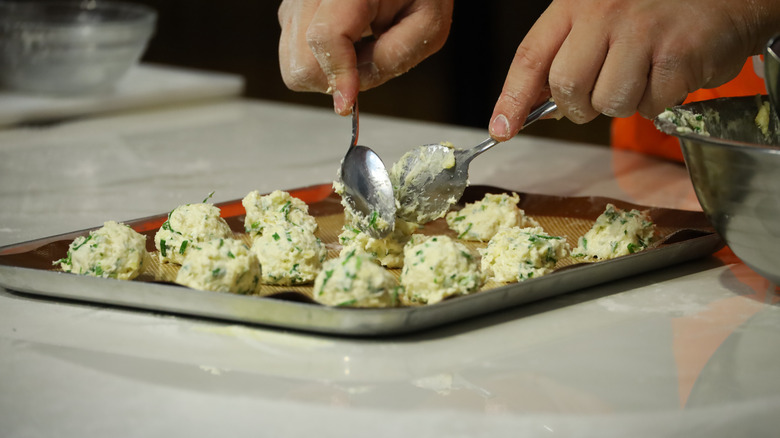
"I want some of my biscuits to turn out burned, while others are still gummy in the middle," said no one ever. Well, if you aren't careful when dropping your biscuits onto the baking sheet, this is precisely what could happen. When some of the biscuits are bigger than others, they will not bake evenly in the oven. If you remove the tray when the smaller biscuits have finished baking, the larger ones won't be fully cooked. If you wait for the biggest ones to finish cooking, then the smaller ones will be burned and dried out.
To avoid both of these problems, it is essential to make sure that your biscuits are evenly sized. Instead of trying to eyeball it, which can always lead to problems, use a tool to help you scoop the batter. A large cookie scoop would be ideal; however, you could also use an ice cream scoop or a small measuring cup (a ¼ cup is perfect for this).
Overcrowding the baking sheet
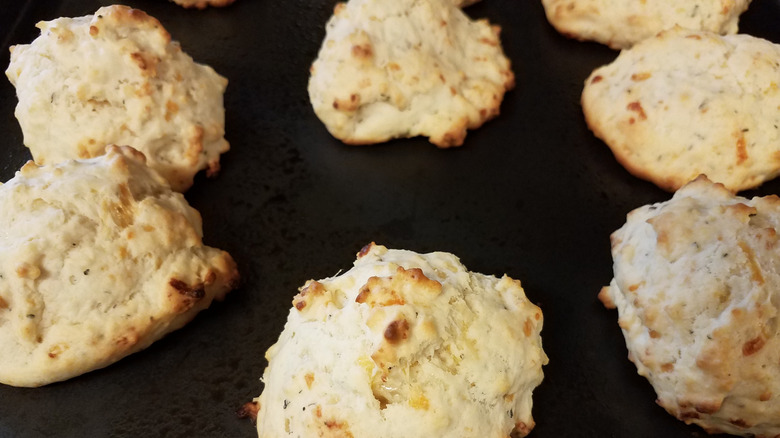
If you're doubling a recipe to feed a crowd and have several biscuits to bake, it can be tempting to squeeze them onto the baking sheet to prevent baking multiple batches. However, doing so will be a mistake you'll certainly regret. Several issues may arise if you crowd the baking sheet. It is important to remember that biscuits, like many other baked goods, expand as they cook.
If drop biscuits are placed in a crowded oven, they will spread as they cook. Not only will this prevent you from having nicely rounded biscuits, but it will also hinder them from baking properly. The parts that get stuck together will be overly thick and take longer to cook than the other edges. Additionally, when you drop biscuits too closely together, there won't be enough room for air to circulate properly as they bake. This can also get in the way of them cooking evenly, and prevent them from getting nicely browned.
So, as you drop the dough onto the baking sheet, be sure to leave at least an inch, if not slightly more, of space between them. This will help ensure enough air circulates, preventing the biscuits from expanding and spreading into one another. Dropping the biscuits in neat rows will help you achieve the ideal spacing. Once you have the first row properly spaced out, it will be easy to drop the next set right above or below it.
Forgetting to grease the pan or use parchment paper
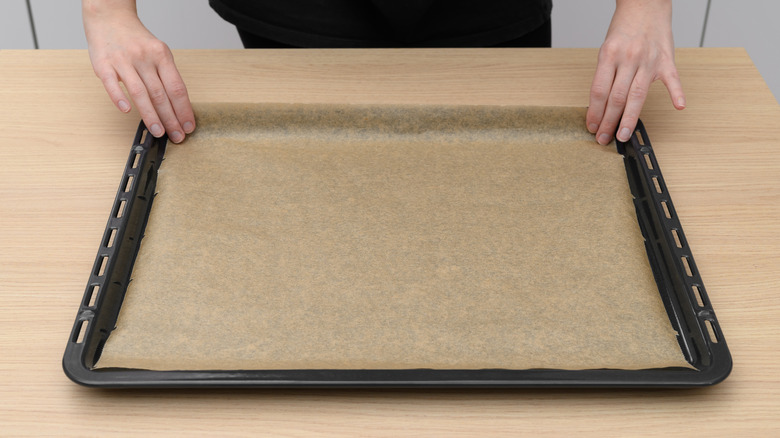
You might not realize you made a mistake by forgetting to grease the pan or line it with parchment paper until the last minute. Failing to take the few seconds that are necessary to prepare the pan can result in the biscuits sticking to it. There are a few ways you can prepare a baking pan for biscuits. Unless the recipe calls for something specific, you can coat the pan with shortening, cooking spray, or butter. All of these offer a similar benefit of creating a little barrier between the biscuits and the pan to keep them from getting stuck as they bake.
Just keep in mind that you may notice a hint of the flavor from the type of grease you choose, so you might want to select one that will complement your biscuit recipe, such as butter or a plain baking spray. Parchment paper serves a similar purpose. It offers a slightly slick texture that allows baked goods to release more easily than they would when placed directly on the pan. If you don't have any parchment paper, you could pick it up at a local grocery store. It is also one of the affordable baking supplies that you'll find at Dollar Tree.
Under- or over-baking the biscuits
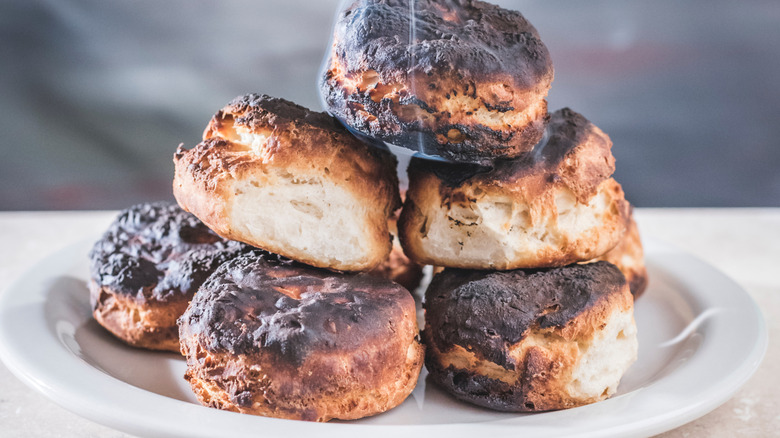
Wouldn't it be nice if the baking time stated in a recipe was exactly what was needed to ensure your drop biscuits turn out just right? Unfortunately, there are too many variables for the stated time to offer such precise results. Ovens can run at slightly different temperatures, and your biscuits may be slightly larger or smaller than those by the recipe's creator. Or, you might have added slightly more flour or milk to the mix than intended. Despite these challenges, it is still crucial to avoid under- or over-baking your drop biscuits.
Undercooked biscuits will be gummy and doughy in the center. They'll make you and the others around the table feel like you're scoping the raw dough right out of the mixing bowl — something no one wants. Overbaked biscuits aren't any better, either. They're dry, may have a burnt base, and will leave you unsatisfied.
Learning how to identify when your drop biscuits have finished baking is crucial if you want to avoid either of these unpleasant experiences. You can use the recommended baking time as a guide. However, you should start checking on the biscuits at least a minute or so before the recipe says they'll be done. You'll know they're ready when they have a nice golden-brown color. This will indicate that the tops and base are slightly crisp and that the inside is fully cooked.
Failing to experiment with different flavor combinations

There is nothing wrong with your go-to buttermilk drop biscuit recipe. These buttery biscuits make a delicious breakfast when paired with butter and jelly, and taste delicious alongside fried chicken. They're even utterly scrumptious when topped with gravy. However, as good as your favorite buttermilk biscuit recipe is, don't convince yourself that you shouldn't branch out and try something new every now and then.
There are many different combinations you can add to your biscuits to introduce more depth and complex flavors into your meals. For example, consider preparing buttermilk biscuits with paprika salt the next time you cook up some homemade mac and cheese or a rack of ribs. Buttermilk sweet corn biscuits, on the other hand, might be the perfect bread substitute for a fried chicken sandwich.