

Why You Should Always Resist The Temptation To Slow-Cook Pot Roast
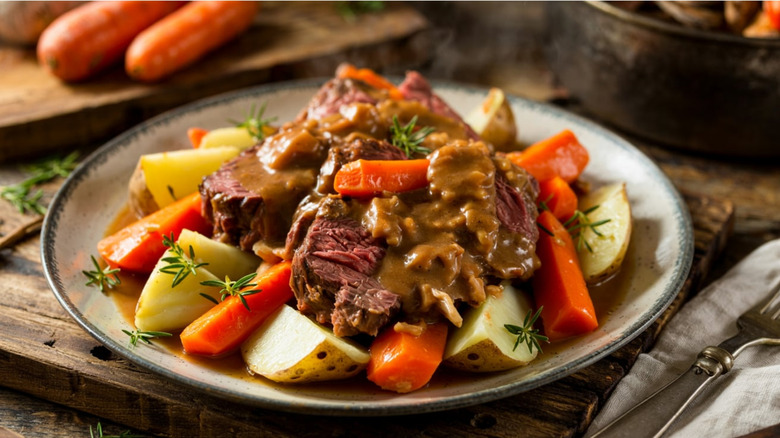
For generations, making pot roast in the slow cooker has promised an effortless path to a fork-tender dinner, and home cooks have fallen in line. You dump in the meat and vegetables, set the dial, and walk away. It's convenient and consistent — no argument there. But a better pot roast doesn't take longer. A faster, oven-based method not only trims hours off the cooking time (typically clocking in at three to four hours versus six to eight in a slow cooker), but even better, it's an opportunity to develop deeper flavors and textures.
While both methods can yield perfectly tender results, using a Dutch oven allows you to build a nice, dark crust on the meat with a stove-top sear, and from there, building an enriched gravy with wine or stock and the browned bits (aka fond) left behind. This is the best way to deglaze pot roast because that sear isn't just for looks — it kickstarts the Maillard reaction, coaxing layers of savory flavors that deepen as the roast cooks. Once the meat is browned and set aside, aromatics like onions, garlic, and carrots can be sauteed in the same pan, soaking up all that flavor. This step builds a rich base that you simply don't get with a slow cooker, where meat and vegetables stew in moisture from the start. An oven-based method works especially well with German pot roast with beer gravy, where tangy and rich flavors prevail. But really, it's the way to go for any pot roast recipe.
Why the Dutch oven delivers better flavor and fewer compromises
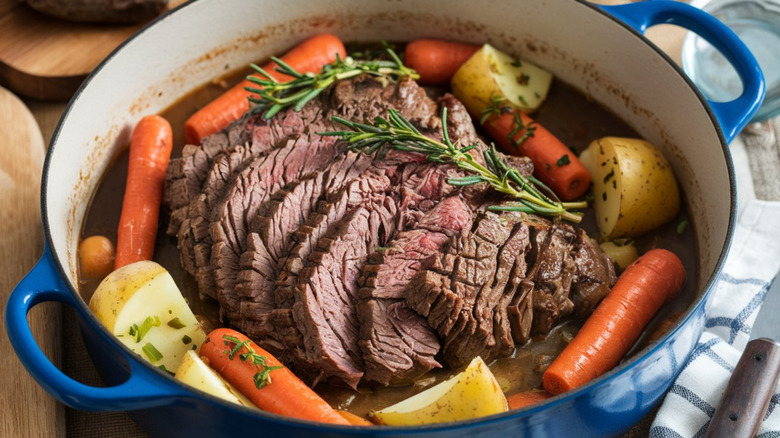
Slow cookers rely on gentle, steady heat and a sealed environment, and that's a beautiful thing when you're ready for a hot meal quickly. But there are only two options: cooked perfectly or overcooked, and that's when the vegetables or the roast become mushy. Oven braising allows us to cook within a range of temperatures, and we can play with the time based on the weight of the roast. A tightly covered Dutch oven with an internal temperature from 275-325 degrees Fahrenheit creates an ideal balance of steam and heat while shortening the cook time. Meanwhile, the high and low settings on a slow cooker top out at around 300 degrees Fahrenheit and can go as low as 175 Fahrenheit. That means your pot roast is going to be brothy since the liquid doesn't evaporate. While the flavors can be tasty and tender, they're also going to be less intense.
The combination of a dark sear and a gentle braise pair beautifully. The heat breaks down collagen into gelatin, making it fork-tender, while the sear maintains structure and bite. As the roast cooks, the liquid slowly reduces and intensifies the flavors. Consider giving your pot roast recipes the boeuf Bourguignon treatment too. It's another fantastic way to braise a roast, by cutting it into chunks and dousing it with two types of alcohol. Bacon and mushrooms are also very involved, as well as you proclaiming, "Bon appétit!" in less than four hours.