

Burger King Vs McDonald's: Which Serves The Healthier Basic Hamburger?
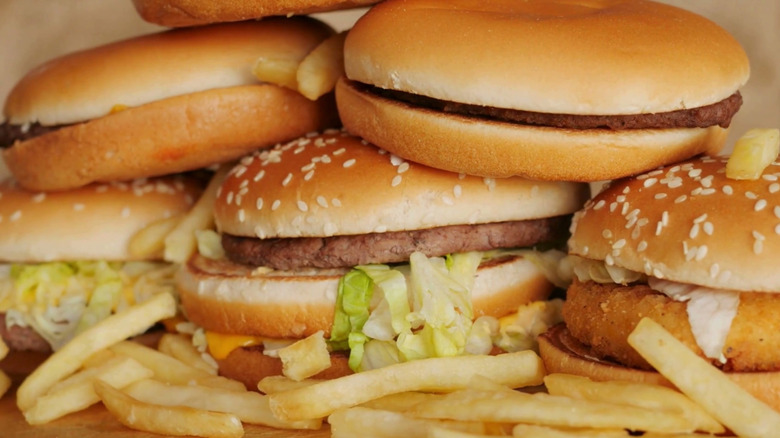
Amid the larger, more famous options like the Big Mac and Whopper, it can be easy to overlook the basic hamburger at McDonald's and Burger King. They are great when you are looking to save a few bucks or just want a slightly lighter meal, and they are also the most basic, purest expression of what you can get at both chains. That also makes them good options to compare the nutritional value of both franchises. But if you are looking for the classic Burger King versus McDonald's debate to have a clear winner here, think again. Your idea of the best basic hamburger is going to change depending on what you're looking for.
First off, both basic hamburgers are close to the same size, but BK's is a little bigger. When comparing the value of the two, NetCredit found the basic hamburger patty at Burger King was 1.26 ounces cooked, and McDonald's was 1.06 ounces. So Burger King's is just under 20% bigger. They also have similar toppings of ketchup, mustard, and pickles, although McDonald's also has onions. While calories are not a great measure of overall nutrition, they are useful for comparing portion sizes as well, and Burger King's hamburger is just a bit higher in calories, at 260 to McD's 250.
We can see those similarities translate to nutrition as well. On the healthier side of things, Burger King's hamburger edges out McDonald's for protein, 14 grams to 12 grams. It also has a tiny bit more fiber, with 2 grams to McDonald's 1. That's a negligible amount of fiber for your day, but not bad for protein in a small sandwich.
Burger King's hamburger has more protein than McDonald's but also more sodium and sugar
While there are healthy fats to add to your diet out there, the U.S. Food and Drug Administration recommends limiting saturated fat and trans fat, and here Burger King is a little higher. Its hamburger has 4 grams of saturated fat, while McDonald's has 3.5 grams. Both are good on trans fat, though, being completely free of it.
The other nutritional elements you may want to limit are sodium and sugar, and here McDonald's has its bigger upside. One BK burger has 600 milligrams of sodium, which is 26% of your entire day's maximum allotment. McDonald's option is a bit lower at 510 milligrams, which is 22%. Its burger also has less sugar, at 5 grams, while BK's has 6 grams. That is not a huge amount of sugar overall for either, but might be more than you want from something savory.
Overall, the basic hamburger at McDonald's and Burger King are very similar. BK's has a little more protein and fiber, while also having more sodium and sugar. And given that Burger King's option is slightly larger, they really are almost identical when you break it down by size. So it depends on whether you are looking to get more of what you want, or care about getting a little less of what you don't. But both are totally fine options for a quick meal from time to time, and nothing to worry about as part of a balanced diet.