

Quail Vs Chicken: Which Type Of Boiled Egg Is Actually Healthier

Eggs are commonly revered as one of the most nutrient-dense foods on the planet, packing a wide array of vitamins, minerals, and proteins in its own self-contained package. This description usually refers to eggs from a chicken, but there are other edible eggs out there. Quail eggs are drastically smaller than chicken eggs, and the shells tend to be adorably speckled with brown spots. If you've ever seen them and wondered how their nutrition stacks up to full-sized chicken eggs, you're not alone.
A typical quail egg weighs about 9 to 10 grams without its shell, while a large chicken egg (the size most commonly sold in stores in the United States) weighs about 50 grams without the shell. To reach a 100-gram serving of each, you'd only require two chicken eggs as opposed to about 10 to 11 quail eggs. Overall, quail eggs have slightly more protein, fat, calcium, iron, and zinc than chicken eggs. They do, however, have a bit more calories than chicken eggs, and they contain more than twice the amount of cholesterol, which is important to note if that's a health concern. But based on nutrition, as long as cholesterol isn't a concern, there are really negligible differences between chicken and quail eggs, and both are wonderful choices to incorporate as part of a "healthy" diet.
Cholesterol aside, either egg is an excellent choice
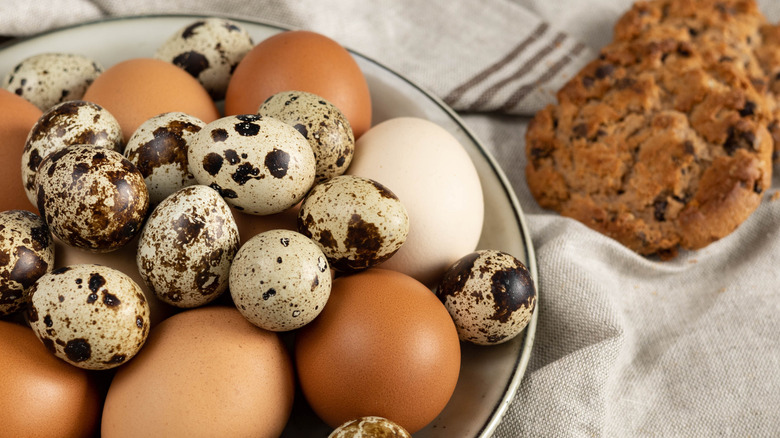
For simplicity, we'll compare 100-gram servings of each type of egg. According to the USDA, 100 grams of chicken egg has 143 calories, 12.6 grams of protein, 9.51 grams of total fat, and 56 milligrams of calcium, as well as 1.75 milligrams of iron, 1.29 milligrams of zinc, 138 milligrams of potassium, 142 milligrams of sodium, and 371 milligrams of cholesterol. In comparison, 100 grams of quail egg has 158 calories, 13 grams of protein, 11.1 grams of total fat, 64 milligrams of calcium, 3.65 milligrams of iron, 1.47 milligrams of zinc, 132 milligrams of potassium, 141 milligrams of sodium, and 844 milligrams of cholesterol.
Most of the nutritional benefits of eggs are found in the yolk versus the egg white, which is essentially just protein. Due to their small size, quail eggs have a larger yolk-to-white ratio — chicken eggs are about 27% yolk while quail eggs are about 32% yolk — meaning that there is a bit more yolk and less white in a quail egg. Due to the larger yolk ratio, quail eggs can taste a bit richer and creamier than chicken eggs.
Another aspect to consider is convenience. The tiny size and fragility of quail eggs makes them frustrating and tedious to work with, depending on how you prepare them. Soft-boiled quail eggs are incredibly delicate in comparison to a soft-boiled chicken egg, as quail eggs have thinner shells. Before you crack into a carton of petite eggs, read up on our essential tips for cooking quail eggs.